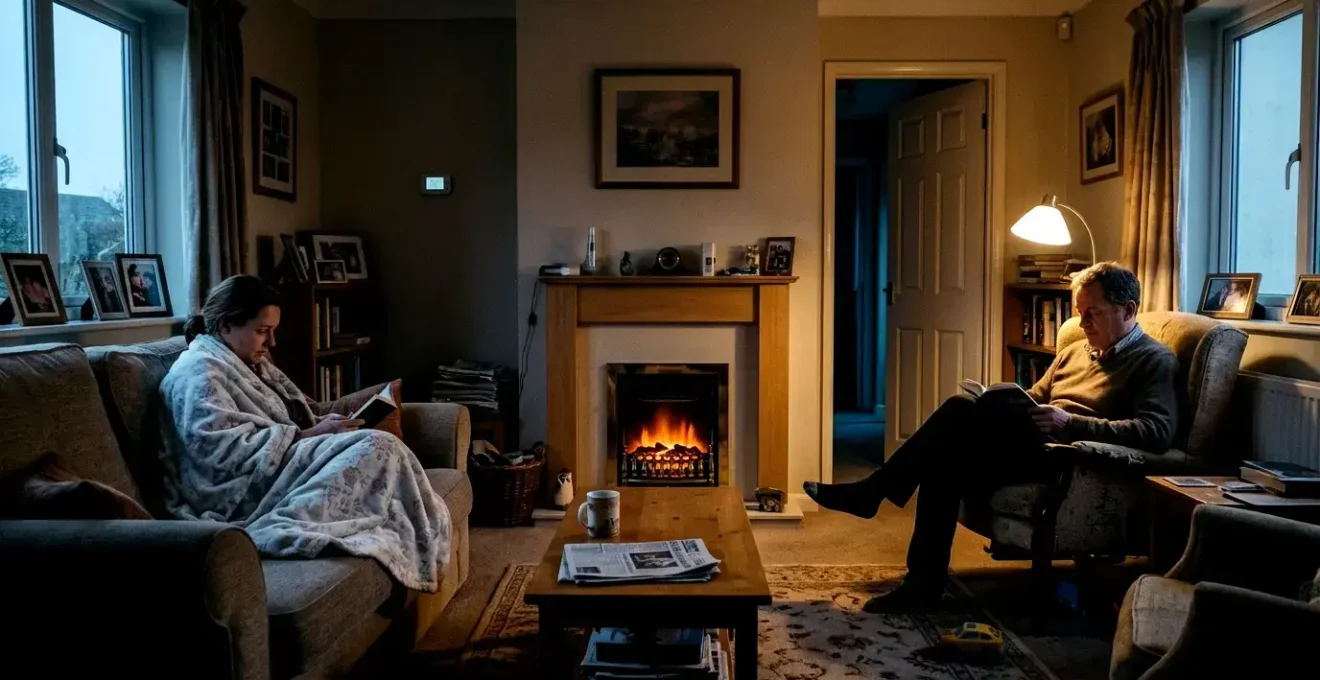
A fireplace can reduce central heating use when it provides targeted warmth in an occupied room while the main heating system operates at a lower setting or runs less frequently. The benefit comes from concentrating heat where people need it, not from assuming that fireplaces are more efficient than boilers or heat pumps.
Consider a household spending an evening in its living room while bedrooms, hallways and other spaces remain largely unused. An appropriately sized electric fireplace may make that occupied area comfortable without raising the temperature throughout the property. However, heating costs only fall if the reduction in central heating consumption outweighs the fireplace’s additional energy use.
Room insulation, door placement, thermostat location, heating-system type and electricity prices all influence the result. A well-separated living room may suit short periods of supplemental heating, while an open-plan or poorly insulated home may benefit more from carefully controlled central heating.
The practical objective is to maintain safe temperatures throughout the house while supplying additional warmth only where it improves comfort.
Fireplace Zone Heating: The Essentials
- Heat occupied space selectively: A fireplace is most useful when people occupy one reasonably enclosed room for a limited period.
- Coordinate both heating systems: Reducing central heating demand requires suitable thermostat settings, rather than running the fireplace on top of unchanged heating.
- Compare total energy costs: Electric fireplaces use resistance heating, so lower central heating consumption does not automatically mean lower bills.
- Why Can Heating One Occupied Room Use Less Energy Than Heating the Whole House?
- How to Use an Electric Fireplace Thermostat for Evening Zone Heating?
- Electric Fireplace or Oil-Filled Radiator for Heating One Living Room?
- Why Running an Electric Fireplace and Central Heating at Full Output Can Waste Energy
- When Should You Use Fireplace Zone Heating Instead of Increasing the Main Thermostat?
- Why Does a Well-Insulated Room Need Less Fireplace Heat Than an Older Room?
- Why a Fireplace Can Feel Hot Nearby While the Rest of the Room Stays Cool
- How Much Fireplace Heat Output Does Your Living Room Really Need?
Why Can Heating One Occupied Room Use Less Energy Than Heating the Whole House?
Heating one occupied room can use less energy because fewer building surfaces and a smaller connected area need to be maintained at a comfortable temperature. The savings come primarily from reducing heat losses in unused areas, provided the occupied room is sufficiently separated and the central heating system genuinely supplies less heat.
A building loses warmth through walls, windows, floors, ceilings and uncontrolled air leakage. The greater the temperature difference between indoors and outdoors, the faster heat generally escapes. Maintaining every room at the same comfortable temperature therefore creates heating demand even where nobody is present.
Zone heating changes that arrangement. Instead of increasing the main thermostat to warm one living room, occupants maintain a lower background temperature elsewhere and use a local heater for comfort.
The relevant boundary is the thermally separated occupied zone. Closing an interior door can reduce the movement of warm air into a hallway, although heat still passes through internal walls, floors and ceilings. Smaller room volume may also reduce initial warm-up demand, but sustained energy consumption depends mainly on heat losses and temperature differences, not air volume alone.
The distinction between zone heating and supplemental heating matters:
- Zone heating: Different areas are deliberately maintained at different temperatures, often using separate controls or heat sources.
- Supplemental heating: A fireplace adds warmth to an existing central heating arrangement without necessarily replacing its function.
- Supplemental zone heating: Local fireplace heat is coordinated with reduced central heating demand while other rooms retain necessary background protection.
An open-plan property changes the calculation. A fireplace may gradually warm the kitchen, hallway and stairwell as heat spreads beyond the seating area. The appliance then works against a larger connected heat load, reducing its potential advantage over a properly controlled central system.
Energy Saving Trust’s advice on electric heating identifies warming one room for a short period as a potentially useful application of secondary electric heating. It also cautions that direct electric heaters can be expensive compared with other heating technologies.
Whether that principle works in practice depends on how successfully the homeowner separates the occupied area and coordinates its fireplace with the central heating controls.
How to Use an Electric Fireplace Thermostat for Evening Zone Heating?
An electric fireplace thermostat can support evening zone heating by controlling how long the appliance produces heat while the central system maintains a suitable background temperature. The practical method is to define the occupied room, adjust the central heating appropriately, set the fireplace for local comfort and check which heater actually runs.
Most thermostatically controlled electric fireplaces switch their heating element on and off around a selected temperature. This cycling is often described as thermostat hysteresis: the temperature at which heating restarts may differ slightly from the temperature at which it stops.
Two independently controlled heating systems can behave unpredictably if their sensors measure different conditions. For example, a central thermostat in a hallway may continue requesting heat even when the living room fireplace has already made that room comfortable.
Setting the fireplace thermostat below the central thermostat is not, by itself, a reliable way to transfer the living room’s heating demand to the fireplace. If both sensors represent the same temperature, the lower-set fireplace may stop heating while the central system continues operating.
A more dependable evening routine is:
- Choose the living room as the occupied zone and close its door where appropriate, without obstructing necessary ventilation.
- Set the main heating controls to a safe, lower background temperature suitable for the property and heating technology.
- Set the fireplace thermostat to the desired living-room comfort temperature, using a separate room thermometer to check the result.
- Observe whether the central heating and fireplace cycle independently, and whether other rooms remain adequately heated.
- Return to the normal household heating schedule when the room is no longer occupied.
For a conventional boiler system, this may involve a scheduled central thermostat setback. Heat pumps require additional caution because large setbacks and repeated recovery cycles may undermine efficient operation.
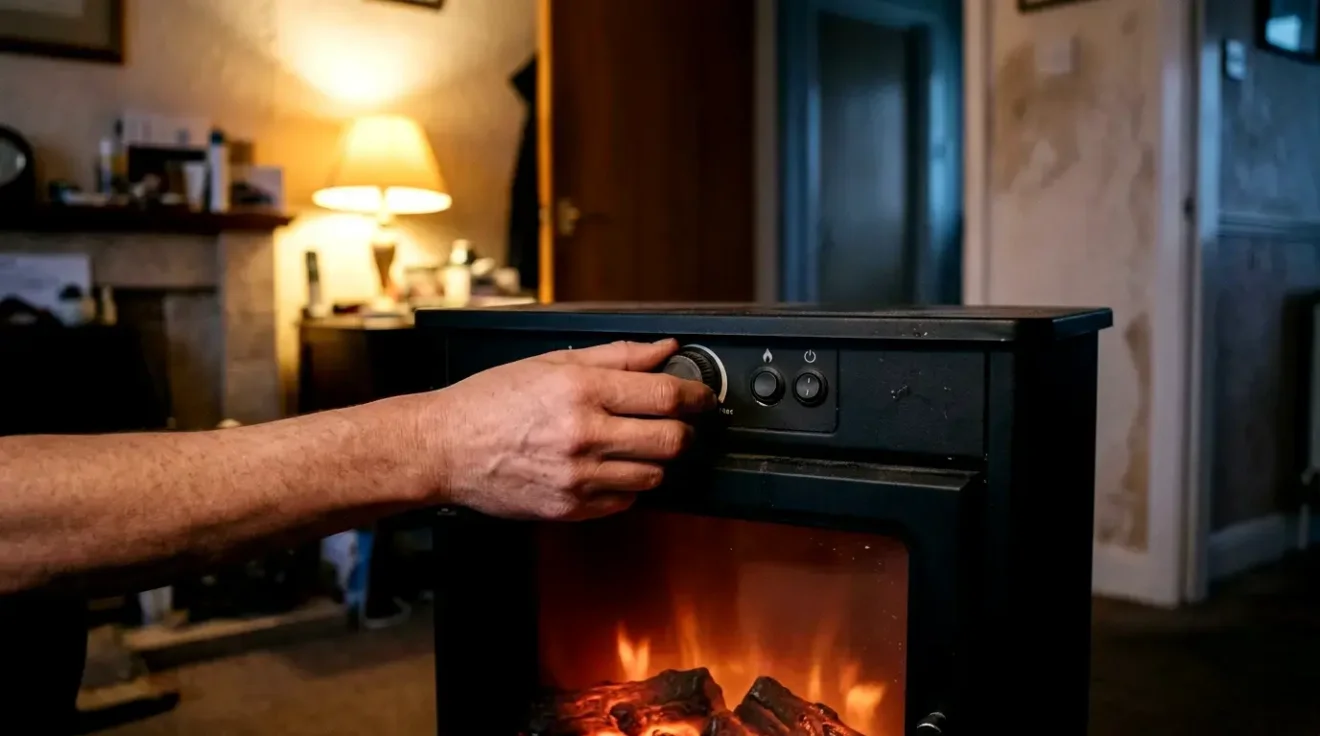
The fireplace thermostat regulates operating time rather than the underlying efficiency of resistance heating. When its heating element is on, electrical consumption follows the appliance’s actual power draw. A shorter operating period uses less electricity, but each unit of electrical energy still produces approximately one equivalent unit of heat inside the room.
Timing therefore matters. Local heating is generally more attractive during a defined period of occupancy than when maintaining the same room at elevated temperature throughout the day and night.
Five Checks for an Evening Fireplace Heating Routine
- Define the heated zone: Identify the occupied room, usable doorway and required ventilation; record the selected room.
- Record starting conditions: Note living-room and hallway temperatures before heating; create a two-location baseline.
- Document thermostat settings: Write down the central heating setback and fireplace comfort setting used for the trial.
- Check heating cycles: Observe when each system turns on and off during the evening; produce a simple runtime log.
- Review the result: Record final temperatures, fireplace electricity consumption where measurable, and comfort; decide whether to keep or adjust the settings.
Once the controls are working together, the next question is whether an electric fireplace is the most suitable appliance for the occupied room.
Electric Fireplace or Oil-Filled Radiator for Heating One Living Room?
An electric fireplace is often preferable for people sitting near its radiant heat and enjoying its flame effect, while an oil-filled radiator is better suited to relatively steady, distributed background heating. Both normally use electric resistance heating, so the economical choice depends on actual power consumption, runtime and the comfort each provides.
Electric fireplaces commonly combine a heating element with fan-driven warm air, sometimes supplemented by radiant heat. Their immediate effect depends on design: a person sitting directly in the warm airflow may feel comfortable before the entire living room reaches the desired temperature.
An oil-filled radiator heats an enclosed thermal fluid, which transfers energy through its metal body to surrounding air and surfaces. Its thermal mass slows initial warming but allows some heat to continue entering the room after the electrical element switches off.
That retained heat is not free additional energy. It is energy the radiator previously consumed and stored.
The following comparison focuses on common portable electric models rather than assuming identical specifications for every product.
| Decision factor | Electric fireplace | Oil-filled radiator |
|---|---|---|
| Heat delivery | Often directed warm airflow with some radiant comfort | Gradual heat transfer through a warm metal body |
| Initial comfort | Potentially fast near the appliance | Generally slower as the radiator warms |
| Room use | Suitable for concentrated seating areas | Suitable for more dispersed occupancy |
| Noise | Fan-equipped models may be audible | Generally quiet, with occasional expansion sounds |
| Temperature control | Depends on thermostat position and model | Depends on thermostat position and model |
| Energy cost | Depends on electrical input and runtime | Depends on electrical input and runtime |
| Additional considerations | Flame-effect electricity use, fan components and decorative value | Stored heat after switch-off, slower response and hot surfaces |
For a clearly hypothetical comparison, consider two heaters each rated at 1,500 W operating continuously for two hours. Each would consume 3 kWh if drawing its full rated power throughout that period. Their heating electricity costs would therefore be equal on the same tariff.
Actual consumption differs when thermostats cycle, power settings change or additional functions operate. Some fireplace flame effects also consume electricity when the heating element is off, while oil-filled radiators typically have simpler controls and fewer moving parts.
For a family sitting together on one sofa, directed heat may deliver comfort without warming every corner equally. For someone moving between a desk, dining table and seating area, steadier room heating may be more useful.
Neither device should be selected as a substitute for a suitable whole-house heating arrangement when the property requires broader temperature protection. Both also need appropriate electrical connections, clearance and supervision according to their manufacturers’ instructions.
Whichever appliance fits the room, its potential advantage disappears if it simply adds unnecessary heat to a space already being maintained comfortably by central heating.
Why Running an Electric Fireplace and Central Heating at Full Output Can Waste Energy
Running an electric fireplace and central heating at full output can waste energy when both systems deliver more heat than the room needs. Excessive temperatures increase heat loss through the building envelope, while competing thermostats can cause uneven heating. Simultaneous operation is not inherently wasteful, but poorly coordinated operation often is.
Consider a living room already maintained at its preferred temperature by central heating. Switching on a fireplace without reducing the central heating demand may push the room above that temperature, particularly if the fireplace lacks effective thermostat control.
The increased indoor-to-outdoor temperature difference causes more heat to escape through windows, walls and other exposed surfaces. The homeowner pays to replace heat that was not required for comfort.
A second problem involves thermostat interference. If the central heating sensor is situated near the fireplace, its reading may rise faster than temperatures in other rooms. The central system can then stop supplying heat even though bedrooms or distant spaces remain cooler than intended.
Conversely, a central thermostat located in a cooler hallway may continue requesting heat while the fireplace maintains an already warm living room. Both systems then operate because neither controller fully represents the entire property’s conditions.
Energy Saving Trust’s central-heating controls advice explains how room thermostats respond to measured temperatures and why their placement away from nearby heat sources matters. The guidance also distinguishes ordinary boiler controls from the operating needs of heat pumps.
A practical way to identify inefficient overlap is to compare similar evenings:
- On one evening, use the normal central heating arrangement without additional fireplace heat.
- On another comparable evening, use a lower central heating setting and the fireplace in the occupied room.
- Record living-room and other-room temperatures, approximate operating periods and energy consumption where meters or system records allow.
- Compare comfort and total energy cost, accounting for outdoor temperature and differences in occupancy.
A further combined-operation test may help diagnose thermostat conflicts. If both systems repeatedly heat the same room beyond the preferred temperature, the settings need revision. If the central system stops while distant rooms become too cold, the main thermostat location or heating-control strategy needs attention.
Importantly, the two systems need not always operate at completely separate times. During very cold weather, central heating may be necessary to maintain safe background temperatures while a fireplace provides local comfort.
The useful rule is to establish which system provides background heating and which supplies the additional occupied-room demand, avoiding uncontrolled duplication.
The appropriate balance depends on occupancy patterns and whether the main thermostat can be lowered without compromising comfort or building protection elsewhere.
When Should You Use Fireplace Zone Heating Instead of Increasing the Main Thermostat?
Fireplace zone heating is worth considering when only one or two rooms are occupied, the heated area can be reasonably separated and the extra warmth is needed for a limited time. Raising the main thermostat is often more appropriate when several rooms need heat or the central system can serve them more efficiently.
Four questions provide a practical starting point:
- How many people are home? A single occupant watching television may need less heated space than a household spread across several rooms.
- How many rooms are occupied? The greater the number of rooms requiring comfort temperatures, the smaller the potential benefit of a single-room heater.
- Can the occupied room be separated? A closed living-room door usually offers better control than an open-plan space connected to a staircase.
- How long is heat needed? Short, predictable periods are generally more suitable for targeted supplemental heating than continuous, widespread demand.
These conditions help identify when to try the strategy, but they cannot guarantee savings.
Whole-house occupancy may favour central heating, particularly where room-level radiator valves, multiple thermostats or other zoning controls already allow unoccupied areas to receive less heat. Such systems can provide zone heating without introducing an additional electric appliance.
The home’s primary energy source also matters. A gas boiler, oil-fired system and heat pump have different delivered-heat costs. A heat pump transfers heat rather than producing all of it through electrical resistance, so it may deliver substantially more heat per unit of electricity than an electric fireplace.
To compare costs, calculate:
Fireplace running cost = electricity consumed (kWh) × electricity unit price.
Then compare the result with the central heating energy and cost avoided over a comparable period. Fuel prices alone are insufficient; central system performance, delivery losses, controls and tariff structures also affect the outcome.
Turning central heating off completely can create additional risks. In cold climates, exposed plumbing, inadequately heated rooms and vulnerable building areas may experience freezing or moisture-related problems. Maintain a suitable minimum temperature based on local conditions, building characteristics and heating-system requirements.
Rooms also need appropriate ventilation even when less heating is supplied. Lower background temperatures should not be used to justify blocking necessary airflow.
Before relying on the strategy, assess the room’s ability to retain heat. Insulation and uncontrolled air leakage often determine whether a modest fireplace can maintain the desired temperature.
Why Does a Well-Insulated Room Need Less Fireplace Heat Than an Older Room?
A well-insulated room generally needs less fireplace heat because it loses warmth more slowly through its building surfaces and uncontrolled air leakage. An older, draughty room may require much more continuous heating to maintain the same indoor temperature, even when its floor area is identical to that of a modern insulated room.
Heating demand is driven by the difference between heat entering the room and heat escaping from it. Walls, glazing, roofs, floors and air movement all contribute to that loss.
Good insulation reduces heat transfer through the building fabric. Effective draught control limits unwanted movement of cold outdoor air into the heated space. Together, these measures allow an appliance to maintain comfort with less frequent operation when other conditions are comparable.
An electric fireplace capable of comfortably supporting a modern living room may struggle in an older room with large single-glazed windows, exposed floors and uncontrolled air leakage.
Rather than assuming that a particular room size requires a fixed wattage, examine its physical characteristics:
- Windows: Consider glazing type, total exposed area, seals and noticeable cold surfaces.
- Walls: Identify available evidence of cavity, internal or external wall insulation.
- Floors: Check whether the room has an insulated floor or exposed boards with noticeable air movement.
- Doors: Look for poorly fitting external doors or openings that allow substantial warm-air movement.
- Room exposure: Consider external walls, adjacent unheated spaces and local winter conditions.
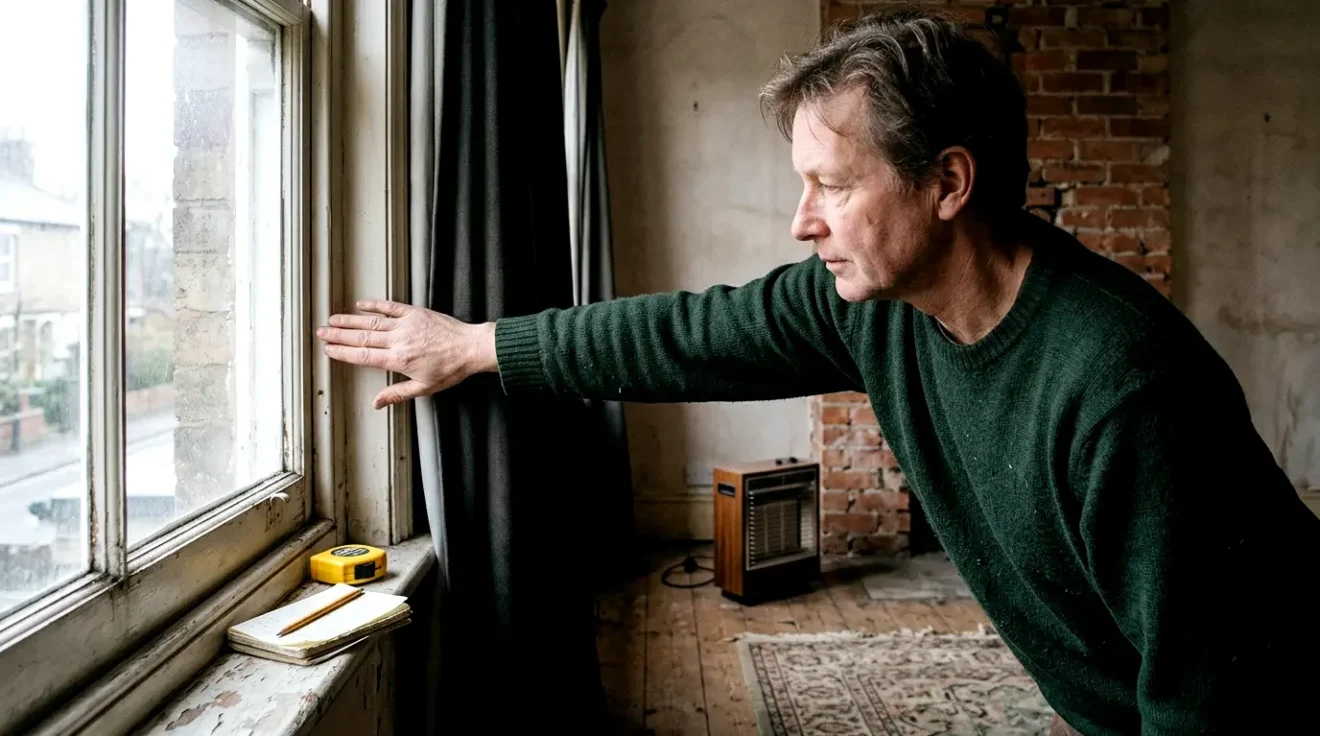
A useful informal test is to observe how quickly the living room cools after the heater stops, while noting outdoor conditions and keeping doors and windows in their usual positions. Rapid cooling suggests a substantial heat-loss burden, although this test does not identify the exact source or replace a professional heat-loss assessment.
Improving the room before increasing heating output can be more economical than purchasing a more powerful appliance.
Energy Saving Trust’s draught-proofing advice recommends addressing unwanted leakage around appropriate windows, external doors and floors while preserving necessary ventilation.
Closing suitable curtains at night can also help reduce discomfort from cold glazing. However, curtains must remain clear of the fireplace and other heating appliances, following the relevant clearance instructions.
Closing an ordinary internal door can limit air movement between rooms, but sealing its ventilation gaps is a different matter. Internal airflow paths and fixed ventilation openings should not be indiscriminately obstructed.
Even an adequately insulated room can feel unevenly heated if the fireplace concentrates warmth close to the seating area while other parts of the room remain cool.
Why a Fireplace Can Feel Hot Nearby While the Rest of the Room Stays Cool
A fireplace can feel hot nearby while the rest of the room remains cool because heat is not distributed uniformly. Radiant heat warms exposed people and surfaces directly, while warm air may circulate unevenly or collect near the ceiling. Feeling comfortable beside the appliance therefore does not necessarily mean the entire room has reached the same temperature.
Radiant heat and convective heat influence comfort differently. Radiant energy is absorbed by skin, clothing and surrounding surfaces, creating an immediate warming sensation without requiring the entire room’s air temperature to rise first.
Convection involves heat transfer through moving air. Fan-equipped electric fireplaces direct warm air into the room, but furniture, room geometry and inadequate circulation can prevent that warmth from reaching every occupied position equally.
A person sitting close to the heater may consequently feel comfortable while another person at a distant desk remains cold.
Temperature stratification can amplify the difference. Warm air tends to accumulate higher in a room when mixing is limited, leaving cooler conditions near the floor or seating areas.
A ceiling fan operating at an appropriate low setting, or a suitably positioned circulating fan, may help redistribute warm air. Any fan should be kept clear of the fireplace’s required ventilation spaces and should not direct airflow in ways that interfere with combustion appliances.
To evaluate the room rather than relying solely on the fireplace’s built-in sensor, place an independent thermometer at approximately seated-body height, around 1 metre above the floor. Check several occupied positions, keeping the thermometer away from direct heater airflow, intense radiant exposure and cold window surfaces.
Compare those readings with the temperature near the central thermostat and, where relevant, another part of the room. A single thermometer cannot establish the full temperature distribution.
It is also important to distinguish radiant comfort from whole-room heating. If someone feels warm only immediately beside the fireplace, the appliance may still be useful for a seated activity. However, it should not be treated as having raised the ambient temperature of the entire room.
This distinction affects energy savings. A person who is comfortable near the fireplace may be able to tolerate a modestly lower central thermostat setting, but any reduction must still leave other occupied rooms adequately heated.
The remaining question is whether the fireplace has enough useful heating capacity for the room’s actual heat losses, or whether its role should be limited to warming a smaller seating area.
Key Takeaways Before Choosing Fireplace Heat Output
- Room dimensions are only the starting point: Windows, insulation, air leakage and outdoor conditions determine the heat the appliance must replace.
- Heating capacity sets a practical limit: A fireplace that cannot match the room’s heat loss cannot maintain the desired temperature on its own.
- Partial coverage may still be useful: Comfortable seating-area warmth can justify supplemental heating without attempting to replace the central system.
How Much Fireplace Heat Output Does Your Living Room Really Need?
The fireplace heat output your living room needs depends on the room’s heat losses, desired indoor temperature and outdoor conditions. Floor area or volume alone cannot establish an accurate wattage requirement. A properly sized supplemental fireplace should deliver useful comfort without requiring continuous maximum operation or allowing other areas of the home to become inadequately heated.
Start by measuring the room’s length, width and height. Multiplying these dimensions gives its approximate volume in cubic metres or cubic feet, depending on the units used.
Volume is useful for describing the heated space and estimating initial warm-up requirements, but it is not a substitute for a heat-loss calculation.
A more complete assessment considers the exposed surface area of walls and glazing, insulation quality, air leakage, indoor and outdoor design temperatures and any heat exchanged with adjacent spaces.
The underlying relationship can be expressed as:
Required steady heating output ≈ heat lost through the building fabric + heat lost through air movement − useful heat gains.
For a clearly hypothetical example, imagine two living rooms with identical dimensions. One has modern insulation and effective window seals, while the other has poorly insulated external surfaces and noticeable draughts.
The second room will generally need more heating power to maintain the same temperature under comparable outdoor conditions. Assigning both rooms a single universal watts-per-square-metre allowance could therefore lead to misleading sizing decisions.
Many portable electric fireplaces are offered with maximum heating outputs around 1,500 W in North American markets, while ratings and circuit requirements differ across countries and products. The appliance’s own specifications, local electrical standards and manufacturer instructions must take precedence over any assumed standard output.
If the room loses heat faster than the fireplace can supply it, the appliance cannot maintain the selected air temperature by itself. The central system must continue supplying the difference, or the homeowner must reduce the room’s heat loss.
It is also necessary to distinguish decorative flame effects from actual heating performance. An electric fireplace may offer attractive visual flames while operating with its heating element switched off. Check the stated heat output, electrical input, power settings and thermostat capabilities rather than treating decorative features as evidence of heating capacity.
For combustion-based fireplaces, fuel input is not equivalent to useful heat delivered indoors. Appliance efficiency, flue losses and combustion-air requirements affect performance.
The U.S. Department of Energy’s Building Science Education guidance explains that combustion fireplaces need an adequate air supply and appropriate backdraft protection. This requirement is especially important when considering room isolation around wood-burning or other combustion appliances. A purely electric fireplace does not require combustion air, but still needs the ventilation and clearances specified by its manufacturer.
When full-room heating is unrealistic, a partial-coverage strategy may be the practical alternative. Position occupants within the fireplace’s effective comfort area, keep the central heating at a safe background level and evaluate whether a modest reduction in its operating demand is possible.
Finally, compare energy consumption over representative evenings rather than assuming that a larger or smaller advertised wattage guarantees savings. Measure actual runtime where possible, calculate electricity costs using the household tariff and consider what the central heating system would otherwise have consumed.
Before making the arrangement permanent, measure room temperatures and energy use over several comparable evenings, verify adequate background protection throughout the house and adjust the fireplace settings only where the results support the change.
Can an electric fireplace lower heating bills if the home uses a heat pump?
It can reduce heat-pump runtime in some circumstances, but lower bills are not guaranteed. Heat pumps generally deliver more useful heat per unit of electricity than resistance heaters. Replacing efficient heat-pump output with direct electric fireplace heat may therefore increase total electricity consumption, even if the living room feels comfortable.
Should bedroom doors stay closed when using a fireplace in the living room?
Closing doors can reduce heat movement between rooms, but the appropriate arrangement depends on the home’s heating, ventilation and airflow design. Bedrooms must retain suitable temperatures and required ventilation. Avoid blocking designed air-transfer paths, particularly in homes with ducted heating or combustion appliances.
Can a fireplace be left running overnight to reduce central heating use?
Overnight operation should not be assumed safe or economical. Follow the manufacturer’s instructions, including restrictions on unattended use, clearances and electrical connections. Many portable electric heaters should not be left operating unattended or while occupants sleep. The central system’s appropriate overnight controls are generally a better starting point for maintaining background temperatures.
How can homeowners tell whether fireplace zone heating actually saves money?
Compare total heating expenditure during reasonably similar periods with and without fireplace assistance. Record electricity consumption, central heating fuel or electricity use, outdoor conditions, occupancy and room temperatures. The meaningful result is the change in combined heating cost while maintaining acceptable comfort and building protection, not merely a reduction in central heating runtime.