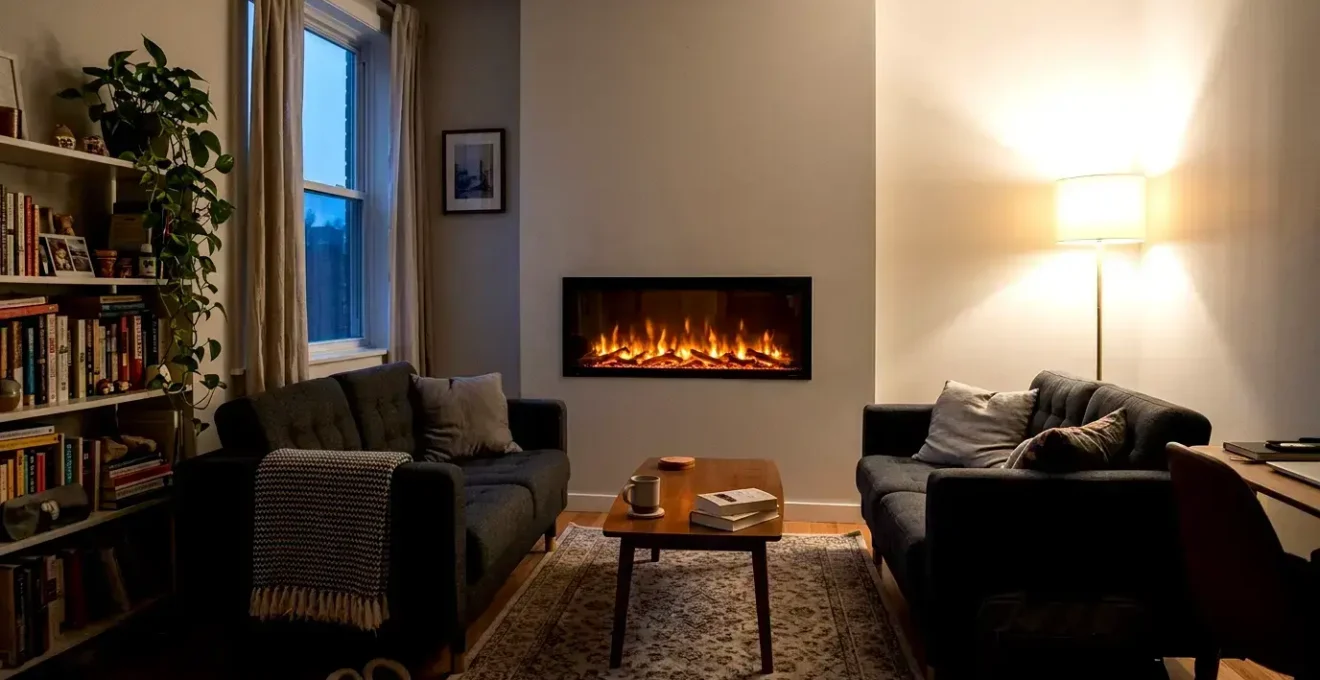
Electric fireplaces are generally the most practical chimney-free option for apartments, particularly when the building restricts alterations or the occupant rents rather than owns the property. Freestanding electric stoves, fireplace consoles and some slim wall-mounted models create a flame effect without burning fuel or requiring a flue.
Choosing the right appliance involves more than finding an attractive design. Apartment residents must consider tenancy agreements, condominium or leasehold rules, electrical capacity, available floor space and the consequences of making permanent changes. An electric fireplace that works perfectly in a detached house may be unsuitable for a studio with older wiring or a lease that prohibits wall fixings.
Other chimney-free technologies, including bioethanol and certain gas appliances, exist, but they introduce combustion, ventilation and approval considerations that electric flame-effect units avoid. The safest practical starting point is therefore a suitable electric model, followed by a check of the building’s rules and the manufacturer’s installation instructions.
Apartment fireplace options at a glance
- For renters: A freestanding plug-in electric fireplace or console usually offers the simplest removable arrangement, subject to lease and building restrictions.
- For small spaces: Slim wall-mounted models can preserve floor area, while recessed fireplaces generally require greater installation work and approval.
- Before installation: Verify permissions, available electrical capacity, mounting requirements and the appliance’s safety clearances.
- Why Are Wood-Burning Fireplaces Often Restricted in Apartment Buildings?
- How to Add an Electric Fireplace to a Rental Apartment Without Altering the Walls?
- Electric Fireplace Console or Freestanding Stove for a Studio Apartment?
- Why Installing a Recessed Fireplace Without Landlord Approval Can Cause Problems
- When Should You Request Building Approval for an Apartment Fireplace?
- Wall-Mounted or Recessed Slim Electric Fireplace for a Small Apartment?
- When Should You Check Your Electrical Circuit Before Adding a Vent-Free Fireplace?
- Are Slim-Profile Electric Fireplaces Suitable for Small Modern Living Rooms?
Why Are Wood-Burning Fireplaces Often Restricted in Apartment Buildings?
Wood-burning fireplaces are frequently restricted in apartment buildings because they involve combustion, shared building infrastructure and potential smoke exposure for neighbouring residents. A property may face several independent restrictions: tenancy or ownership rules, building and fire-safety requirements, and local air-quality regulations. Permission to burn wood in a nearby detached house does not establish permission in an apartment.
The first restriction comes from the building itself. A lease, condominium declaration or management agreement may prohibit solid-fuel appliances, require prior approval or restrict alterations to shared ventilation systems. In multi-unit buildings, a chimney may pass through several properties or form part of the common structure, making individual modifications more complicated.
The second concerns the building’s physical configuration. A working wood-burning fireplace needs an appropriate flue, compatible construction and safe smoke evacuation. Installing a new chimney through floors, roofs or external walls may require permissions that an individual apartment occupant cannot obtain independently.
The third restriction involves local smoke-control and air-quality rules. In the United Kingdom, the UK Government guidance on smoke control areas explains that unauthorised fuels such as wood can only be burned in qualifying exempt appliances within designated areas. These rules depend on location and do not amount to a nationwide prohibition on wood-burning fireplaces.
In the United States, state and local authorities may impose restrictions on residential wood burning, including temporary no-burn periods. The EPA‘s guidance on residential wood-burning restrictions explains the local nature of these requirements, although its Burn Wise content is no longer updated and should not replace current municipal guidance.
An existing fireplace is not automatic permission to use it. A visible chimney breast, original hearth or sealed fireplace opening may remain in an apartment after the flue has been disconnected, capped or declared unsuitable. Reopening it without checking ownership, inspection requirements and building permissions can expose neighbouring homes to smoke or combustion gases.
Unauthorised use may also create insurance disputes, liability for damage affecting other residents and complications during a property sale if alterations were never declared. Insurance outcomes depend on the policy, the circumstances and applicable law; a breach does not automatically invalidate every claim.
Before relying on an existing fireplace, examine the tenancy agreement or ownership documents, ask the landlord or building manager for written confirmation, and check current municipal restrictions. Where use is potentially permitted, obtain an appropriate professional assessment of the chimney and appliance.
For apartments without an approved working chimney, an electric flame-effect appliance avoids the solid-fuel and smoke-evacuation problems, although electrical and occupancy restrictions still apply.
How to Add an Electric Fireplace to a Rental Apartment Without Altering the Walls?
The simplest way to add an electric fireplace to a rental apartment without altering the walls is to choose a freestanding, plug-in model that rests securely on the floor. Fireplace consoles and freestanding electric stoves generally avoid drilling, recessed wiring and permanent framing. However, tenants should still check their lease, electrical arrangements and appliance clearances before using one.
There are three practical levels of installation commitment:
- Freestanding electric fireplace: Sits directly on the floor, can usually be relocated and typically leaves no wall-fixing marks.
- Electric fireplace console: Combines a flame-effect insert with furniture, sometimes providing storage or a television stand. Certain consoles require anti-tip restraints, which may involve wall fixings.
- Surface-mounted electric fireplace: Preserves floor area but ordinarily needs appropriately rated brackets and wall anchors. Removable rails or low-impact fixings still alter the wall and may require permission.
For a rental property, the first two approaches are usually easier to justify because the appliance resembles removable furniture rather than a permanent improvement.
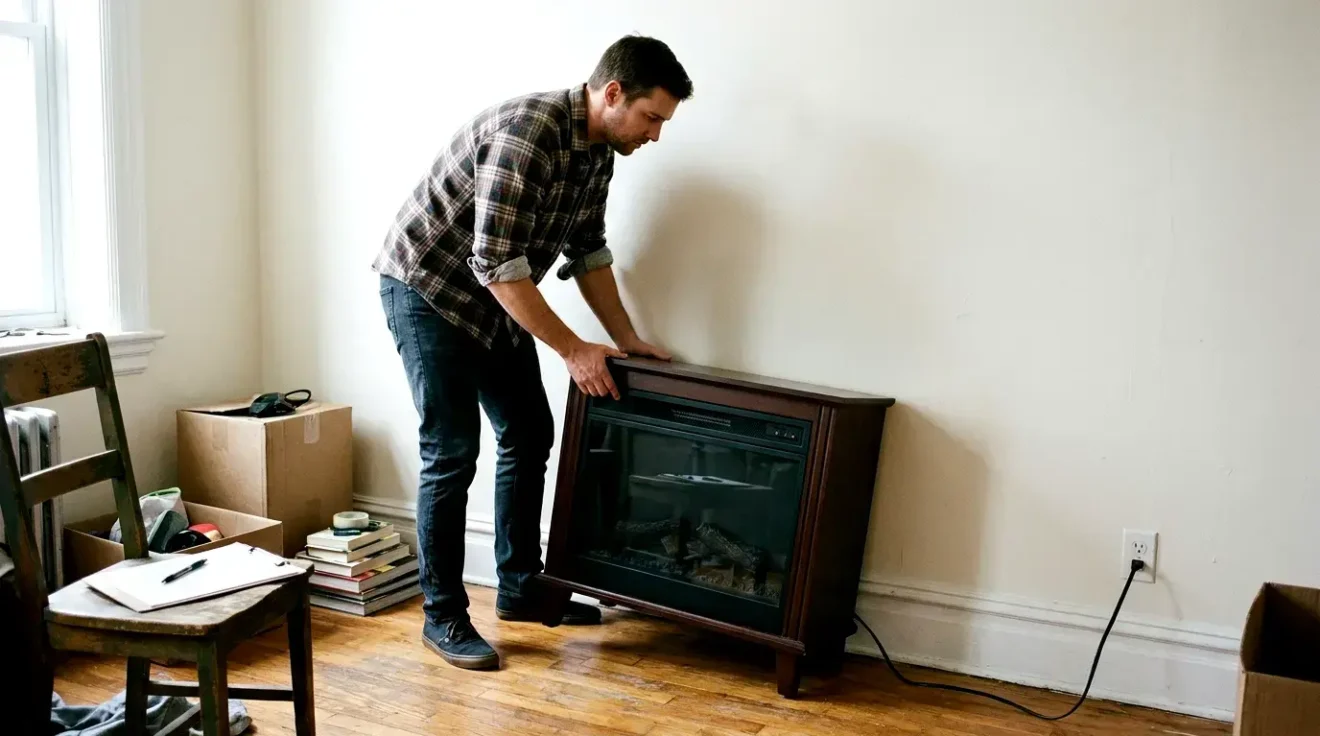
When permission is uncertain, explain the intended arrangement to the landlord in writing. Identify the exact appliance, confirm whether wall fixings are necessary and describe how it can be removed. Photographs of the installation area before and after placement can help document the property’s condition. Keep the purchase invoice and manufacturer’s instructions as evidence of the appliance’s design and installation requirements.
For any proposed fixing, request written agreement covering the installation method and the condition expected when moving out. A specific reinstatement agreement is more useful than an informal conversation, although neither guarantees protection from every legitimate deposit deduction.
Technical details also matter. Check the manufacturer’s minimum clearances behind, above and around the unit, particularly near skirting boards, curtains and furniture. Do not assume that a shallow cabinet leaves adequate space for heat release. Heavy wall-mounted appliances also require a suitable supporting structure; lightweight partitions may not safely accommodate the proposed fixings.
Connect the heater directly to a suitable outlet unless the manufacturer explicitly permits another arrangement. Shared circuits and ageing sockets deserve particular attention because electric fireplaces can draw substantial power when heating is enabled.
Once a no-drill installation is feasible, the next decision is whether a storage-oriented console or a compact standalone stove makes better use of the apartment’s limited space.
Electric Fireplace Console or Freestanding Stove for a Studio Apartment?
An electric fireplace console is often the better choice for a studio that needs furniture, storage and a flame effect in one location. A freestanding electric stove is generally preferable when flexibility and easy relocation matter more. The decision should account for usable floor area, viewing angles, airflow, fan noise and how close the appliance will be to the sleeping area.
In a studio, every furniture item competes with circulation space. A console can replace an existing media unit or cabinet, while a freestanding stove requires its own safe position. Neither format automatically saves space: a bulky console may occupy more wall length than a compact stove.
The comparison is easier when considered alongside the studio’s existing furniture.
| Decision factor | Electric fireplace console | Freestanding electric stove |
|---|---|---|
| Floor-space use | Can replace another furniture item but may need a wide wall | Usually narrower, but requires a separate floor position |
| Storage | May include shelves, cupboards or media storage | Generally provides no storage |
| Flame visibility | Usually designed for viewing from the front | May work as a focal point from several seating positions, depending on design |
| Flexibility | Movable but potentially bulky | Usually easier to reposition |
| Best functional fit | Studios needing a combined media and fireplace unit | Studios with flexible furniture layouts or an unused corner |
Placement changes how spacious a studio feels. A console aligned with existing cabinetry can create a coherent furniture wall, reducing visual clutter. A stove positioned near a seating area can establish a distinct living zone without partitions, but it should never obstruct doors, walkways or required safety clearances.
Fan noise deserves special consideration because the heater may be only a short distance from the bed. Look for operating-noise information and check whether the flame effect works independently of the heating function. A flame-only mode makes the appliance useful for evening ambience without necessarily adding unwanted heat.
Heating performance should be assessed against the actual room rather than a generic advertised coverage figure. Insulation, window area, ceiling height and existing heating all influence comfort. A thermostat allows better temperature control in a small enclosed space, where continuous heating can quickly become uncomfortable.
Before purchasing, outline the appliance’s dimensions on the floor using removable tape or paper and verify the required clearances. This simple exercise reveals whether drawers, doors and normal movement remain practical.
Whichever style fits the room, avoiding permanent construction remains particularly important when a tenant is considering the more integrated appearance of a recessed fireplace.
Why Installing a Recessed Fireplace Without Landlord Approval Can Cause Problems
Installing a recessed electric fireplace without landlord approval can create tenancy, financial and safety problems because the work usually changes the property itself. Cutting an opening, constructing a built-in enclosure or altering electrical wiring goes beyond placing removable furniture in a room. Even apparently reversible installations may require costly restoration when the tenancy ends.
A recessed fireplace is designed to sit within a wall opening or purpose-built enclosure. Depending on the model, installation may involve cutting plasterboard, altering framing, securing mounting brackets and concealing or installing electrical connections. Some models also require specific ventilation spaces around the enclosure.
These changes can affect the fabric of the property even when no load-bearing structure is altered. They should not automatically be described as structural modifications, but they may still constitute alterations requiring express consent under the tenancy agreement.
For renters in England, Shelter‘s guidance on improvements to rented homes recommends obtaining the landlord’s agreement in writing before starting improvements. The possible consequences of unauthorised alterations depend on the agreement and circumstances.
Those consequences may include a request to restore the wall, reasonable deductions from the tenancy deposit, additional claims for damage or, in sufficiently serious circumstances, tenancy enforcement proceedings. Eviction is not an automatic outcome of an unauthorised fireplace installation.
Electrical incidents introduce another concern. An improperly installed or non-compliant appliance may complicate an insurance claim, particularly when the installation is connected to the damage. The actual outcome depends on the policy terms and applicable law rather than the mere absence of landlord consent.
A frequent misconception is that a decorative plasterboard recess can simply be removed before moving out. In reality, the original surface may need reconstruction, finishing and repainting. Concealed wiring or new circuits can require additional professional work to restore a compliant installation.
The alternative is straightforward: request detailed written approval before undertaking the work, or choose a slim surface-mounted or freestanding model that provides a similar visual effect with fewer alterations.
Before commissioning an installation, residents should also establish who has authority to approve it, because landlord consent and building-management approval are not interchangeable.
When Should You Request Building Approval for an Apartment Fireplace?
Building approval should be requested before installing an apartment fireplace whenever the work affects shared property, fixed wiring, walls, structural elements or building-managed systems. A landlord’s consent may also be necessary, but it does not automatically replace condominium, leasehold or building-management approval. Requirements vary by jurisdiction, building documents and the installation method.
The clearest approval triggers include:
- Cutting into walls, altering fixed partitions or constructing a recessed enclosure.
- Adding, relocating or modifying permanent electrical wiring.
- Hardwiring an appliance rather than connecting a suitable plug-in model to an existing outlet.
- Attaching a substantial wall-mounted appliance where fixing methods or loads require approval.
- Changing shared ventilation, fire-rated construction, external walls or any feature visible from common areas.
There is no universal appliance-weight threshold that automatically triggers building consent. A relatively light unit might still require approval if its fixings penetrate a fire-rated partition, while a heavier freestanding console may require no construction work at all.
Landlord permission and building approval serve different purposes. A landlord can authorise an alteration under a tenancy agreement without having authority to approve changes affecting common property. Equally, a building association may permit a particular type of wall-mounted appliance while an individual landlord prohibits drilling in the rented unit.
For owner-occupiers, removing the landlord from the process does not eliminate condominium, strata, leasehold or building rules. Depending on the building, an owner may still need formal management approval or approval from the relevant owners’ association.
Edge cases deserve careful treatment. A decorative flame-effect unit with heating permanently disabled may present fewer thermal concerns, but its mounting can still require consent. An existing false wall does not necessarily authorise a new recess. Replacing an already installed fireplace may also require approval if its electrical load, dimensions or mounting method changes.
Five checks before requesting fireplace approval
- Identify the occupancy rules: Review the lease and building regulations, and save the relevant clauses in a single document.
- Specify the proposed appliance: Record its model, dimensions, weight, heat output and electrical rating in a short specification sheet.
- Document the installation location: Take photographs and prepare a simple sketch showing the wall or floor position, outlet and proposed clearances.
- Clarify the proposed work: List all fixings, framing changes and electrical alterations, then identify which parties must approve them.
- Request and retain written decisions: Send the complete proposal to the relevant parties and save their responses, conditions and any reinstatement agreement.
A complete request makes it easier for the landlord or building manager to distinguish a removable plug-in appliance from a permanent modification. Approval should identify the actual installation rather than offer vague permission for a fireplace in general.
Once the necessary permissions are clear, the choice between a wall-mounted and recessed design becomes a more practical question of space, installation complexity and long-term flexibility.
Wall-Mounted or Recessed Slim Electric Fireplace for a Small Apartment?
A wall-mounted slim electric fireplace is generally more practical in a small rental apartment because it avoids creating a permanent recess and is easier to remove. A recessed fireplace can provide a more integrated appearance, but it requires a suitable wall cavity or enclosure, compatible electrical arrangements and the necessary approvals. Neither option is universally suitable for every partition.
Both formats can create a contemporary fireplace effect without a chimney, but they occupy space differently. A surface-mounted unit projects into the room, while a recessed unit places some or most of its depth inside a prepared opening.
| Criterion | Wall-mounted | Recessed |
|---|---|---|
| Visible depth | Projects beyond the existing wall surface | May sit nearly flush, depending on the model and enclosure |
| Building alterations | Usually requires mounting holes and appropriate fixings | Typically requires framing, a prepared opening and finishing work |
| Maintenance access | May be relatively easy to remove from its bracket | Access depends on the designed service openings and installation |
| Rental suitability | Potentially suitable with permission | Usually more difficult to justify without substantial approval |
| Future relocation | Possible after removal and wall repair | Generally requires additional restoration work |
Choose by eliminating unsuitable options in a fixed order. First, establish whether the apartment is rented or owner-occupied and what alterations are permitted. Second, assess the construction and available depth of the proposed wall. Third, confirm electrical compatibility. Only then compare finishes, flame effects and viewing dimensions.
Wall construction is a decisive constraint. A lightweight partition may not provide the required anchorage without suitable reinforcement. A recessed model cannot simply be inserted into any wall: the opening must comply with the manufacturer’s framing and ventilation requirements, and fire-rated assemblies must not be compromised.
Ultra-slim models also involve compromises. The shallowest appliance does not necessarily produce the most convincing flame effect, and some heating systems need ventilation space that is not obvious from the front-facing product photograph. Consider the full installed depth, including brackets and clearances, rather than the advertised cabinet depth alone.
For a homeowner planning a long-term interior renovation, a recessed unit may be worthwhile where construction and approvals permit. For a tenant, a slim surface-mounted design or a freestanding alternative generally preserves more flexibility.
The final technical decision is whether the apartment’s existing electrical installation can safely support the selected appliance, particularly when the building is older.
When Should You Check Your Electrical Circuit Before Adding a Vent-Free Fireplace?
Check the electrical circuit before buying or connecting a chimney-free electric fireplace whenever its heating output may place a significant load on an existing circuit. This is especially important in older apartments, rooms with several high-power appliances and buildings with uncertain wiring conditions. The relevant factors are the appliance’s electrical rating, circuit capacity, existing loads and manufacturer requirements.
Electric fireplaces avoid combustion and therefore need no smoke flue, but their heating elements still consume electricity. When multiple appliances operate on the same circuit, their combined demand may exceed its safe capacity.
The immediate symptom can be a tripped circuit breaker. More concerning warning signs include a warm or discoloured outlet, a damaged plug, unusual smells or repeated electrical faults. These conditions warrant stopping use and obtaining a qualified electrician’s assessment rather than repeatedly resetting the breaker.
There are three distinct consequences to consider: inconvenience when a breaker trips, potential equipment or wiring damage from overheating, and possible insurance complications if an incident arises from a non-compliant installation. Insurance coverage depends on the facts and policy terms.
A useful first check is to identify the appliance’s rated power in watts and the relevant circuit’s voltage and current rating. In principle, electrical power relates to voltage and current through the expression P = V × I, although actual loading assessments must account for equipment characteristics, circuit arrangements and applicable electrical rules.
Next, list other appliances supplied by the same circuit and identify which may operate simultaneously. A living-room socket may share a circuit with outlets in another room, so visible proximity alone does not establish electrical independence.
Manufacturer instructions take priority over assumptions. For example, the Dimplex Ignite Bold installation manual specifies a dedicated, properly fused 13 A circuit for its documented 230–240 V models. It also prohibits extension cords for those models. These requirements are product-specific, not universal specifications for every electric fireplace.
13 A
Dedicated circuit specified for the documented Dimplex Ignite Bold BXLF1200, BXLF1500 and BXLF1800 models on 230–240 V installations. Other fireplace models and electrical markets may have different requirements.
Manufacturer installation documentation: Dimplex Ignite Bold, 2024.
Older buildings require additional caution. Some outlets may lack a suitable protective earth, wiring may have deteriorated, and circuit labels may be incomplete. Tenants should not modify the distribution board themselves or assume that an available outlet is suitable for a powerful heater.
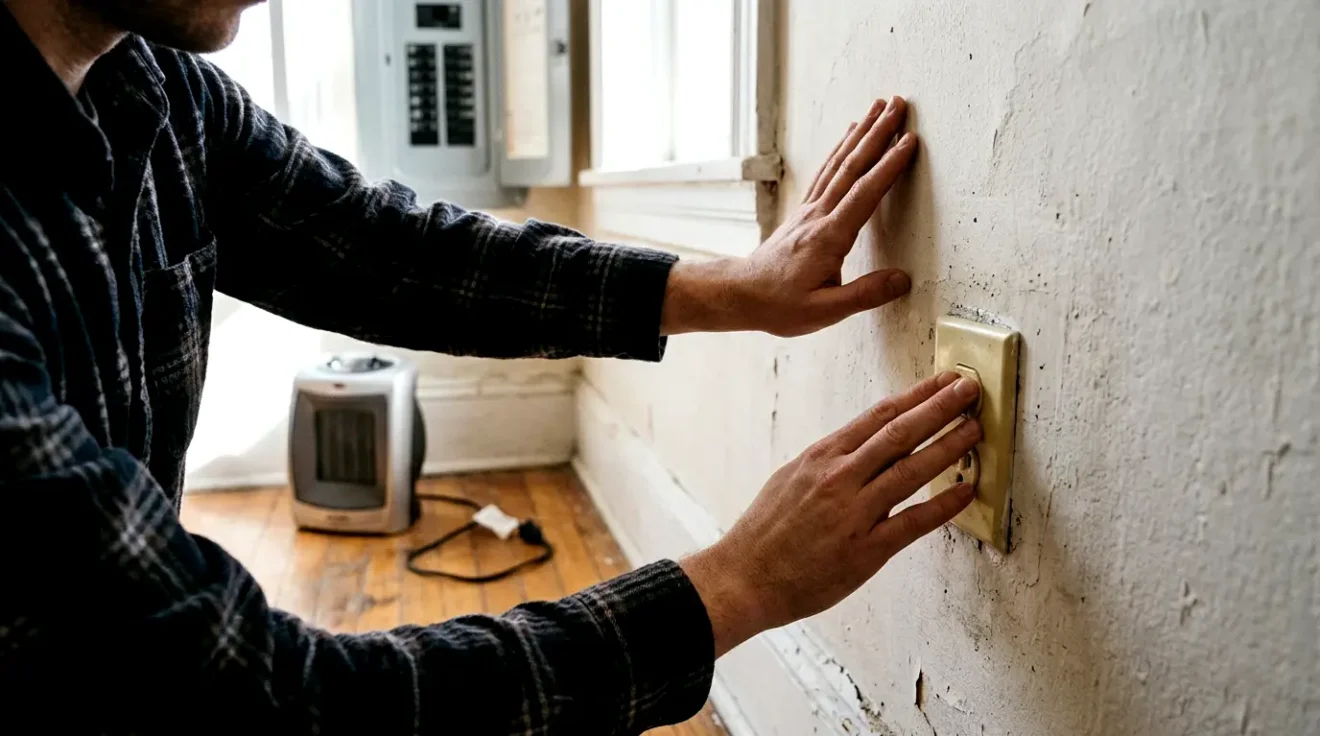
Never touch exposed electrical conductors or open electrical equipment to perform these checks. A socket that feels warm during normal use is a warning sign, not a reason to continue testing it by hand. Disconnect the appliance safely if possible and arrange an inspection.
For electric fireplaces, the circuit check concerns electrical heating rather than the ventilation of combustion gases. Fuel-burning vent-free products require separate assessment of indoor air quality, local regulations and whether the appliance is permitted at all.
With the electrical supply and permissions confirmed, a slim electric fireplace can then be assessed on its actual suitability for the room rather than its appearance alone.
Key takeaways before choosing a slim fireplace
- Measure the installation envelope: Account for the complete appliance depth, mounting hardware, furniture and required clearances—not just the visible front panel.
- Decide how the fireplace will be used: Occasional ambience and regular supplemental heating place different demands on features and electrical supply.
- Prioritise long-term practicality: A removable design, accessible controls and straightforward maintenance can be more valuable than a completely flush appearance.
Are Slim-Profile Electric Fireplaces Suitable for Small Modern Living Rooms?
Yes, slim-profile electric fireplaces can suit small modern living rooms when the available wall space, electrical supply and installation permissions are compatible with the chosen appliance. Their main advantages are a compact visual profile and controllable flame effect, often without combustion or a chimney. However, they should generally be treated as decorative features with supplemental heating rather than guaranteed replacements for a home’s primary heating system.
The first question is whether the room can accommodate the fireplace comfortably. Measure the usable wall width, accounting for doors, shelving, radiators and furniture. Consider the seated viewing position, because an appliance that looks proportionate in a showroom can dominate a narrow living room.
Installation height also changes the result. A fireplace placed too high may feel disconnected from the seating area, while one placed too low may conflict with furniture, skirting boards or required clearance distances.
In contemporary interiors, a slim fireplace can work particularly well when aligned with existing architectural features. A black metal surround may blend into dark media cabinetry; a matte-white surround can create a quieter visual transition against a pale wall; and a stone-effect finish can introduce texture where other furnishings are minimal.
Where a television sits above the fireplace, the manufacturer’s heat-clearance requirements must determine the layout. It is not safe to assume that every electric fireplace can be installed directly beneath a screen or close to sensitive electronics.
The heating function should match realistic expectations. A slim electric fireplace may provide useful warmth in an appropriately sized, insulated room, but comfort depends on the building envelope, climate, room dimensions and existing heating. A poorly insulated living room should not be expected to become adequately heated solely because the appliance has an attractive flame display.
When comparing models, prioritise these features:
- Independent flame-only operation for ambience without unnecessary heat.
- An adjustable thermostat for controlling supplemental heating.
- Accessible controls or a remote control for convenient daily use.
- Complete installed depth and documented clearance requirements.
- Electrical specifications compatible with the apartment’s supply and circuit capacity.
- Accessible maintenance points and a mounting arrangement appropriate to the wall.
A useful final comparison is between the fireplace and the room’s existing functions. If adding the appliance would obstruct a walkway, eliminate necessary storage or require unapproved construction, a smaller freestanding model may be the more successful interior choice.
Start by measuring the proposed location, selecting a model with documented installation requirements and confirming the necessary approvals and electrical compatibility before ordering. That sequence makes it possible to enjoy the fireplace effect without treating apartment restrictions as an afterthought.
Can you have a real-flame fireplace in an apartment without a chimney?
Some bioethanol and specifically designed vent-free gas appliances operate without a conventional chimney, but they involve real combustion. Their suitability depends on local regulations, manufacturer instructions, ventilation, indoor air-quality considerations and building permissions. They should not be assumed acceptable in rented apartments. Electric fireplaces offer a flame effect without an actual flame or combustion emissions inside the room.
Can an electric fireplace be used in an apartment without central heating?
An appropriately rated electric fireplace can provide heat, but its adequacy as the sole heating source depends on the apartment’s size, insulation, climate and heating requirements. Many models are intended for supplemental or occasional heating. Check the manufacturer’s specifications and seek appropriate heating advice rather than assuming that a decorative fireplace can replace a complete heating system.
Do electric fireplaces produce carbon monoxide?
Electric fireplaces do not burn fuel, so they do not produce carbon monoxide through their normal heating operation. This distinguishes them from combustion-based appliances. Nevertheless, they remain electrical heating equipment and must be installed and operated according to the manufacturer’s safety instructions.
Can you take an electric fireplace with you when moving out?
A freestanding electric fireplace is generally removable personal property, subject to the tenancy agreement and any furniture restraints or installation conditions. Wall-mounted models may also be removable, but fixings, damage and reinstatement obligations must be addressed. Built-in fireplaces can raise additional ownership and alteration questions, so written agreements are particularly important.
Is a decorative electric fireplace without heating easier to approve?
A flame-effect appliance without active heating may avoid some thermal concerns, but approval can still depend on how it is installed. A freestanding decorative unit is different from a permanently recessed or hardwired appliance. Building rules may regulate electrical equipment, wall fixings and alterations even when no heating is involved.