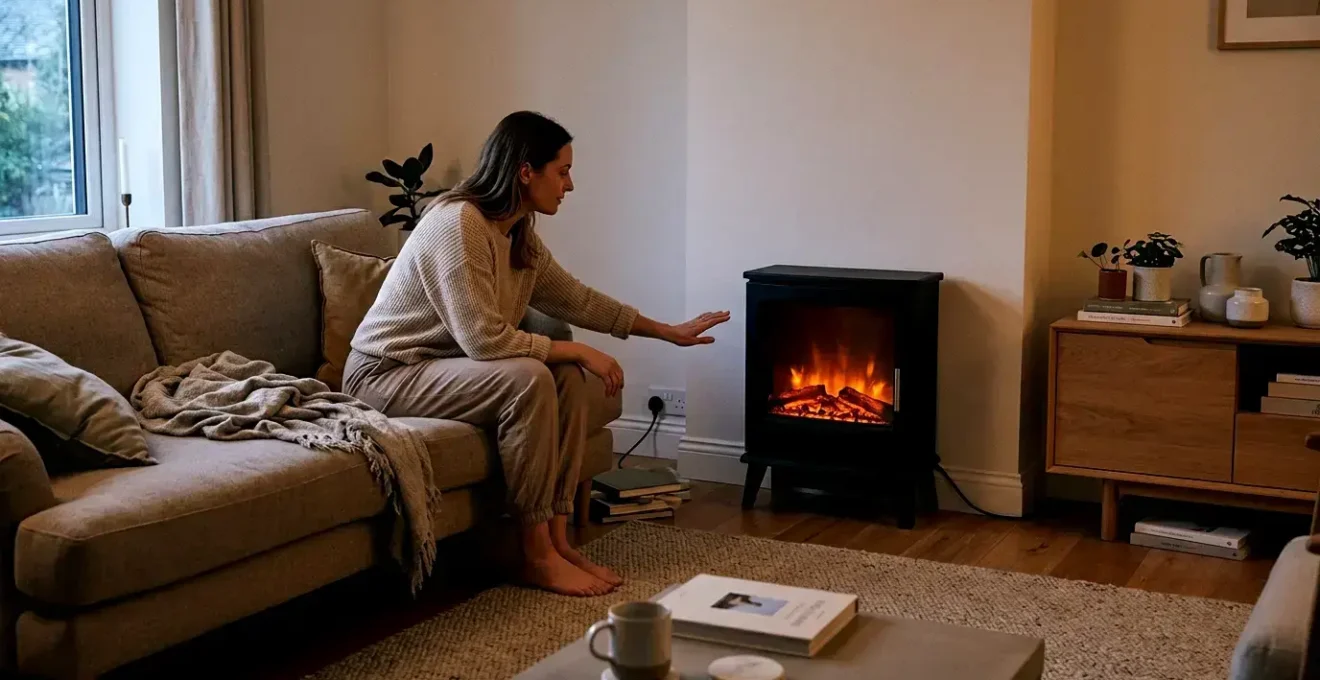
The best place for an electric fireplace is usually a solid wall facing the main seating area, close enough to a suitable electrical outlet for direct connection and sufficiently clear of furniture, curtains and other obstructions. The ideal position also depends on how the fireplace delivers heat, whether it is primarily decorative and how its flames appear from everyday viewing positions.
A central feature wall may create a striking focal point, but it is not automatically the most comfortable or practical location. Open doorways can carry warm air away, large glazed doors can contribute to cold drafts, and an inconvenient socket may leave visible cables or require electrical alterations.
Wall-mounted, recessed and freestanding electric fireplaces also have different installation requirements. A location that works for one model may be unsuitable for another, particularly around heat outlets and ventilation openings.
Choosing the right position therefore means evaluating heat delivery, electrical access, manufacturer clearances and visual balance together, before committing to a mounting height or altering the room.
Electric fireplace placement at a glance
- Prioritize the occupied area: Position the fireplace so its heat reaches the seats used most often, without furniture or openings interrupting delivery.
- Check electrical access and safety first: Confirm direct socket reach, suitable electrical capacity and the specific manufacturer’s clearance requirements before choosing the final wall.
- Match placement to the room: Use viewing angles, fireplace proportions, glazing, television position and available floor space to select a practical location.
- Why Does Electric Fireplace Positioning Affect Heat Distribution in a Room?
- How to Position an Electric Fireplace Near a Socket Without Exposed Trailing Cables?
- Low-Mounted or Eye-Level Electric Fireplace for a Contemporary Living Room?
- Why Placing an Electric Fireplace Too Close to Curtains Can Be Unsafe
- How to Position an Electric Fireplace in a Room With Large Patio Doors?
- How to Maintain Airflow Around an Electric Fireplace That Needs No Flue?
- How to Position a Television Beside a Fireplace on a Wide Living Room Wall?
- Are Slim-Profile Electric Fireplaces Suitable for Small Modern Living Rooms?
Why Does Electric Fireplace Positioning Affect Heat Distribution in a Room?
Electric fireplace positioning affects heat distribution because warmth must reach the people occupying the room rather than escaping toward unused spaces. Fan-forced fireplaces circulate heated air, while infrared models transfer radiant heat toward people and surfaces within their effective range. The most comfortable location depends on the heater type, furniture arrangement and surrounding openings.
Fan-forced electric fireplaces use a heating element and fan to discharge warm air through an outlet. Positioning a front-venting model toward the main sofa can help occupants experience warmth sooner than placing it behind large furniture or facing an open hallway. Actual performance depends on the outlet direction, fan design and room conditions.
Infrared electric fireplaces deliver radiant energy that warms exposed surfaces and occupants directly. A person outside the effective radiant area may feel less warmth even when the fireplace is operating normally. For these models, the orientation of the heating element and the positions of occupied seats are particularly important.
Room geometry changes the result. An open staircase can allow heated air to rise away from the seating zone, while an adjoining hallway increases the area into which warmth can disperse. High ceilings and open-plan layouts may also make it harder for a supplemental heater to maintain comfortable conditions throughout the entire space.
Before selecting a location, sit in the intended seating position and visually trace the heater’s projected airflow or radiant path. Check whether a coffee table, sofa back or large cabinet would interfere, and whether the output is directed toward an opening rather than the occupied zone.
The fireplace’s purpose matters as much as its position. If it is intended to provide meaningful supplemental warmth, prioritize coverage of the seating area. If the flame effect is primarily decorative, sightlines and architectural balance can carry more weight.
An interior wall may be a useful candidate in a poorly insulated room because it avoids placing the feature directly against a potentially cold exterior surface. However, an exterior-wall installation is not inherently inefficient: insulation, air leakage, glazing and the heating arrangement determine the actual comfort outcome.
Many electric fireplaces are designed for supplemental heating. The manufacturer, for example, explicitly identifies the Orion Slim series as supplemental heaters rather than primary heat sources.
Once the likely heating position is identified, the next constraint is whether the fireplace can be powered safely without creating an exposed or strained cable route.
How to Position an Electric Fireplace Near a Socket Without Exposed Trailing Cables?
Position an electric fireplace within the reach of its supplied power cord and connect it directly to a suitable wall outlet, following the manufacturer’s instructions. Measure the cable route before selecting the installation wall, keeping the cord free from tension, heat and physical damage. If the outlet is too far away, arrange appropriate permanent electrical provision rather than relying on an extension lead.
Electrical access is often the practical constraint that determines which wall can accommodate an electric fireplace. The most visually appealing position may be unsuitable if the supplied plug cannot reach an outlet safely.
The Electrical Safety Foundation International extension cord safety advice warns against using extension cords or power strips with heaters and against routing extension cords through concealed building spaces. Its broader recommendation is to provide suitable permanent outlets where needed.
For electric fireplaces, check both the manufacturer’s connection instructions and the electrical supply available in the property. Some models have specific circuit requirements; others may offer an approved hardwired installation option.
Safe cable concealment should preserve access and avoid contact with hot surfaces. A cord may be routed discreetly behind a suitable media console or sideboard if it is not trapped, compressed, sharply bent or exposed to heat. A manufacturer-approved recessed connection arrangement may provide a cleaner appearance.
A low-profile plug can be useful in confined spaces only when its configuration is compatible with the appliance, outlet and applicable instructions. Do not modify a plug, use an unapproved adapter or force a socket behind tightly positioned furniture.
Running ordinary appliance cords underneath rugs, through wall cavities or across doorways is not a suitable way to hide them. When the intended location requires concealed in-wall electrical work, use an appropriate permanent wiring method installed by a qualified electrician in accordance with local requirements.
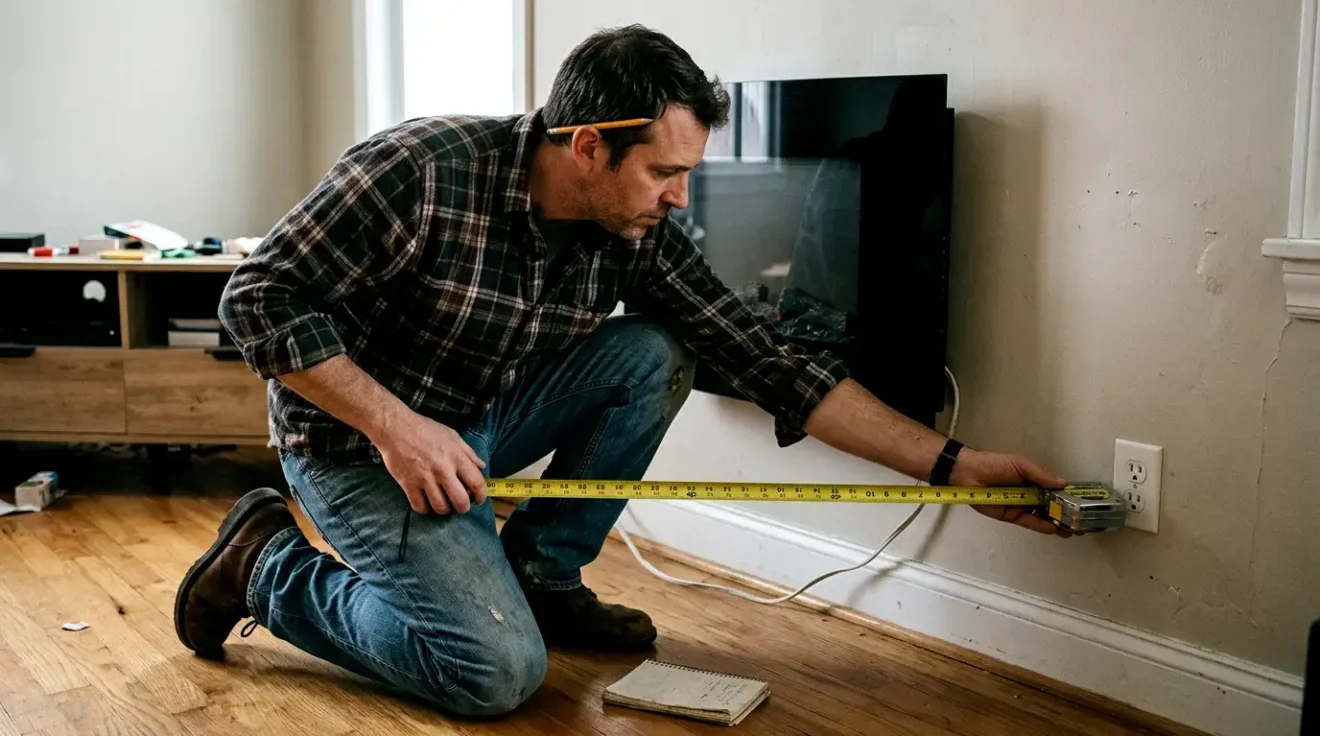
Before mounting the fireplace, use the actual appliance dimensions and cord-entry position to confirm the routing. The straight-line distance between the fireplace and socket is not enough: bends around furniture and the final mounting height affect the length required.
Five checks before choosing the fireplace wall
- Measure the supplied cord: Record its usable length and the location of the plug connection or cord exit on the appliance.
- Map the socket: Mark the outlet and proposed fireplace position on a room sketch, including the intended cable route.
- Verify electrical suitability: Check the appliance rating, manufacturer circuit requirements and available supply; record whether an electrician must assess or install an outlet.
- Inspect the proposed route: Confirm that the cord can reach without tension, extension leads, floor crossings, compression or contact with hot surfaces; note any obstruction.
- Confirm the final arrangement: Produce a simple installation sketch showing the mounting position, accessible outlet and safe cable concealment before drilling.
Once electrical access is confirmed, fireplace height can be selected according to how the flames should appear and how the heater will serve seated occupants.
Low-Mounted or Eye-Level Electric Fireplace for a Contemporary Living Room?
A low-mounted electric fireplace generally suits a traditional hearth arrangement, while a higher wall-mounted position can emphasize the flame display in a contemporary feature wall. Neither position is universally better. The right height depends on the heater outlet, seating position, television arrangement and manufacturer clearances, which must take precedence over styling preferences.
For homeowners choosing between these positions, the fireplace’s primary role provides a useful starting point. A decorative installation may benefit from a higher flame display, whereas a fireplace below a television or within a mantel-style feature often looks more balanced nearer floor level.
The practical differences are easier to assess side by side.
| Placement factor | Low-mounted fireplace | Eye-level fireplace |
|---|---|---|
| Visual character | Creates a hearth-like appearance and grounds the furniture arrangement. | Creates a prominent wall feature with flames closer to the natural line of sight. |
| Heating experience | May deliver warm air around lower body level, depending on outlet design. | May direct warm air closer to the torso or above seated occupants, depending on mounting height. |
| Furniture interaction | Coffee tables, sofas and low cabinets may obstruct the outlet or flame display. | Usually avoids low-level furniture, but can conflict with wall-mounted televisions or artwork. |
| Viewing comfort | Works well when the flames remain visible over nearby furniture. | Works well when flames can be enjoyed without repeatedly looking upward. |
| Installation constraints | Requires compliance with model-specific floor and combustible-material clearances. | Requires compliance with mounting instructions and clearances above, below and around the appliance. |
Heater outlet location is more important than decorative height alone. A front-facing outlet on a higher installation may send warm air toward seated occupants, while a top outlet behaves differently. A very low outlet can be ineffective if a coffee table intercepts the airflow, even though warm air naturally rises after discharge.
Test the proposed height from the main sofa before fixing the appliance. Sit in a normal relaxed position and check whether the flame display is comfortably visible. Then examine the outlet direction to determine whether heated air would travel toward the legs, torso or an unoccupied part of the room.
A higher fireplace can become visually dominant on a narrow wall. A low installation, by contrast, may appear disconnected from the room’s main focal point if the surrounding wall is left largely empty. Proportion and furniture relationships are therefore part of the decision.
Mounting clearances cannot be reduced to a universal measurement. The model-specific manual must determine minimum distances from floors, surrounding surfaces and combustible materials. In particular, a model designed for fixed mounting must not be assumed safe to operate freestanding on the floor.
The chosen height should improve both viewing and heat delivery without weakening installation safety. Nearby window treatments are an especially important consideration when assessing a wall.
Why Placing an Electric Fireplace Too Close to Curtains Can Be Unsafe
Placing an electric fireplace too close to curtains can create a fire hazard because the heater outlet and nearby surfaces may become hot during operation. Curtains can enter the heat path or obstruct ventilation, even when the appliance has no open flame. Safe positioning requires measuring the manufacturer’s specified clearances against the curtains’ actual movement and hanging position.
Electric fireplaces do not burn fuel to create their flame effects, but models with electric heating elements still generate substantial heat. Hot air discharged through an outlet can expose nearby fabric to temperatures it was not designed to withstand. Depending on the appliance and fabric, prolonged exposure may cause deterioration or create an ignition risk.
The US Consumer Product Safety Commission heating safety recommendations, published January 23, 2026, advise maintaining at least 3 feet (approximately 0.9 m) between portable heaters and combustible materials, including drapes and furniture.
That recommendation applies to portable heaters as a category. It is not a universal installation clearance for every recessed or wall-mounted electric fireplace. The appliance’s specific requirements must be checked separately.
3 ft (0.9 m)
The US CPSC’s recommended minimum separation between portable heaters and combustible materials. Individual electric fireplaces may require different clearances according to their installation manuals.
US Consumer Product Safety Commission, January 2026 consumer heating safety guidance.
A common planning mistake is measuring from the window frame rather than from the curtain’s actual position. Drapes can extend beyond the frame, gather in thick folds when opened or move into the fireplace’s heat path as doors and windows are used.
For a meaningful assessment, identify the fireplace’s front, side and upper clearance requirements. Then inspect the curtains when fully drawn, fully gathered and positioned as they would be during normal use. Consider movement caused by drafts as well as the fabric’s distance from the outlet.
Heat exposure may also affect appearance and durability before an obvious safety incident occurs. Depending on fabric composition and temperature, possible warning signs include discoloration, distortion or damaged fibers. These changes are reasons to reassess placement, not reliable indicators that a particular distance is safe.
Where fixed curtains prevent compliance, consider a different wall or an alternative window treatment. Blinds or roller shades may improve the available space when fully retracted, provided their materials and positions still meet the appliance’s clearance rules. Shortening curtains alone does not necessarily resolve the risk from projected warm air.
Windows affect more than fire safety: large glazed doors can also change how comfortable a fireplace feels and where its warmth is most useful.
How to Position an Electric Fireplace in a Room With Large Patio Doors?
In a living room with large patio doors, a solid side wall facing the seating area is often a practical starting point for electric fireplace placement. This arrangement can direct warmth across occupied space while keeping door access unobstructed. The best final position depends on the glazing’s heat loss, drafts, furniture layout, electrical access and the fireplace’s installation requirements.
Large glazed areas can influence indoor comfort because heat transfers through glass and air may leak around poorly sealed frames. Occupants near cold glazing may feel cooler even when the room’s air temperature appears satisfactory.
The US Department of Energy residential window performance guidance identifies thermal transmittance and air infiltration as important influences on heating demand and comfort. Lower heat transfer and reduced air leakage can improve conditions, although the magnitude depends on the window, climate and installation quality.
For rooms where patio doors occupy most of one wall, the longest suitable solid wall perpendicular to the glazing is worth evaluating first. It may allow the fireplace to face the main seating zone without obstructing circulation or directing its output immediately toward an exterior opening.
This is a layout recommendation rather than a proven universal heating optimum. A well-insulated room with high-performance patio doors may perform comfortably with the fireplace on a different wall. Heater type and furniture position still matter.
Placing the fireplace immediately beside poorly sealed doors can be less useful when drafts affect the heating zone. Similarly, positioning a small supplemental heater across a large open-plan room does not guarantee that it will compensate for glazing-related heat losses.
Where the patio-door wall dominates the room, several alternatives may be considered:
- Adjacent return wall: A compact wall-mounted or suitable corner installation can preserve the glazed opening while directing heat toward nearby seating.
- Short internal partition: A fireplace designed for that mounting arrangement may create a focal point without competing with the doors.
- Freestanding appliance: A model specifically approved for freestanding use can offer flexibility, provided it remains stable and clear of walkways, combustible materials and door movement.
Always verify whether the patio doors swing inward, outward or slide along a track. Their full operating range must remain accessible. Furniture used to conceal a fireplace cable should not interfere with handles, tracks, emergency exit routes or normal movement through the opening.
Socket placement also requires attention. An outlet near the door may appear convenient but become impractical if connecting the fireplace would place a cord across the walking route or behind moving furniture.
Finally, consider the room envelope itself. Weather sealing and glazing performance may influence comfort more than small adjustments to fireplace orientation. An electric fireplace intended for supplemental warmth should not be treated as a substitute for addressing significant drafts or heat losses.
After choosing a position that works with glazing and circulation, check whether the intended enclosure leaves enough space for the appliance to operate without overheating.
How to Maintain Airflow Around an Electric Fireplace That Needs No Flue?
An electric fireplace that needs no flue still requires unobstructed airflow around its intake and heat outlet. Because it does not produce combustion exhaust, it needs no chimney for fumes, but its heating and electrical components must dissipate heat safely. Maintaining the model’s specified ventilation openings and installation clearances helps prevent overheating and unnecessary heater shutdowns.
The term flueless can be misleading when planning a built-in fireplace. It means that combustion gases do not need to be vented outdoors. It does not mean the appliance can be enclosed without regard to the air circulation required by its heating system.
Different models place their intake and exhaust grilles in different locations. A front-venting wall-mounted unit may have different enclosure needs from a recessed design with designated internal airflow paths.
Before finalizing the installation, locate the intake and outlet on the actual appliance and compare them with the manufacturer’s instructions. Inspect nearby media cabinets, television equipment, shelves, decorative trim and any proposed wall recess for potential obstruction.
The Modern Flames Orion Slim installation manual offers a concrete product-specific example. For its listed models, the manual specifies a minimum recessed-opening depth of 6 inches (152 mm) and an appliance depth of approximately 6-5/16 inches (160 mm). It also requires the air intake and exhaust openings to remain unobstructed.
Those figures illustrate why installation drawings must be read carefully: opening dimensions, overall appliance dimensions and ventilation requirements are separate specifications that must be reconciled using the complete manufacturer instructions. They must not be transferred to other products.
The same manual lists a minimum vertical clearance of 11.8 inches (300 mm) between the fireplace top and certain features above it, including a television, mantel or ceiling, for its specified configuration. Its listed zero-clearance values at other surfaces do not permit blocking vents or placing combustible objects in the heater’s airflow path.
In a custom media wall, confirm the required enclosure construction, recess depth, ventilation provisions and electrical access before the surrounding structure is finished. Some appliances are designed for particular recessed configurations, while others require an installation that remains open around designated sections.
“This product is not intended to be a primary heat source. It is for supplemental heat only.”
A fully sealed surround that conflicts with the installation instructions can trap heat or restrict cooling airflow. The resulting high temperatures may activate a thermal protection system or cause an overheating warning. This is a possible installation fault, not proof that every enclosed media wall will overheat.
If the heater repeatedly shuts down unexpectedly, switch it off and follow the troubleshooting instructions. Check for blocked openings and inappropriate surrounding materials after the appliance has cooled. Do not bypass thermal protection or assume recurring shutdowns are harmless; continued overheating can place stress on internal components.
Ventilation requirements become particularly important when the fireplace shares a feature wall with sensitive electronic equipment, including televisions.
How to Position a Television Beside a Fireplace on a Wide Living Room Wall?
On a wide living room wall, placing the television beside the electric fireplace can maintain comfortable screen height while separating the display from the heater’s main airflow path. Start by observing the manufacturer’s clearance requirements, then divide the wall into two functional zones. A shared console, consistent finish or coordinated framing can make the arrangement visually cohesive.
Heat management should determine the initial layout. A television must remain outside the fireplace’s restricted clearance areas and should not sit directly in a stream of heated air. Electronics can be affected by excessive temperatures even without touching the heater.
Side-by-side placement is often convenient because it reduces the need to position a screen directly above the fireplace. However, it does not automatically eliminate thermal concerns. Side-facing vents, nearby warm-air outlets or restricted air circulation can still create conflicts, depending on the appliance.
For a balanced installation, imagine the wall divided into a media zone and a fireplace zone. Position the television where it can be viewed comfortably from the primary sofa, then locate the fireplace in the remaining suitable area without compromising clearance or circulation.
A continuous low media console can help connect the two visually, but it must not obstruct heater outlets. A consistent wall finish, carefully aligned edges or coordinated recesses can also create a unified composition without requiring both devices to be stacked.
The fireplace and television do not need to have identical widths or heights. Their visual relationship is more important: one element can anchor the entertainment area while the other provides atmosphere and supplemental warmth.
Electrical planning should account for both appliances separately. Each must have an appropriate power connection consistent with its electrical requirements. Do not solve an inconvenient layout by connecting the heater through a shared extension strip or an overloaded power arrangement.
In a custom installation, allow for maintenance access to both electrical connections and the fireplace’s serviceable components. Concealed wiring must use methods appropriate to the installation and local electrical rules.
Fan noise is another practical consideration. If the electric fireplace uses a blower, its sound may become noticeable during quiet television scenes. Before mounting, compare the fireplace’s operating noise with the intended speaker arrangement, if the appliance can be tested safely in an approved operating configuration.
A side-by-side layout is particularly effective when it preserves comfortable television viewing and allows the fireplace to face an occupied part of the room. If the fireplace ends up behind the main sofa or directed toward an empty corner, the visual benefit may come at the expense of heating comfort.
The same principles apply to smaller rooms, but limited wall width and floor space make fireplace dimensions and installation depth more influential.
Key takeaways before choosing a compact fireplace
- Decide whether the room’s main limitation is available wall width, usable floor area or the depth needed for a recessed installation.
- Compare heater coverage and flame visibility separately; a compact appliance may suit the design without delivering the desired level of supplemental warmth.
- Scale the fireplace to surrounding furniture and preserve usable circulation space instead of choosing dimensions solely for visual impact.
Are Slim-Profile Electric Fireplaces Suitable for Small Modern Living Rooms?
Slim-profile electric fireplaces can work well in small modern living rooms because their reduced depth can preserve floor space and support a clean, wall-mounted design. However, suitability depends on the appliance’s actual dimensions, heating capacity, required clearances and electrical connection. A slim appearance alone does not establish equal or inferior heating performance compared with deeper models.
Reduced depth is the principal design advantage. A shallow wall-mounted fireplace may project less into the room than a conventional mantel arrangement, leaving more space for seating and movement. A recessed unit can create an even more integrated appearance when the wall construction and appliance specifications permit it.
The internal design still matters. Heater output, flame presentation, air intake and outlet configuration vary between models. Some slim units offer substantial decorative flame displays, while others prioritize compact proportions. It is therefore important to compare the stated electrical input, heat output, intended coverage and flame effect rather than treating depth as a direct measure of performance.
For a small room, three configurations deserve consideration:
- Wall-mounted slim fireplace: Keeps the floor clear and can sit above a low console where the manufacturer’s clearances allow.
- Recessed electric fireplace: Produces a streamlined architectural finish but requires appropriate wall depth, installation space and airflow provisions.
- Compact freestanding electric fireplace: Avoids certain fixed-installation constraints and may be easier to reposition, but occupies floor space and must be specifically designed for freestanding operation.
Before purchasing, measure the usable wall width and the appliance’s complete depth, including any required mounting arrangement. Confirm that the supplied power connection can reach a suitable outlet and that the front clearance can be maintained without intruding into a narrow walkway.
Check the manufacturer’s stated heating coverage against the room’s actual needs. Coverage figures are useful for initial comparison but cannot guarantee comfort in rooms with large glazed areas, frequent drafts or unusual ceiling heights.
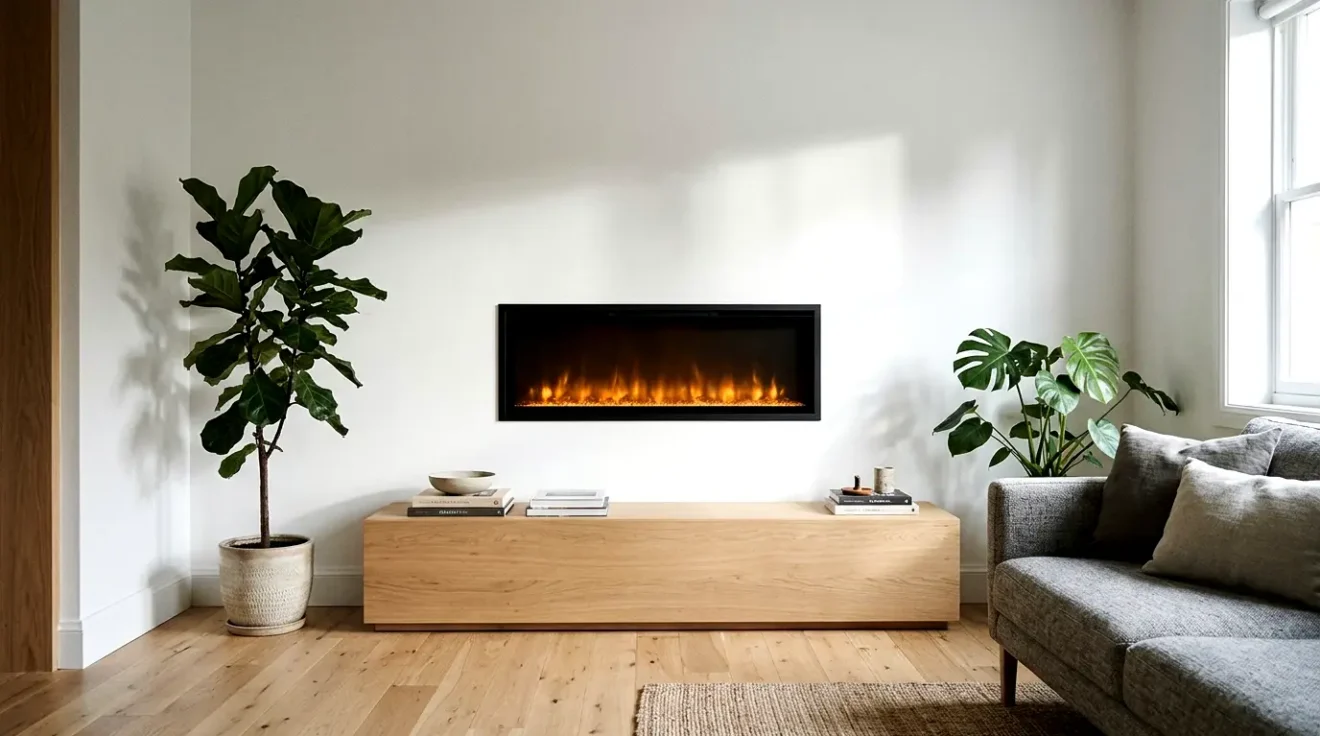
Visual proportion is especially important when wall space is limited. A narrow fireplace on an expansive blank wall may appear disconnected from the rest of the furniture, while an excessively wide unit can overwhelm a compact living room.
Use the width of an existing console, the available solid wall and the main sofa as visual references. The fireplace does not need to match any of them exactly, but its proportions should create a deliberate relationship with the surrounding arrangement.
A slim fireplace can become an effective focal point without taking over the room. Restraint in surrounding furniture, adequate wall space and a clear view of the flames often contribute as much to the final appearance as the fireplace itself.
For recessed designs, remember that a visually flush installation may still require significant internal wall space. Do not assume a shallow-looking appliance can be installed into a thin partition without checking structural, electrical and ventilation requirements.
To make the final decision, shortlist the walls that provide suitable electrical access and manufacturer-compliant clearances, then test each location from the main seating position. Compare the appliance’s dimensions and heating specifications with the room before fixing the mounting height or approving any building work.
Can an electric fireplace be installed in a bedroom?
Yes, if the specific model is suitable for bedroom installation and its electrical, mounting and clearance requirements can be met. Keep bedding, curtains and furniture away from the heating outlet. Follow the manufacturer’s operating instructions, particularly those concerning unattended use, sleeping and any automatic shutoff or timer functions.
Can an electric fireplace be installed beneath a shelf or mantel?
It may be possible when the manufacturer explicitly permits the arrangement. Check the required vertical separation, mantel material, outlet location and airflow requirements. Some models discharge heat through their upper section, making the shelf position particularly important. Never assume a decorative mantel is safe simply because the appliance has no real flames.
Does an electric fireplace need its own electrical circuit?
Not every electric fireplace has identical circuit requirements. Some manufacturers specify a dedicated circuit, while other products have different electrical instructions. Check the appliance rating and installation manual, then have the existing supply assessed where necessary. Requirements also differ between countries using different voltage systems and wiring standards.
Can an electric fireplace be installed on an exterior wall?
Yes, an exterior wall may be suitable if it supports the appliance correctly and meets the installation, electrical and clearance requirements. Thermal comfort depends on the wall’s insulation, air leakage and nearby glazing rather than its exterior location alone. For a recessed installation, consider the effects of altering insulation or air barriers and obtain appropriate professional advice.
Can the flame effect run without the heater?
Many electric fireplaces offer separate flame-display and heating controls, allowing the visual effect to operate without active space heating. This feature varies by model, so verify it in the product specifications. A flame-only mode offers greater flexibility for decorative placement, but electrical safety, mounting stability and applicable ventilation instructions still need to be respected.