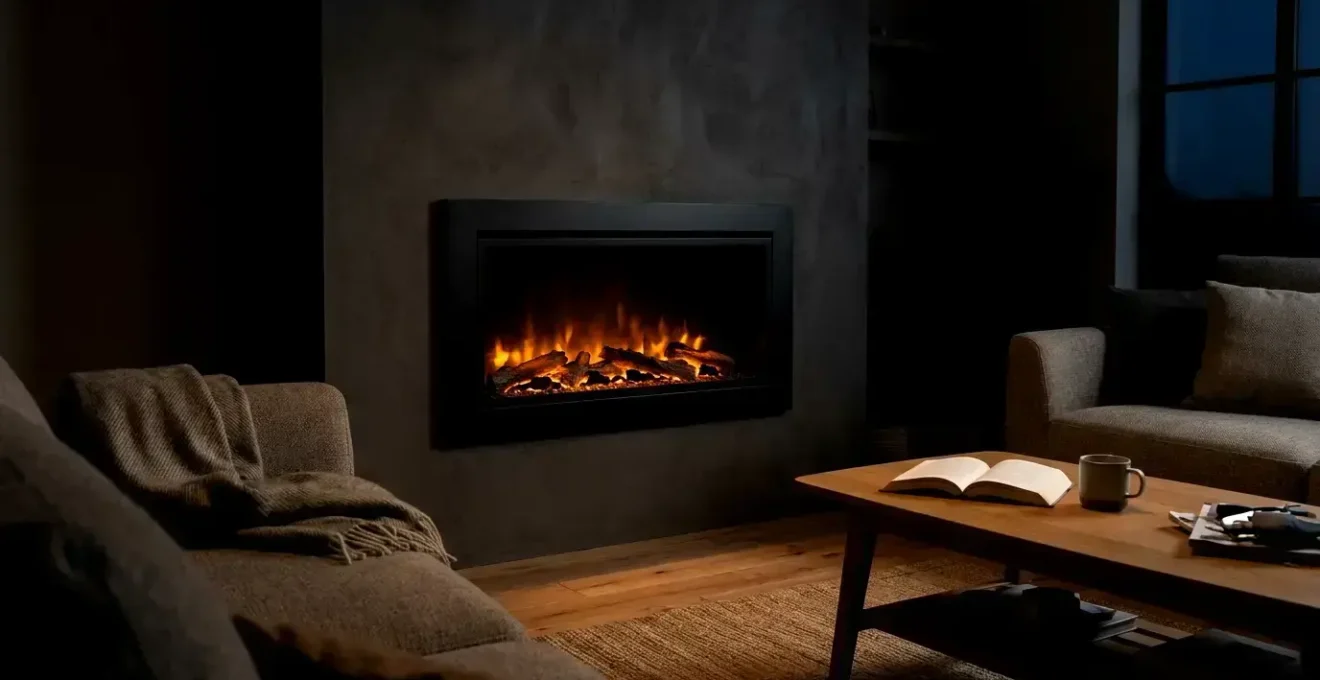
Modern electric fireplaces can produce surprisingly convincing flames, particularly in softly lit rooms where warm colours, moving light and glowing embers combine to suggest a real wood fire. However, realism varies considerably between models. Some LED flame effects resemble a moving image behind glass, while others create a stronger impression of depth through carefully arranged optical components.
The difference is not simply a matter of price or LED brightness. Projection design, flame movement, fuel-bed materials, glass reflections and the surrounding room all influence whether an electric fire feels natural or noticeably artificial.
For homeowners seeking the atmosphere of a traditional fireplace without combustion, the most convincing option is usually the one that maintains believable flame movement and visual contrast from the actual seating position. A spectacular showroom demonstration does not necessarily translate into a comfortable evening display.
Understanding how these effects work makes it easier to compare electric fireplaces, identify their visual limitations and choose settings that enhance realism rather than exaggerate the technology.
LED Fireplace Flame Realism: What Matters Most
- Depth matters more than brightness: layered reflections, realistic movement and an irregular ember bed usually create a stronger fire illusion than intensely illuminated flames.
- Room conditions change the result: subdued ambient lighting, warm colours and controlled reflections can significantly improve perceived realism.
- Technology involves trade-offs: conventional LED projection offers convenient, low-maintenance ambience, while illuminated water mist can create a more spatial flame effect but requires additional care.
- Why Do Some LED Fireplace Flames Look More Three-Dimensional Than Others?
- How to Set LED Fireplace Flames for a Natural-Looking Evening Display?
- LED Projection or Holographic Flame Effects: Which Suits a Modern Electric Fireplace?
- Why Extremely Bright Electric Fireplace Flames Can Look Artificial
- How to Make LED Flames Look More Convincing With Logs or Crystal Embers?
- Why Does Daylight Glare Make a Glass-Fronted Fireplace Harder to See?
- Electric Flame Display or Water-Vapour Fire Feature for a Modern Apartment?
- Are Slim-Profile Electric Fireplaces Suitable for Small Modern Living Rooms?
Why Do Some LED Fireplace Flames Look More Three-Dimensional Than Others?
Some LED fireplace flames appear more three-dimensional because their optical systems create separate visual layers rather than displaying all movement on one flat surface. Reflectors, projection panels, illuminated logs and carefully positioned light sources can create apparent depth. The result depends on their arrangement, the viewing angle and the physical space available inside the firebox.
Conventional electric fireplaces often use LEDs to illuminate moving reflective elements. A rotating mechanism changes the direction of reflected light, producing the characteristic flickering flame pattern. Other designs combine reflected light with partially transparent panels or background scenery, giving the eye multiple surfaces to interpret.
Dimplex’s technical service manual on electric fireplace technologies documents distinct Optiflame and Revillusion arrangements involving LEDs, rotating components and flame projection onto glass. These examples demonstrate that LED flame simulation can use different optical architectures rather than a universal projection mechanism.
More LEDs do not automatically mean greater realism. Their position, distribution and interaction with reflective surfaces can be more important than the number of light sources.
Perceived flame depth also differs from the physical depth of the fireplace. A deep decorative log bed can make a relatively flat flame image feel more substantial, while a genuine multilayer projection system may appear less dimensional when viewed from an unfavourable angle.
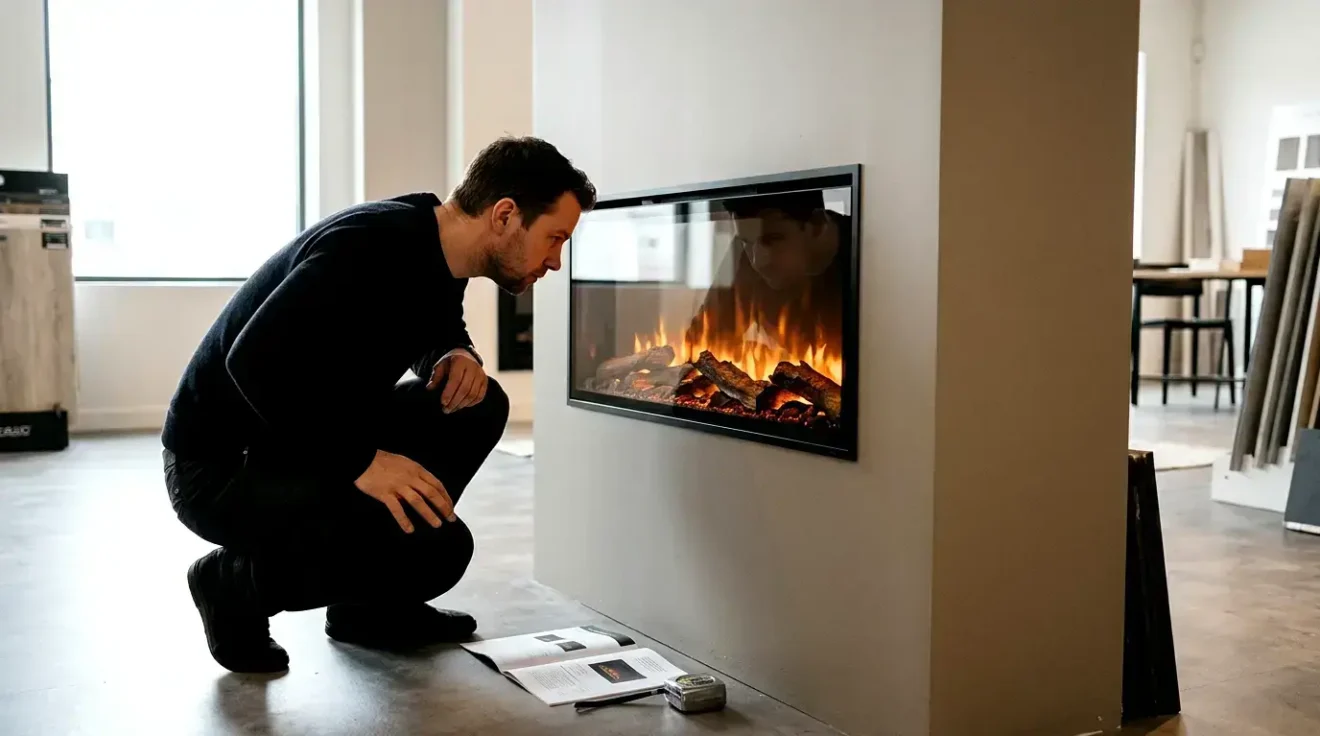
A useful showroom comparison involves observing the same fireplace from three positions: directly ahead, slightly to the left and slightly to the right. Repeat the observation from the intended seating distance and from closer to the glass.
Look for changes in the apparent relationship between flames, logs and background elements. If everything moves together like a single flat picture, the effect may have limited apparent depth. If different elements seem spatially separated, the optical design may provide stronger dimensional cues.
This is a practical visual assessment, not a definitive test of the number of projection layers. Reflections and viewing geometry can make even a multilayer effect look flat from certain positions.
Firebox depth places additional constraints on optical design. A shallow insert provides less room for physically separated components, although compact optical arrangements can still produce convincing results.
Background finishes also influence perception. A reflective rear panel may introduce additional light patterns, sometimes making the scene appear richer but potentially creating obvious duplicated flames. A matte black background suppresses unwanted reflections and can emphasise individual flame shapes, though it may also reveal a simple projection more clearly.
Ultimately, realistic depth is not determined by a single component. It emerges from the interaction between optical construction, fuel-bed arrangement and viewing conditions. Once those elements work together, adjusting the display becomes the next important step.
How to Set LED Fireplace Flames for a Natural-Looking Evening Display?
For a natural-looking evening display, begin with low flame brightness, warm amber or orange colours and slower movement where the controls permit it. Reduce competing room lighting while keeping enough illumination for comfortable use. Adjust the settings from the normal seating position, because realistic flames depend on the contrast between the display and its surroundings.
Real wood flames do not illuminate every part of a firebox equally. Their brightness changes continuously, with darker spaces between glowing regions and an irregular ember bed beneath. An electric fireplace looks more believable when its settings preserve some of that variation.
A practical evening adjustment follows this sequence:
- Lower the flame brightness. Start at the lowest clearly visible setting, then increase it only until the movement is comfortable to follow.
- Reduce flame speed if adjustable. Compare the available speeds and select the one that resembles irregular, unhurried combustion rather than a fast repeating animation.
- Choose warm flame colours. Amber, yellow-orange and deeper orange tones generally support the visual impression of burning wood.
- Dim competing lights. Reduce overhead lighting and nearby decorative lighting, keeping appropriate task or safety lighting where needed.
- Reassess from the sofa. Check whether the flame and fuel bed remain visually balanced during normal viewing.
The important variable is relative brightness. A low setting that appears convincing in a dark room may become barely visible during the day. Conversely, a setting that performs well under strong ambient lighting may look excessively vivid in the evening.
Blue, purple and multicolour effects can be attractive in contemporary interiors, but they generally function as decorative lighting rather than a realistic representation of burning wood.
Pay particular attention to the relationship between the flame silhouette and the glowing fuel bed. When separate controls are available, a modest flame setting with a subtly illuminated log bed can create a more convincing visual balance than maximum brightness across both elements.
Heating behaviour deserves consideration as well. Some fireplaces allow their flame display to operate independently of the heater, while others have controls or automatic behaviours that may affect the experience. Fan noise, changes in lighting or repeated thermostat cycling can interrupt an otherwise calm atmosphere.
Before buying, check whether the selected flame settings remain unchanged when the heater switches on or off. A demonstration of this feature is more informative than relying on a promotional photograph.
Five Checks for a Convincing Evening Flame Display
- Test the lowest usable flame brightness and record the selected level.
- Compare available flame speeds and note the setting that looks least repetitive.
- Select a warm amber or orange mode and save its name or control position.
- Adjust the ember-bed lighting separately, where supported, and photograph the resulting balance from the sofa.
- Switch the heater through its normal operating modes and confirm whether flame settings remain stable; record any changes.
These adjustments cannot overcome every limitation of the projection system, but they can improve the appearance of an already capable fireplace. Homeowners seeking substantially more depth may need to compare different flame-generation technologies rather than continue adjusting the same display.
LED Projection or Holographic Flame Effects: Which Suits a Modern Electric Fireplace?
LED projection is generally the more straightforward choice for homeowners who want convincing ambience with minimal routine maintenance. Advanced holographic displays and illuminated water-vapour systems can offer stronger impressions of depth, but they are not the same technology. Water-vapour fireplaces create illuminated moving mist, while holographic systems use optical imagery; their maintenance requirements and visual characteristics differ.
Traditional LED projection commonly relies on illuminated reflective components, moving mechanisms and projection surfaces. The resulting flame is an optical illusion that can appear highly effective from the intended viewing direction, especially behind a realistic log bed.
Holographic is a term that requires careful interpretation. Some products use digital imagery and optical arrangements described as holographic without producing a flame that physically occupies the space in front of the display. Marketing terminology alone cannot establish whether the effect is genuinely volumetric.
Water-vapour systems work differently. An ultrasonic transducer generates fine mist that is illuminated to resemble rising flames. Because the mist occupies physical space and moves through the air, the illuminated effect can look spatially convincing from multiple viewpoints.
However, mist is not combustion. Its movement, brightness and appearance depend on the specific appliance, airflow, lighting and operating conditions.
The following comparison distinguishes the main practical considerations.
| Criterion | Conventional LED projection | Illuminated water vapour |
|---|---|---|
| Flame mechanism | Moving or projected light on optical surfaces | Illuminated mist generated by a water-based system |
| Perceived depth | Depends on optical layers and viewing position | Physical mist can provide stronger spatial depth |
| Routine maintenance | Generally limited to appropriate cleaning and inspection | Water replenishment and periodic cleaning required |
| Room moisture | No moisture generated by the flame effect | Releases water mist into the surrounding air |
| Sound | May include mechanism or heater-fan noise | May include operating sounds from mist-generation components |
| Heat | Depends on the integrated heater | Depends on whether the product includes a heater |
| Best suited to | Convenient everyday ambience and optional heating | Design-led installations prioritising a spatial flame effect |
Budget comparisons should be made between complete installed systems rather than flame technologies in isolation. Product size, finish, heating capability, installation requirements and control features can all influence cost.
Water-vapour features also introduce considerations absent from conventional dry LED displays. Water quality affects maintenance requirements, while inadequate cleaning can contribute to deposits within water-contact components. The potential for visible residue on nearby surfaces depends on the equipment, water and operating conditions; it should not be assumed to occur with every model.
Some installations combine different visual techniques to create a more elaborate effect. However, a product advertised with advanced projection does not necessarily include illuminated mist. Buyers should verify the actual components and whether the required features are included in the quoted configuration.
The decision is ultimately about priorities. A fireplace used frequently for supplemental heat may favour a simple LED system, whereas an installation intended primarily as a visual centrepiece may justify a more involved flame mechanism.
Technology alone does not guarantee realism. Even sophisticated flame effects can appear artificial when displayed at unsuitable brightness levels, making light control an essential part of the final result.
Why Extremely Bright Electric Fireplace Flames Can Look Artificial
Extremely bright electric fireplace flames can look artificial because excessive illumination reduces the contrast between bright flame regions and darker spaces. Real fire contains irregular light, shadows and changing intensity. When an LED effect becomes uniformly bright and highly saturated, the eye may interpret it as an illuminated graphic rather than a naturally moving flame.
Real combustion produces constantly changing flame shapes and pockets of darkness. Its brightness is uneven across the burning material, with separate regions of flame, ember glow and shadow.
An electric fireplace must reproduce this impression using controlled light. Increasing every illumination element simultaneously can obscure the subtle differences that make the effect believable.
Strong brightness is not necessarily evidence of poor design. In a brightly illuminated showroom, a conspicuous flame setting makes the product easier to notice. Online demonstrations introduce further complications because camera exposure, display settings and video compression can change how the flame appears.
Consequently, the brightest showroom setting should not be treated as a recommendation for normal evening use.
A better adjustment method begins with the flame itself. Reduce its brightness until distinct moving regions and darker gaps become visible. If the appliance provides independent controls, adjust the ember-bed illumination next, followed by any overhead or downward-facing accent lighting.
This creates a more plausible visual hierarchy: the burning material appears to glow, while the flames rise above it rather than behaving like a uniformly illuminated screen.
Visual comfort matters alongside realism. A highly luminous fireplace against a dark wall can become a distracting bright area, particularly during television viewing or extended periods of relaxation.
Whether it causes discomfort depends on luminance, viewing distance, surrounding lighting and individual sensitivity. There is no basis for assuming that a particular LED brightness setting will cause visual fatigue in every viewer.
For a practical assessment, observe the fireplace for a normal viewing period rather than judging it immediately after switching it on. If the display continually draws attention away from the rest of the room or produces bothersome glare, reduce its brightness or adjust the surrounding lighting.
Warm colour does not compensate for excessive intensity. A bright orange flame can still look artificial if its movement and internal contrast are poorly defined.
Reducing brightness is often an effective first correction, but the appearance of the fuel bed matters just as much. Logs, crystals and other decorative media determine how the light is distributed beneath the simulated flames.
How to Make LED Flames Look More Convincing With Logs or Crystal Embers?
LED flames often look more convincing when the decorative fuel bed creates irregular pools of light rather than a uniformly illuminated surface. Resin logs, ceramic-style media and glass crystals reflect and scatter light differently. Carefully positioned logs with visible gaps can suggest natural combustion, while crystals produce a brighter, more decorative effect suited to contemporary interiors.
The fuel bed is more than a visual accessory. Its shapes, textures and surface finishes influence how light emerging from the fireplace is perceived.
Matte, textured logs tend to create softer highlights and darker recesses. Translucent or reflective crystals can produce stronger points of light, making the ember bed appear luminous but also emphasising its artificial construction.
For a realistic wood-burning appearance, asymmetry is particularly useful. Real logs rarely form a perfectly uniform pattern, and combustion does not illuminate every piece of wood identically.
Where the manufacturer allows rearrangement, consider the following principles:
- Leave small visible gaps between approved decorative logs so light can emerge from different positions.
- Vary log heights and orientations within the permitted arrangement to avoid an overly symmetrical pattern.
- Use darker and lighter log surfaces to create contrast between shadowed and glowing regions.
- Keep bright crystal media concentrated where their reflections enhance the intended effect rather than overwhelming the flame image.
These are visual arrangement principles, not permission to modify an appliance internally. Some fireplaces have fixed or prescribed media layouts. Never block ventilation, alter electrical components or place unapproved materials near heating elements.
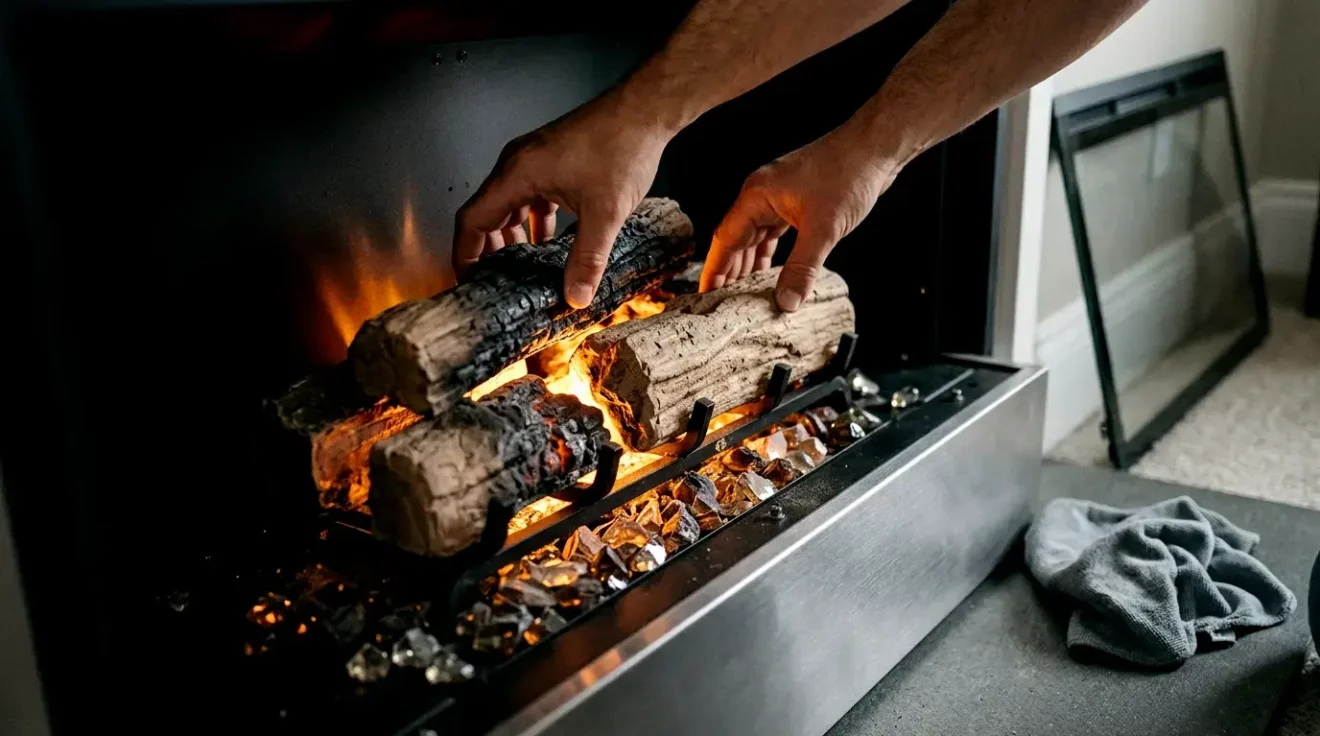
Resin logs are generally appropriate when the desired result is a traditional wood-fire illusion. Their silhouettes provide familiar visual cues, especially when combined with amber light and restrained flame movement.
Crystal embers are more consistent with a contemporary decorative fireplace. Their reflective surfaces distribute light into sparkling highlights. This can be visually appealing, but it does not necessarily make the display resemble real burning wood.
A mixed arrangement can offer a compromise when expressly supported by the manufacturer. Darker log shapes provide visual structure while selected translucent pieces introduce variation in the glowing bed.
Maintenance also affects the result. Dust collecting on textured logs can obscure fine surface details, while fingerprints and residue on crystal media can change their reflective appearance.
For compatible removable media, cleaning with a soft, dry cloth may be suitable. Always follow the manufacturer’s instructions, disconnect power when required and allow heated components to cool before maintenance. Avoid applying cleaning liquids directly to electrical or optical components unless specifically permitted.
Assess the arrangement with the front panel correctly installed, because reflections and glass transmission can change the final appearance.
Even a carefully constructed fuel bed cannot overcome every viewing problem. Daylight reflected from the fireplace glass can conceal much of the effect, making room placement a critical consideration.
Why Does Daylight Glare Make a Glass-Fronted Fireplace Harder to See?
Daylight glare makes a glass-fronted electric fireplace harder to see because the glass reflects bright windows, doors and other illuminated surfaces into the viewer’s line of sight. These reflections compete with the relatively faint LED flame image behind the glass. As reflected brightness increases, the contrast needed to distinguish flame shapes and movement decreases.
A glass fireplace front serves two visual functions simultaneously: it transmits light from the display and reflects some light from the room. The relative strength of those contributions determines whether viewers primarily notice the flames or the surroundings reflected in the glass.
On a sunny day, a bright window may become the most conspicuous feature reflected across the fireplace. The LEDs can remain fully operational while their visual impact becomes substantially weaker.
The underlying principle is documented in Lawrence Berkeley National Laboratory’s daylighting reference, which describes how bright reflections on shiny surfaces can reduce contrast and impair visibility. The report addresses lighting and visual performance in buildings, not specific electric fireplace models, but the optical principle is relevant.
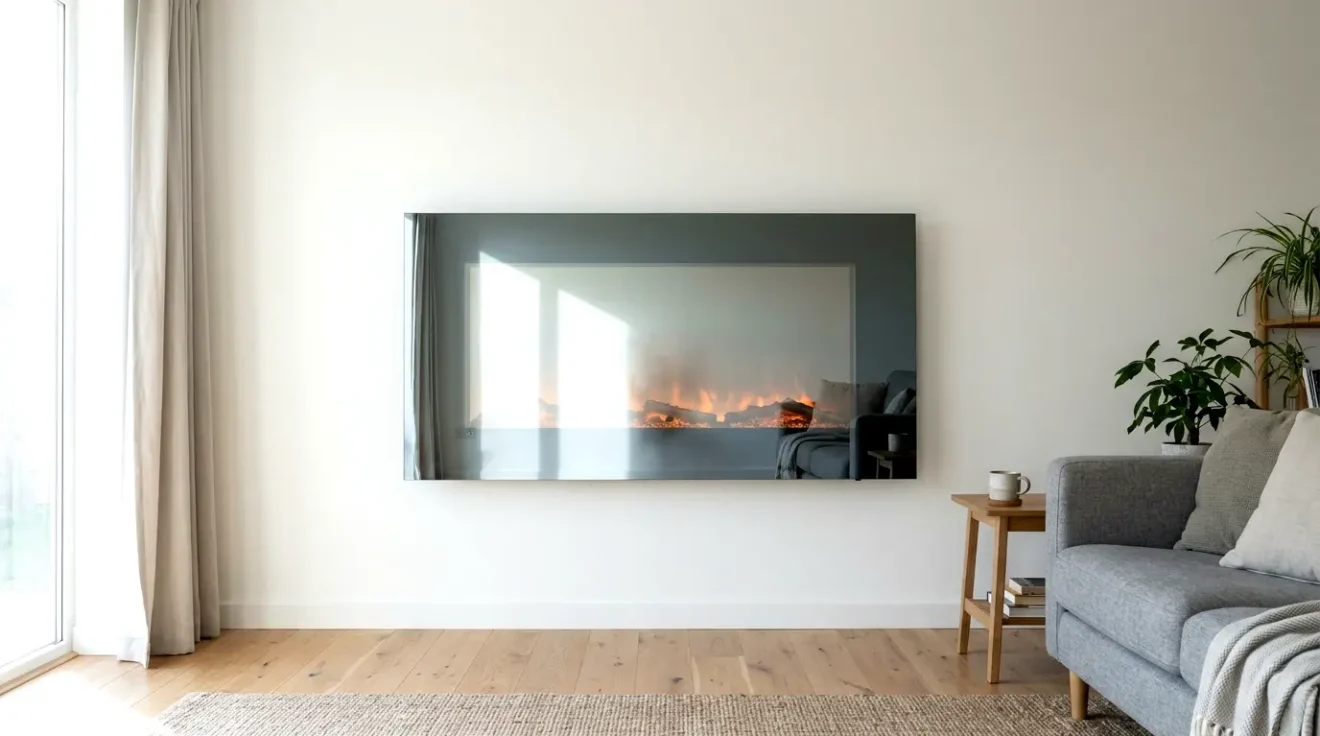
Fireplace positioning can reduce this problem. Installing the unit on a wall perpendicular to the main window may redirect unwanted reflections away from the usual viewing position. However, the outcome depends on the room geometry and should be checked rather than assumed.
Angled or recessed glass can also change where reflections appear. Certain anti-reflective treatments may reduce unwanted reflection, while curved glass can redistribute reflected images across different directions. These features have model-specific benefits and limitations; a curved surface is not automatically less reflective in every room.
Before purchasing, conduct a simple location assessment. Sit where the fireplace will normally be viewed and identify the bright windows, doors and ceiling lights that would be reflected by a glass surface on the proposed wall.
A temporary reflective panel held at the approximate installation position can help illustrate competing reflections, although it will not perfectly reproduce the optical behaviour of the finished appliance.
When evaluating a fireplace in person, compare its appearance under both subdued lighting and stronger ambient light. Ask whether the exact glass configuration being demonstrated matches the model intended for purchase.
Flat glass can provide a clear, direct view of the flames in favourable lighting. Anti-reflective surfaces or alternative glass shapes may offer useful improvements, but their effects should be assessed for the particular installation rather than inferred from the product category.
Lighting and reflections become particularly important in apartments, where viewing distances are often short and the fireplace may share wall space with other furniture or screens. These constraints also influence the choice between conventional LED displays and water-vapour alternatives.
Electric Flame Display or Water-Vapour Fire Feature for a Modern Apartment?
A conventional electric flame display is usually the more practical option for an apartment where easy operation, limited maintenance and occasional heating are priorities. An illuminated water-vapour feature may be more appealing when the fireplace is primarily a visual centrepiece viewed at close range. The better choice depends on space, ventilation, water maintenance and the specific appliance’s heating capabilities.
Neither conventional LED simulation nor an electric water-vapour flame effect requires a chimney for combustion exhaust, because the visual effect does not involve burning fuel. That makes both technologies potentially suitable for apartments where a traditional combustion fireplace would be impractical.
Nevertheless, an electric fireplace still requires an appropriate electrical supply, a permitted installation location and compliance with the manufacturer’s ventilation and clearance instructions.
For smaller living rooms, a standard LED fireplace offers several advantages. It does not require a water reservoir to create flames, and many models allow the visual effect to operate independently of supplemental heating.
Routine ownership is generally straightforward, although cooling fans, rotating optical mechanisms and other moving components mean that not every LED fireplace is completely silent.
Water-vapour systems offer a different viewing experience. Their illuminated mist can occupy physical space, making the effect more convincing from certain close angles than a flat optical display.
However, the mist-generation mechanism requires water, and the tank or water-contact components need maintenance according to the relevant product instructions.
The Dimplex Optimyst cassette owner’s manual specifies cleaning water-containing components every two weeks for the identified DFI400LH, DFI400RH and DFI600LH models. It also provides water-refilling and transducer-maintenance instructions. This schedule applies to those specified appliances, not automatically to every water-vapour fireplace.
In a compact, well-sealed apartment, the release of water mist also deserves consideration. Its actual impact on indoor humidity depends on the appliance’s output, operating duration, room volume and ventilation.
Rather than assuming moisture will become problematic, review the manufacturer’s operating guidance and monitor indoor humidity if necessary. Regular ventilation may be appropriate where moisture accumulates, and a lower mist-output setting can be useful when available.
Sound can influence the experience too. Some mist systems generate a faint mechanical or operational sound, but the level varies between designs. It is worth listening to a demonstration in a relatively quiet environment.
Choose according to typical use: an LED fireplace is generally sensible for convenient everyday ambience with optional heat, while a water-vapour feature can justify its greater maintenance demands when spatial flame appearance is the primary design objective.
Neither option should be assumed safe for unrestricted unattended operation. Follow the manufacturer’s operating instructions, particularly where heaters, water reservoirs or automatic shut-off features are involved.
The available installation space may ultimately narrow the decision further. In many small living rooms, a slim electric fireplace provides an attractive compromise between wall space, visual impact and practical heating.
Key Takeaways Before Choosing a Slim Fireplace
- Assess depth as well as width. A compact firebox may offer fewer opportunities for physically separated optical layers, but the actual flame design matters more than dimensions alone.
- Judge the display from the sofa. The ideal fireplace width depends on seating distance, wall proportions and whether flame movement remains convincing at the intended viewing angle.
- Check installation and heating needs separately. A visually attractive slim insert must still meet structural, electrical, airflow and clearance requirements.
Are Slim-Profile Electric Fireplaces Suitable for Small Modern Living Rooms?
Slim-profile electric fireplaces can work very well in small modern living rooms because they provide a visible flame feature without the installation depth associated with many traditional fireplaces. However, their compact construction may restrict certain flame-projection arrangements. Buyers should compare perceived depth, seating distance, heating requirements and installation clearances rather than selecting a model solely for its narrow profile.
The main advantage of a slim electric fireplace is spatial efficiency. A shallow wall-mounted or recessed unit can fit into a contemporary media wall or compact living area while maintaining a relatively wide visual display.
The trade-off is that reduced cabinet depth leaves less physical room for projection surfaces, reflective components and decorative media. In designs that rely on substantial separation between those components, this may limit the perceived depth of the flame effect.
That relationship is not universal. A carefully engineered shallow display can be more visually convincing than a deeper model with poorly controlled reflections or repetitive flame movement.
For a small room, viewing distance is especially important. An extremely wide fireplace may dominate the wall when the sofa sits close to it. At short distances, individual repeating flame patterns and limited projection depth can become more apparent.
A useful sizing method is to compare the proposed flame viewing width with the normal seating position rather than relying only on the overall wall dimensions.
- Identify the main seating position and estimate the viewing distance to the planned fireplace location.
- Measure the usable wall width, accounting for surrounding furniture and the intended visual balance.
- Compare different flame-window widths at a similar viewing distance in a showroom or through carefully framed demonstrations.
- Check whether flame movement remains natural across the full display without dominating the room.
There is no single ideal fireplace-width-to-seating-distance ratio that applies to every interior. Personal preference, flame technology, wall composition and other visual elements affect the result.
Heating capacity deserves independent evaluation. Smaller living rooms may need less supplemental heat than larger open-plan spaces, but actual demand depends on insulation, room dimensions, climate and the existing heating system.
A fireplace should not be selected for maximum advertised heater output alone. If the primary purpose is ambience, the quality of the flame effect, independent flame-only operation and convenient controls may be more relevant.
Installation requirements are equally important. Wall-mounted fireplaces need appropriate structural support, while recessed models require suitable cavity dimensions, safe electrical arrangements and the manufacturer’s specified air clearances.
Restricting intake or outlet airflow can impair heater operation and create safety problems. The visible slimness of a product does not indicate whether it can be enclosed within a particular wall construction.
Before purchase, obtain the exact installation instructions and confirm that the proposed wall, electrical connection and surrounding materials are compatible with the appliance. Professional installation may be appropriate depending on the design and local requirements.
The most useful next step is to shortlist fireplaces that fit the room safely, then compare their flame effects at the intended viewing distance under both daylight and evening lighting. Prioritise natural movement, comfortable brightness and a believable fuel bed over dramatic showroom settings.
Do LED fireplace flames look realistic when the heater is switched off?
They can. Many electric fireplaces allow flame effects to operate independently of the heater, preserving the visual appearance without producing supplemental heat. Realism still depends on projection quality, room lighting and the decorative fuel bed. Check that the particular model supports flame-only operation.
Can LED fireplace flames look realistic in photographs but artificial in person?
Yes. Camera exposure, viewing angle, video processing and ambient lighting can make a flame effect appear different from its real-life presentation. Photographs also cannot fully reveal repeating movement patterns or the loss of depth from side angles. An in-person demonstration remains useful when evaluating an unfamiliar technology.
Do electric fireplaces need artificial crackling sounds to feel realistic?
No. Sound can add a sensory cue associated with burning wood, but it cannot correct unrealistic flame movement or poor visual depth. Some homeowners prefer a quiet visual display, particularly in apartments or during television viewing. Where a crackling feature is available, adjustable volume or independent control provides greater flexibility.
Can the flame effect deteriorate over time?
Its appearance can change if optical surfaces become dusty, reflective components develop faults or decorative media accumulate residue. Water-vapour systems have additional cleaning and water-related maintenance needs. Follow the specific manufacturer’s servicing instructions and investigate unusual changes in flame movement or brightness rather than assuming they are normal ageing.
Are realistic LED fireplace flames safe to watch for long periods?
Ordinary viewing is not inherently problematic, but comfort varies with brightness, flicker characteristics, surrounding light and individual sensitivity. Avoid an excessively bright display in a dark room and adjust the settings if the effect becomes distracting or uncomfortable. People sensitive to flickering light should evaluate the particular model carefully before purchase.