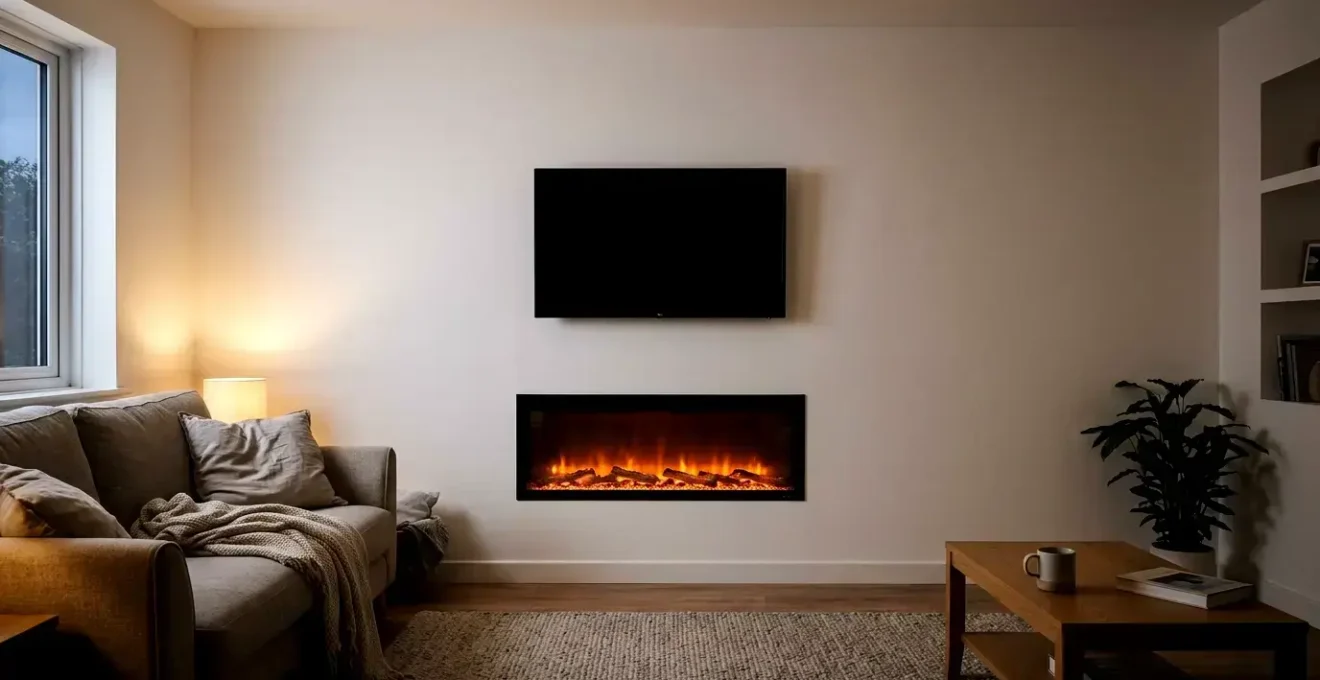
Electric fireplaces need no chimney or external flue because they generate heat using electricity rather than burning fuel. Their flames are simulated, and their operation produces no combustion exhaust that must be discharged outdoors. For homeowners with a blocked chimney, an internal room without an exterior venting route, or a property where structural alterations are impractical, this removes a major installation obstacle.
However, no venting does not mean no ventilation around the appliance. Many electric fireplaces rely on internal airflow to distribute heat and protect components from overheating. They also require appropriate electrical connections, separation from combustible materials and, for recessed models, an enclosure that follows the manufacturer’s installation instructions.
The practical advantage is flexibility: a suitable electric fireplace can often be installed without chimney construction, gas piping or an exterior wall penetration. The limitations depend on the specific model, the available electrical circuit and the surrounding room or wall structure.
Electric fireplace installation: the essentials
- Electric fireplaces do not burn fuel, so they need no chimney, flue or combustion-exhaust system.
- Air intakes, heat outlets and manufacturer-specified clearances must remain unobstructed, including inside recessed installations.
- Electrical capacity, wall construction and property restrictions determine whether a plug-in, wall-mounted or built-in model is appropriate.
- Why Can Electric Fireplaces Operate Without a Chimney or Flue?
- How to Maintain Safe Airflow Around a Vent-Free Electric Fireplace
- Electric Fireplace vs. Direct-Vent Gas Fireplace for a Home Without a Chimney
- Why a Vent-Free Electric Fireplace Still Requires Manufacturer-Specified Clearances
- When Should You Check Your Electrical Circuit Before Installing a Vent-Free Fireplace?
- How to Frame a Recessed Electric Fireplace Insert in a Stud Partition
- Why Placing an Electric Fireplace Too Close to Curtains Can Be Unsafe
- What Type of Fireplace Can You Have in an Apartment Without a Chimney?
Why Can Electric Fireplaces Operate Without a Chimney or Flue?
Electric fireplaces operate without a chimney or flue because they contain no fuel-burning combustion chamber. Electrical heating elements produce warmth, while lighting and other visual-effect systems create the appearance of flames. Since no wood, natural gas or propane is burned, the appliance produces no combustion gases requiring an outdoor exhaust route.
In a conventional electric fireplace, resistance heating converts electrical energy into heat. A fan may move room air across the heating element and return warmed air through an outlet. Other designs use infrared heating elements to transfer radiant heat toward nearby surfaces and occupants.
The flame display is a separate function. LED lighting, reflective components and, in some designs, water-vapor effects reproduce the appearance of a fire without actual combustion. This is why many electric fireplaces can display flames with the heating function switched off.
EPRI’s technical information sheet on electric fireplaces, published in October 2024, describes electrical heating elements, simulated flames and the elimination of direct combustion emissions at the appliance. This distinction concerns on-site operation; it does not imply that electricity production has no environmental impact.
Vent-free electric fireplaces and ventless gas fireplaces are not equivalent. A ventless gas appliance still burns fuel indoors, producing combustion byproducts that can include carbon dioxide, water vapor and other emissions. Its suitability depends on specific appliance approvals, indoor air quality considerations and local regulations.
Electric fireplaces avoid that combustion-related issue, but they are not free of installation requirements. Heat-producing components still need adequate cooling and safe separation from surrounding materials.
For example, a freestanding electric fireplace can potentially operate in an interior bedroom without an exterior wall opening, provided its electrical supply, location and operating conditions satisfy the instructions for that model.
Once the exhaust requirement has been eliminated, the next consideration is how the appliance moves air through its heating and cooling components.
How to Maintain Safe Airflow Around a Vent-Free Electric Fireplace
Safe airflow around a vent-free electric fireplace requires keeping its air intakes and warm-air outlets unobstructed and maintaining the free space specified by the manufacturer. Identify each opening before positioning the unit or constructing a surround. Recessed installations also need adequate internal ventilation so discharged heat does not accumulate around the appliance.
The first step is to distinguish room ventilation from appliance airflow. An electric fireplace does not require a flue to remove combustion gases, but a fan-assisted model still needs a clear path for incoming and outgoing air.
Depending on the design, openings may be positioned at the front, bottom, top or rear. A decorative frame, carpet edge or cabinet panel can interfere with circulation even when the glass front remains completely visible.
For recessed models, enclosure dimensions are particularly important. If warm discharge air is trapped inside a media wall and recirculates into the intake, internal temperatures may rise. This can activate an over-temperature safety cutout, reduce heating performance or place additional thermal stress on components.
40 in² (258 cm²)
Minimum intake ventilation below the fireplace specified for the Dimplex/Faber e-MatriX models covered by the manufacturer’s manual. This is a model-specific requirement, not a universal electric fireplace clearance.
The same manual specifies 2 inches (50 mm) of free space above the fireplace in the documented installation configuration. Such requirements demonstrate why enclosure design cannot be based on the visible dimensions of the appliance alone.
Airflow should also be checked after installation. Rugs can shift toward lower openings, decorative objects may obstruct outlets, and dust can accumulate around intake grilles.
A practical routine is to inspect the visible intake and discharge areas before seasonal use, check for nearby obstructions during regular cleaning and follow the manufacturer’s maintenance instructions. Unexplained heating shutdowns may indicate restricted airflow, although electrical faults or other conditions can produce similar symptoms.
This distinction becomes important when comparing electric appliances with gas fireplaces, which use a fundamentally different approach to heating and exhaust management.
Electric Fireplace vs. Direct-Vent Gas Fireplace for a Home Without a Chimney
An electric fireplace is usually the simpler option when a home has no usable chimney or practical exterior vent route. It requires a suitable electrical supply and compliant placement rather than combustion venting. A direct-vent gas fireplace can also operate without a traditional chimney, but it needs an approved outdoor vent termination, gas infrastructure and more extensive installation work.
A direct-vent gas fireplace uses a sealed combustion system that draws combustion air from outdoors and discharges exhaust outdoors through a designated vent assembly. This differs from a ventless gas appliance, which does not have an external combustion-exhaust connection.
Some direct-vent designs allow horizontal termination through an exterior wall. The DESA direct-vent fireplace installation manual documents horizontal wall and vertical roof venting configurations for its specified models. This establishes that an existing chimney is not always required, although an appropriate vent route remains essential.
The following comparison helps identify which technology suits the property’s constraints.
| Decision factor | Electric fireplace | Direct-vent gas fireplace |
|---|---|---|
| Chimney requirement | No chimney or combustion flue | No existing chimney necessarily required, but approved exterior venting is essential |
| Installation work | Suitable electrical connection, clearances and any necessary framing | Gas supply, certified venting system, structural penetration and compliant installation |
| Heat output | Limited by the appliance’s electrical rating and available supply | Model-dependent; can provide substantially greater room-heating capacity |
| Installation cost | Generally less complex when an appropriate circuit already exists | Often involves additional professional labor and venting materials |
| Operating cost | Depends on electrical consumption and local electricity tariffs | Depends on gas consumption, tariff structure and appliance efficiency |
| Flame appearance | Simulated flames, often available without heat | Real fuel-burning flames inside a sealed combustion chamber |
| Property restrictions | Electrical, placement, structural and tenancy requirements | Gas, venting, building, permission and tenancy requirements |
Actual running costs cannot be determined from fuel prices alone. The useful heat delivered, appliance efficiency, local tariffs and intended hours of operation all affect the comparison. Likewise, installation costs depend on whether existing electrical or gas infrastructure can be reused.
For renters and residents of upper-floor apartments, a portable electric fireplace is often more practical because it avoids permanent exterior alterations. A homeowner with an internal living room and no feasible external penetration faces similar constraints.
Conversely, a property with an accessible exterior wall, a permitted gas supply and a substantial heating requirement may justify evaluating a direct-vent gas model. Approval of the vent termination location and professional installation are necessary considerations.
No existing chimney does not automatically rule out gas. The deciding factor is whether an approved exhaust route can be constructed safely, legally and economically.
Whichever technology is selected, installation safety depends on respecting the space around the appliance. Electric models eliminate combustion exhaust but not the effects of concentrated heat on nearby surfaces.
Why a Vent-Free Electric Fireplace Still Requires Manufacturer-Specified Clearances
A vent-free electric fireplace still requires manufacturer-specified clearances because its heating elements, warm-air outlets and nearby surfaces can become hot enough to damage surrounding materials. Clearances protect combustible furnishings and finishes while allowing the appliance to operate within its designed temperature range. The absence of real flames or exhaust gases does not eliminate these thermal hazards.
Heat may leave the appliance through a front or upper outlet, depending on its construction. A mantel, television or shelf placed in that discharge path can experience repeated warming even without touching the heater.
Over time, unsuitable exposure may contribute to damaged finishes, warped components or shortened electronic equipment life. The risk depends on temperature, exposure, material properties and the manufacturer’s stated installation limits.
Two types of dimensions must be distinguished:
- Clearance to combustible materials: the required separation between designated appliance surfaces or outlets and materials such as timber, fabric, paper and certain plastics.
- Minimum enclosure dimensions: the space needed for the appliance to fit, circulate air and remain serviceable within an approved built-in configuration.
These measurements serve different purposes. Providing a generous cavity behind an insert does not compensate for positioning a wooden mantel too close to its heat outlet. Likewise, adequate front clearance does not make an undersized enclosed cavity acceptable.
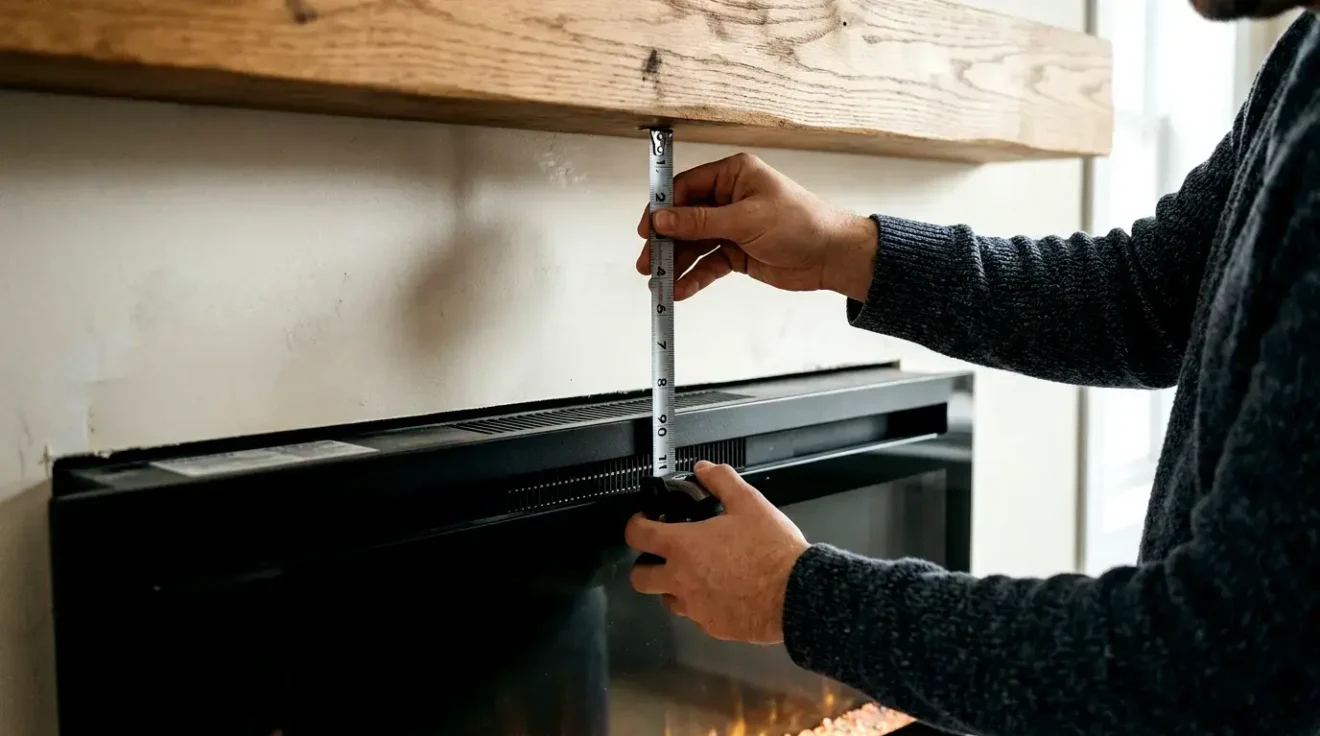
Before installing a unit beneath a television, measure from the reference points identified in its instructions. Confirm both the fireplace’s requirements and the television manufacturer’s operating-temperature and placement restrictions. There is no universal distance that makes every fireplace-and-TV combination safe.
The same principle applies to decorative surrounds. Non-combustible lining may be required or permitted in certain configurations, but it does not automatically make combustible studs or materials behind the lining exempt from specified clearances.
Incorrect installation may also affect warranty coverage under the applicable manufacturer’s terms. Insurance consequences depend on the policy, the circumstances of any damage and relevant law; a claim should not be assumed automatically valid or invalid solely because a clearance was breached.
After confirming that the surrounding materials can tolerate the intended installation, the remaining essential constraint is whether the property’s electrical supply can support the appliance.
When Should You Check Your Electrical Circuit Before Installing a Vent-Free Fireplace?
Check the electrical circuit before purchasing or installing a vent-free electric fireplace, especially if it will share an outlet circuit with other appliances or operate for extended periods. Compare the fireplace’s rated electrical demand with the circuit’s capacity and existing loads. A suitable plug does not, by itself, establish that the entire circuit can safely support the heater.
The appliance nameplate or technical manual provides its voltage and power rating. For a straightforward resistive load, expected current can be estimated using the relationship:
Current (A) = Power (W) ÷ Voltage (V)
As a hypothetical example, a fireplace rated at 1,500 W on a 120 V supply draws approximately 12.5 A at its rated operating conditions. A 2,000 W appliance on a 230 V supply draws approximately 8.7 A. These calculations illustrate electrical demand; they do not establish whether a particular existing circuit is adequate.
Actual circuit suitability also depends on other connected equipment, wiring, protection devices, the appliance instructions and local rules concerning sustained loads.
A common oversight is assuming that one wall outlet serves only the room in which it is located. Several outlets, sometimes across adjacent spaces, may share the same branch circuit.
If an electric fireplace operates alongside other high-demand appliances, the combined load may cause a protective device to trip when heating begins. Such problems may appear more frequently during colder weather when several electrical heaters or appliances are in use simultaneously.
Repeated breaker trips should never be addressed by fitting a higher-rated breaker without professional assessment of the wiring and circuit design.
Plug-in and hardwired models also require different planning. A plug-in unit must use an appropriate accessible outlet in accordance with its instructions; extension leads and power strips should not be assumed suitable for heater loads. A hardwired fireplace requires a compliant permanent electrical connection, and some installations may need a dedicated circuit.
Requirements vary by country. In the United States, relevant provisions of the National Electrical Code and local amendments apply. In England and Wales, domestic electrical work is subject to building regulations, with BS 7671 providing the relevant wiring standards. The Planning Portal guidance on domestic electrical building regulations identifies the installation of a complete new circuit as notifiable work within its stated framework.
Other jurisdictions, including Scotland, Northern Ireland, Canada, Australia and New Zealand, have their own applicable electrical requirements.
Five checks to complete before ordering an electric fireplace
- Record the model’s rated power, supply voltage and connection type. Deliverable: a photograph or copy of its electrical specification.
- Identify the intended outlet or connection location and its circuit. Deliverable: a labeled circuit reference or a note requesting electrician verification.
- List the other known appliances supplied by that circuit. Deliverable: a basic shared-load inventory.
- Compare the fireplace’s demand and proposed installation with the available circuit information. Deliverable: a documented assessment by a qualified electrician where circuit capacity is uncertain.
- Confirm whether new wiring, a dedicated circuit or certification is required locally. Deliverable: an installation plan recording the applicable requirements and responsible installer.
With the electrical connection planned, a recessed installation can move to the structural stage, where cavity dimensions and future access become equally important.
How to Frame a Recessed Electric Fireplace Insert in a Stud Partition
To frame a recessed electric fireplace insert in a stud partition, start with the manufacturer’s specified rough opening, cavity depth, ventilation allowances and fixing method. Construct the timber or metal framework around those requirements, accounting for the finished wall surface and planned electrical connection. The completed installation must also permit any maintenance access or removal specified by the manufacturer.
Before cutting plasterboard or assembling studs, establish whether the selected fireplace is approved for full recessing, partial recessing or surface mounting. A wall-mounted model is not automatically suitable for installation inside a sealed wall cavity.
The structural work should follow a defined sequence:
- Check the complete dimensional drawing. Record rough opening width, height and depth, including any ventilation, mounting and service-space requirements.
- Inspect the partition. Identify load-bearing elements, electrical wiring, plumbing and any other concealed services before alteration. Obtain structural advice where the work may affect load-bearing construction.
- Construct the approved opening. Use the specified framing layout, compatible fixing points and materials, without reducing required distances to combustible components.
- Plan the electrical connection. Arrange the outlet or permanent wiring in the location allowed by the appliance instructions and applicable electrical rules.
- Finish and verify the installation. Allow for plasterboard or other finish thickness, confirm airflow openings remain clear and test operation following the manufacturer’s commissioning instructions.
An easily overlooked error is framing the opening to the visible glass dimensions instead of the complete installation diagram. Another is placing a socket behind the insert where it becomes inaccessible, prohibited by the product instructions or obstructs installation.
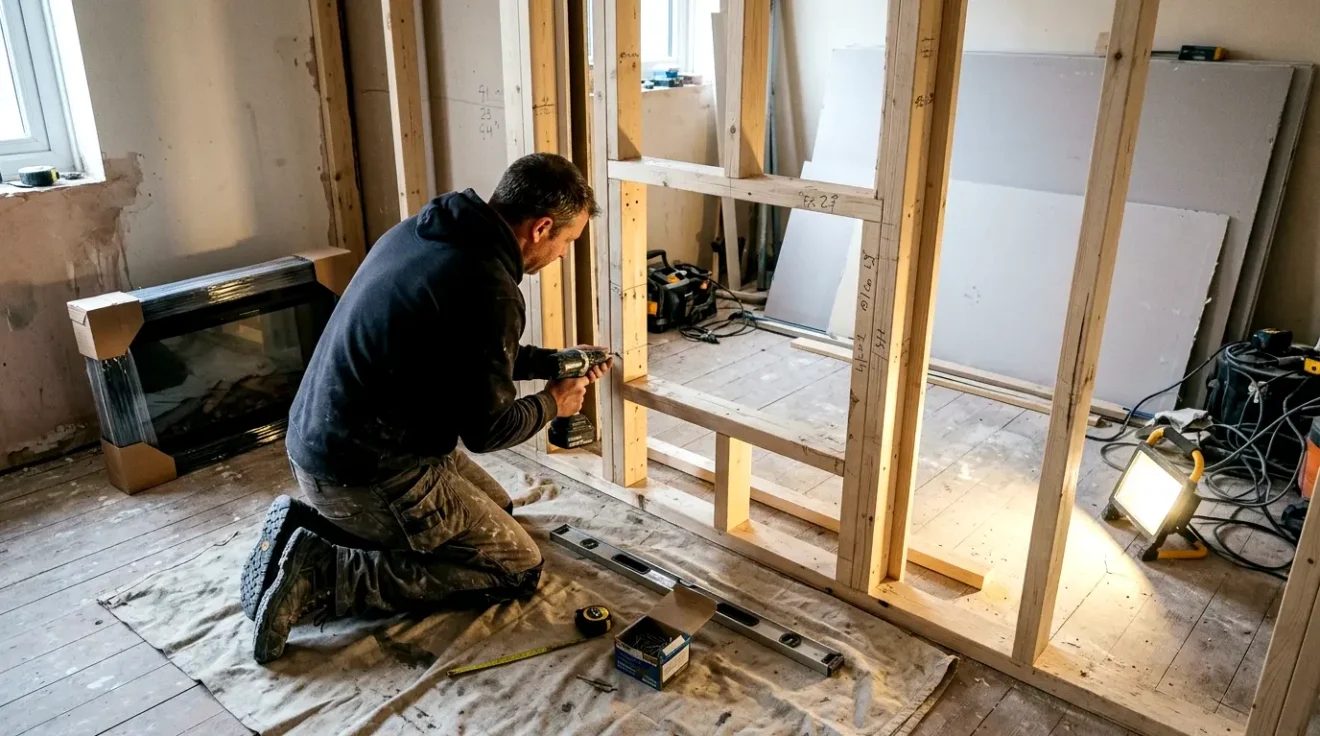
Wall location also changes the design. An internal partition may offer a straightforward framing arrangement, while an exterior wall can contain insulation, vapor-control layers, moisture-management components and structural elements that must not be compromised.
Where a fireplace is installed in an exterior-wall assembly, assess the effect of the recess on insulation continuity and moisture protection. Simply removing insulation to accommodate the unit can create a separate building-envelope problem.
Even a surround lined with non-combustible material may contain timber studs behind it. Those concealed components must remain compatible with the fireplace’s approved installation configuration.
Finally, built-in should not mean permanently inaccessible. Any required control box, water reservoir, filter, connection or removable fireplace body must remain serviceable according to the product documentation. A permanently sealed surround may make routine maintenance unnecessarily destructive.
Once the insert is secured, the surrounding furnishings must remain compatible with its heat discharge during everyday use, particularly movable fabrics near the appliance.
Why Placing an Electric Fireplace Too Close to Curtains Can Be Unsafe
Placing an electric fireplace too close to curtains can be unsafe because its heater may discharge hot air or radiate heat toward nearby fabric. Curtains can move into restricted areas during normal use, and repeated exposure may damage, discolor or potentially ignite susceptible materials. Electric flames may be simulated, but the heating components still create genuine thermal risks.
The hazard depends partly on outlet position. A top-discharge heater can expose fabric hanging above or beside the appliance to rising hot air. Front-discharge and infrared models create different exposure patterns that must be evaluated using their own installation instructions.
Lightweight curtains may sway when windows open, doors close or air circulates around the room. A fabric edge that was outside the specified clearance when the fireplace was installed can subsequently move closer to the outlet.
Synthetic fabrics may soften or melt when exposed to sufficient heat, while other textile materials can scorch, degrade or ignite under hazardous conditions. The exact behavior depends on the material and exposure; the absence of direct flame contact is not proof of safety.
For a practical placement check, locate the minimum clearance to combustible materials in the fireplace manual. Measure in the directions specified by the manufacturer, rather than assuming a single horizontal gap covers every part of the installation.
Then assess the curtain’s full range of movement, including its position when drawn closed, moved by a draft or handled during cleaning. The fabric should remain outside the prohibited zone under foreseeable conditions, not only when arranged neatly.
Do not assume that curtains described as flame-retardant can be installed closer than the appliance instructions allow. Fabric treatment does not override the heating appliance’s specified clearances.
The same concern applies to blankets, paper decorations, pet bedding and seasonal displays. These items can gradually migrate toward the fireplace, particularly in busy living spaces.
A useful household habit is to inspect the clearance zone whenever furniture or decorations are rearranged and before switching the heating function on after a period of non-use.
For apartments and other compact properties, these practical limitations can influence which fireplace format is appropriate even when no chimney is available.
Key takeaways before choosing a fireplace
- Choose the installation format according to the property: a freestanding plug-in unit offers greater reversibility than a recessed wall insert.
- Confirm building and tenancy permissions before making permanent changes, even when no exterior venting is required.
- Compare appliance safety, electricity availability and everyday space constraints before prioritizing flame appearance or decorative integration.
What Type of Fireplace Can You Have in an Apartment Without a Chimney?
In an apartment without a chimney, a freestanding electric fireplace or a suitable wall-mounted electric model is often the most practical choice because neither requires combustion venting. A recessed electric insert is another possibility where structural modifications are permitted. Ethanol fireplaces may also be available, but their real flames introduce combustion, indoor-air and building-safety considerations.
The most suitable option depends on whether the apartment is rented or owner-occupied, what alterations are allowed and how the appliance will be used.
| Fireplace type | Installation implications | Principal limitation |
|---|---|---|
| Freestanding plug-in electric fireplace | Normally requires no structural alteration when placed at a compliant location with a suitable outlet | Electrical load, clearances and available floor space |
| Wall-mounted electric fireplace | Requires suitable wall fixings and possibly electrical alterations | Wall suitability, mounting permissions and outlet positioning |
| Recessed electric insert | Requires an approved wall cavity, framing and electrical provision | Permanent alterations, enclosure ventilation and service access |
| Ethanol fireplace | May avoid a traditional flue, subject to product design and local rules | Real combustion, indoor emissions, fuel handling and open-flame restrictions |
For tenants, a portable electric fireplace generally offers the greatest flexibility. However, a reversible installation is not automatically permitted under every lease. Some rental agreements or building policies restrict additional heating appliances, even when they plug into an existing outlet.
A recessed installation is more involved because it alters the wall assembly and may affect electrical wiring, fire separation or building services. Written landlord approval, building management authorization or other permissions may be necessary.
Apartment buildings also create shared safety considerations. Penetrating a fire-rated wall, modifying a party wall or interfering with protected building elements may require specialist assessment and authorization regardless of whether the fireplace uses combustion.
Ethanol appliances deserve particular caution. Although certain models operate without a conventional chimney, they burn fuel and therefore produce combustion products indoors. Their suitability depends on manufacturer instructions, ventilation conditions, building rules and local fire-safety requirements. They should not be treated as interchangeable with emission-free-at-point-of-use electric flame effects.
Before purchasing any fireplace for a multi-unit building, check the lease or ownership rules, building management requirements, relevant insurance conditions and applicable local regulations. The absence of a chimney requirement does not override these restrictions.
Where structural changes are prohibited and the electrical supply is appropriate, a freestanding electric model will often be easier to accommodate. Where wall modifications are authorized, a properly designed recessed installation can provide a more integrated appearance.
Before committing to a fireplace, select a specific model and review its installation manual against the available circuit, planned location and any property permissions. That model-specific check is the most useful next step toward a safe installation without external venting.
Can an electric fireplace be installed on an interior wall with no outside access?
Yes. An electric fireplace does not require an exterior exhaust outlet, so an interior wall may be suitable. The installation must still meet the manufacturer’s mounting, enclosure, airflow and electrical requirements. Check for concealed services and structural constraints before creating a recessed opening.
Does a vent-free electric fireplace need a room ventilation grille?
It does not need a dedicated room grille to remove combustion exhaust because it produces none. However, the appliance may require unobstructed intake and outlet openings or specific enclosure ventilation. Those requirements are model-dependent and should not be confused with a flue or outdoor combustion vent.
Can an electric fireplace be used without switching on the heater?
Many electric fireplaces offer a flame-only mode that displays simulated flames without activating the main heater. Feature availability and electrical consumption vary by model. The appliance still needs its specified electrical supply, and applicable installation and safety instructions remain in force.
Can an electric fireplace replace a blocked or unused traditional fireplace?
A compatible electric insert may be installed in an existing fireplace opening without using the old chimney for combustion exhaust. The cavity must be assessed for dimensions, dampness, electrical provision, fixing requirements and airflow. Any necessary treatment of the existing chimney or fireplace structure should be considered separately rather than assuming the old opening is suitable as found.
Do electric fireplaces produce carbon monoxide during normal operation?
Electric fireplaces do not generate carbon monoxide through normal heating operation because they do not burn fuel. This does not eliminate carbon monoxide risks from other fuel-burning appliances in the property. Existing alarms and safety precautions for gas, oil, wood or other combustion equipment should remain in place where required.