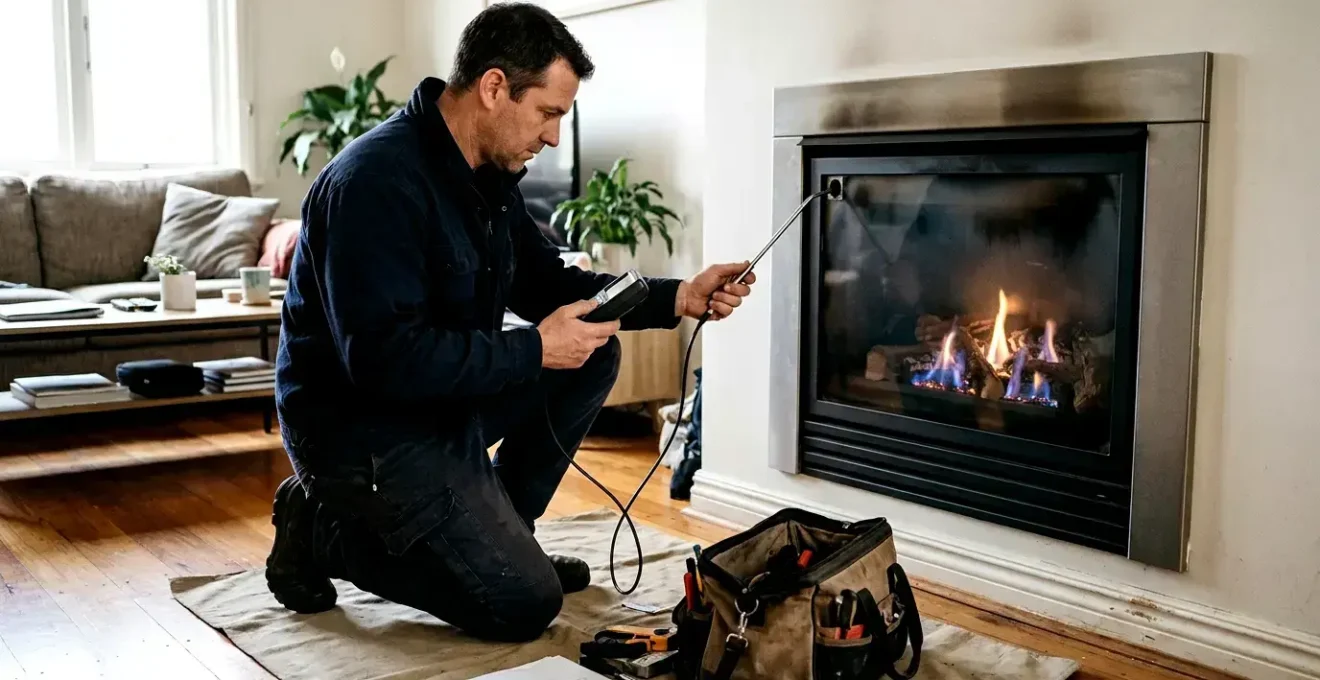
Gas fireplace ventilation problems can appear as soot on the glass, unstable flames, repeated shutdowns, corrosion around an exterior vent or unusual condensation. However, some exhaust faults develop without obvious changes in how the fireplace operates. Recognising these warning signs helps homeowners identify when a gas appliance needs professional attention.
A gas fireplace depends on adequate combustion air and a suitable flue system to remove combustion products safely. When airflow becomes restricted, a vent connection deteriorates or an exterior terminal is obstructed, combustion performance and indoor air safety may be affected. Carbon monoxide is a particular concern because it cannot be detected by smell or sight.
Homeowners can observe accessible components, document visible changes and keep the area around a vent terminal free from external obstructions where safe to do so. Testing combustion performance, repairing flue connections and servicing gas components require appropriately qualified professionals. The appliance manufacturer’s instructions and local gas safety requirements determine which procedures apply.
Gas fireplace ventilation: essential safety points
- Watch for soot, unstable flames, recurring ignition failures, corrosion and visible terminal obstructions. These are warning signs, not definitive diagnoses.
- Damaged flue joints or restricted exhaust paths can create carbon monoxide hazards even when a fireplace appears to operate normally.
- Arrange a qualified inspection whenever venting integrity is uncertain, particularly after construction work or changes around the flue outlet.
- Why Can a Blocked Gas Fireplace Vent Cause Poor Operation?
- How to Spot Visible Damage Around an Exterior Gas Fireplace Vent Terminal?
- Balanced Flue or Conventional Flue: Which Gas Fireplace Venting System Suits Your Home?
- Why Damaged Gas Fireplace Vent Connections Can Create Indoor Air Hazards
- When Should Gas Fireplace Venting Be Rechecked After Roof or Exterior Wall Work?
- Why Does a Gas Fireplace Burner Produce Uneven or Unusual Flames?
- When Should a Fireplace Draft Problem Be Investigated by a Chimney Specialist?
- What Causes Gas Fireplace Burner Problems and When Should You Call a Technician?
Why Can a Blocked Gas Fireplace Vent Cause Poor Operation?
A blocked gas fireplace vent can interfere with combustion air delivery or prevent exhaust gases from leaving the appliance correctly. Depending on the fireplace design and the severity of the obstruction, this may cause unstable flames, soot formation, ignition difficulties or activation of a safety device. Some restrictions produce few visible symptoms, making professional vent inspection essential.
Gas combustion requires an appropriate supply of oxygen and a reliable route for combustion products to escape. A direct-vent fireplace typically uses a room-sealed arrangement that draws combustion air from outside. A conventional open-flued fireplace may depend on air from the room and natural chimney draught.
Bird nests, leaves, construction debris, damaged vent caps and deteriorating internal components can interfere with these pathways. Their effects differ according to the appliance’s combustion system, flue geometry and safety controls.
Partial obstruction may reduce airflow without stopping the fireplace immediately. Possible consequences include abnormal flame movement, increased soot deposition or inconsistent performance. Persistent condensation can also warrant investigation, although brief moisture formation during a cold start may be normal on certain models.
Severe obstruction may cause a fireplace to shut down if its safety system detects an unsafe operating condition. However, shutdown behaviour is model-specific. Not every gas fireplace has an oxygen depletion sensor, and neither a pilot assembly nor another safety device should be assumed to detect every exhaust blockage.
The following observations help determine how urgently professional advice is needed.
| Observation | Possible explanation | Recommended response |
|---|---|---|
| Soot accumulating on glass | Incomplete combustion, burner problems or restricted airflow | Stop using the appliance and request inspection |
| Pilot repeatedly extinguishes | Faulty safety components, gas supply issues or combustion-related problems | Have a qualified technician diagnose the fault |
| Unusual persistent condensation | Temperature conditions, excess moisture or venting problems | Compare with manufacturer guidance and arrange inspection if unexplained |
| Unusual burning or exhaust odour | Overheated materials, contamination or an appliance fault | Switch off and investigate professionally; follow emergency procedures if gas or exhaust leakage is suspected |
| Visible blocked terminal | Debris, nesting material or structural obstruction | Do not operate until the obstruction and vent safety have been assessed |
The UK’s HSE domestic gas safety FAQs emphasise the importance of unobstructed flues, adequate ventilation and regular appliance maintenance. The HSE recommends servicing gas appliances at least annually by a suitably qualified professional, with Gas Safe registration required for relevant gas work in Great Britain.
A particularly important limitation is that normal-looking flames do not prove the vent is clear. A partial obstruction may remain difficult to recognise without examination of the full venting arrangement.
Because the exterior terminal is exposed to weather and debris, examining its visible condition is a useful next step when evaluating potential exhaust restrictions.
How to Spot Visible Damage Around an Exterior Gas Fireplace Vent Terminal?
Visible damage around an exterior gas fireplace vent terminal may include rust streaks, deteriorated louvres, soot deposits, scorching, damaged surrounding masonry or debris obstructing the outlet. Homeowners can inspect an accessible terminal from a safe distance without dismantling it. Heavy staining, heat damage or structural deterioration warrants professional assessment before the fireplace is used again.
The terminal is the point where combustion products leave the building. On many balanced-flue systems, it also provides the combustion air intake. Its position, condition and clearances are therefore important to safe operation.
A visual assessment should begin with the surrounding wall. Look for cracks, discolouration, displaced render or siding damage close to the outlet. Rust streaks below the terminal can suggest corrosion, while nesting material or accumulated debris may indicate restricted openings.
Inspect the visible terminal housing for missing louvres, corrosion, distortion or signs of overheating. Frost and light moisture deposits can occur under certain weather and operating conditions, so their significance depends on the appliance. Heavy soot, melted components or scorching are more serious warning signs and should not be dismissed as ordinary weathering.
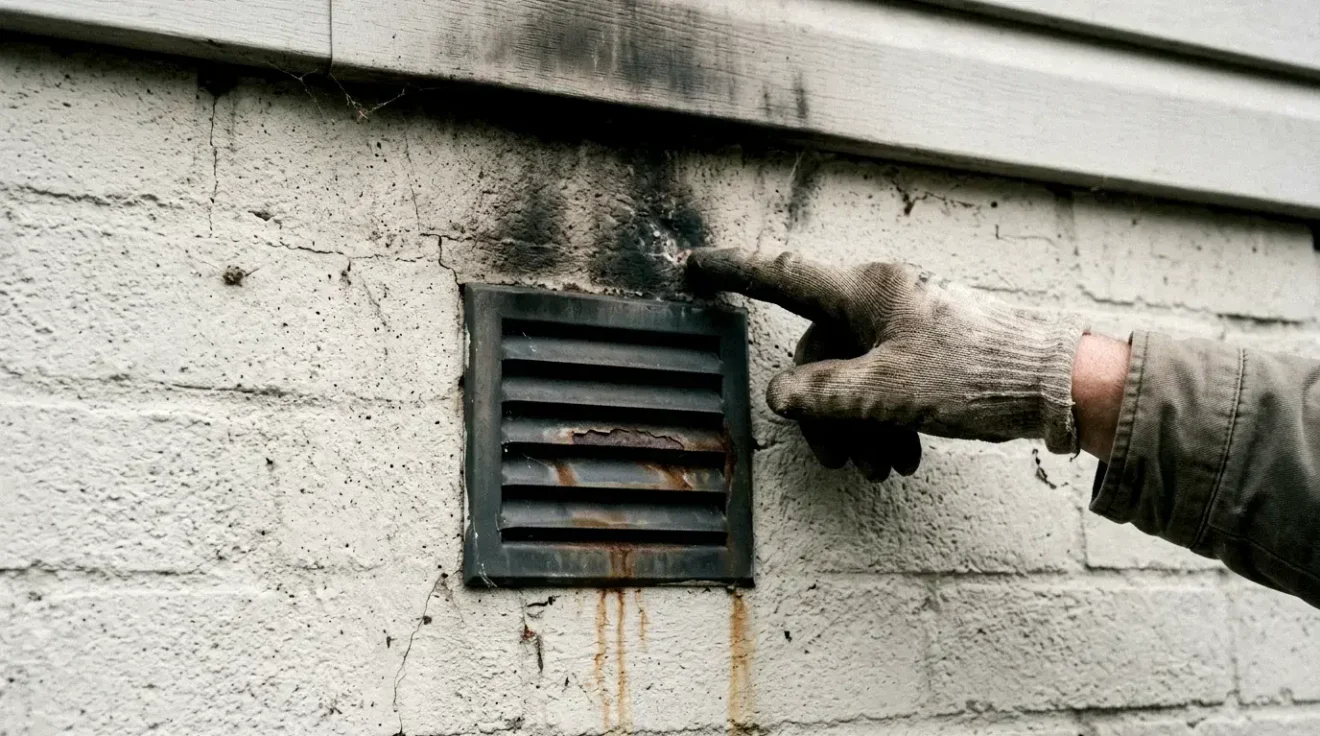
Interior evidence can provide additional context. Peeling paint, unexplained damp patches or corrosion near the fireplace wall may indicate moisture ingress or an issue with the surrounding building envelope. These observations do not independently establish a damaged vent seal, but they should be reported alongside exterior findings.
Manufacturer maintenance information supports careful attention to weather-exposed venting. The Regency fireplace maintenance FAQs identify corrosion, excessive condensation, disturbed joints and foreign material as potential venting concerns. Their detailed procedures and inspection intervals apply to the relevant Regency products and should not automatically be transferred to other models.
Five safe visual checks to document before a vent inspection
- Identify the accessible exterior terminal without opening any housing or cover. Record its location and take an overview photograph.
- Look for visible debris, nesting material or blocked openings from a safe position. Record the obstruction without attempting to remove it from the vent.
- Check for rust streaks, broken louvres or displaced components. Take close-up photographs without touching the assembly.
- Examine nearby wall surfaces for soot, scorching or moisture damage. Record the location and approximate extent of each visible mark.
- Note any interior staining or changes in fireplace operation. Prepare a dated list of observations to give the qualified technician.
A homeowner should not remove a terminal, install an improvised screen, reseal a joint or modify its position. Such changes can affect the designed relationship between combustion air intake and exhaust discharge.
The significance of these observations also depends on the type of flue installed, since balanced-flue and conventional-flue systems manage combustion air and exhaust differently.
Balanced Flue or Conventional Flue: Which Gas Fireplace Venting System Suits Your Home?
A balanced-flue gas fireplace is generally suited to installations where a room-sealed combustion system and an approved route to the outdoors are available. A conventional open-flued fireplace may suit a property with a suitable chimney and adequate combustion ventilation. The correct choice depends on the appliance model, building layout, flue compatibility and applicable installation requirements.
A balanced-flue system supplies combustion air from outside and discharges combustion products to the outdoors through a room-sealed arrangement. Many gas fireplaces use a concentric or coaxial vent, although this is not the only possible balanced-flue configuration.
A conventional open-flued system typically uses combustion air from the room or building and sends exhaust through a chimney or another approved flue. Natural-draught versions rely on pressure and temperature differences to establish upward exhaust movement.
These differences affect installation options and the types of faults that can arise.
| Criterion | Balanced flue | Conventional flue |
|---|---|---|
| Combustion air | Supplied from outside through a room-sealed arrangement | Commonly supplied from the surrounding building |
| Exhaust route | Approved room-sealed vent system, with horizontal or vertical configurations depending on the appliance | Suitable chimney or approved open-flue arrangement |
| Existing chimney | Not necessarily required | May be usable if its condition and compatibility are verified |
| Typical vulnerability | Blocked terminals, damaged joints or unsuitable terminal surroundings | Chimney obstruction, inadequate draught or pressure-related spillage |
| Installation flexibility | Potentially suitable for properties without a traditional chimney | Depends strongly on available flue routes and combustion ventilation |
| Professional assessment | Vent routing, terminal clearances and appliance compatibility | Chimney integrity, draught, ventilation and appliance compatibility |
For a home with an existing chimney, a conventional-flue appliance may be feasible after professional assessment. The chimney must be suitable for the specific appliance, and its existence alone does not guarantee safe operation.
For a new building or a room without a usable chimney, a balanced-flue model may offer greater installation flexibility. However, a nearby exterior wall does not automatically make balanced flue the only option, nor does it guarantee that terminal positioning requirements can be met.
England’s Approved Document J on combustion appliances and flues explains room-sealed arrangements, natural draught and the importance of terminal positioning. Its installation provisions apply within the document’s stated jurisdiction and should not be treated as international requirements.
Wind exposure, nearby structures, building pressure and flue geometry can all influence performance. Conventional systems may experience draught reversal under adverse conditions, while balanced-flue terminals must be positioned to limit interference with air intake and exhaust dispersal.
Converting from conventional flue to balanced flue is not simply a matter of replacing the terminal. Flue configuration is determined by appliance design, approved components and building conditions. A conversion may require replacement of the complete fireplace with a compatible model.
Regardless of the chosen system, the condition of every flue connection remains essential because defects can compromise indoor air safety without producing obvious external damage.
Why Damaged Gas Fireplace Vent Connections Can Create Indoor Air Hazards
Damaged gas fireplace vent connections can allow combustion products to escape outside their intended exhaust pathway. Depending on the appliance and pressure conditions, leakage may introduce carbon monoxide into occupied spaces without visibly changing the flames. Because carbon monoxide is colourless and odourless, suspected connection damage requires professional inspection rather than reliance on visible symptoms alone.
Vent connections join the appliance to its approved flue components. Their construction, locking arrangements, seals and mechanical supports are designed for the temperatures, pressure conditions and materials associated with that fireplace.
Connections can become compromised through corrosion, inadequate installation, mechanical displacement or disturbance during building work. Thermal expansion and repeated operation also make correct component selection and assembly important.
In an open-flued installation, defective joints or poor draught may permit exhaust spillage. In a room-sealed system, damaged vent connections can compromise the designed separation between combustion gases, combustion air and occupied spaces. The actual consequences depend on the location of the defect and the operating pressure within the vent system.
Carbon monoxide exposure is a major safety concern. Possible symptoms include headache, dizziness, nausea and unusual tiredness. These symptoms have many possible causes and cannot diagnose a flue defect, but they should never be ignored when a combustion appliance is operating.
Other observations, such as unexplained condensation on windows or discoloration around a fireplace, may support an investigation. They are not reliable tests for a damaged connection. Likewise, an absence of soot or flame disturbance cannot establish that the exhaust pathway is sound.
Carbon monoxide alarms provide an important additional layer of protection when appropriately selected, positioned and maintained. However, their response characteristics vary, and an alarm that has not activated does not confirm that an appliance or flue is safe.
If a carbon monoxide alarm activates or occupants develop symptoms suggesting exposure, stop using the appliance, leave the affected building and seek urgent assistance through local emergency or gas safety services. Anyone experiencing possible carbon monoxide poisoning should obtain prompt medical assessment. Do not re-enter until the appropriate professionals confirm it is safe.
Where connection damage is suspected without an immediate emergency, leave the fireplace switched off and arrange an inspection. A qualified professional may assess vent joint integrity, appliance operating conditions and combustion performance using appropriate diagnostic equipment, including a combustion analyser where relevant.
Applying household sealant or attempting to reconnect a loose flue is unsafe. The repair must use components and methods approved for the appliance, with appropriate verification after the work.
These connections can also be disturbed indirectly when contractors alter the roof, exterior wall or surrounding building structure, making post-construction checks particularly important.
When Should Gas Fireplace Venting Be Rechecked After Roof or Exterior Wall Work?
Gas fireplace venting should be reassessed when roof repairs, exterior wall alterations or nearby construction could have disturbed the flue, blocked its openings or changed the conditions around its terminal. A professional check is especially important before further use if the vent was moved, enclosed, damaged or exposed to construction debris, even when the fireplace appears functional.
Roof replacement, chimney repairs, new cladding, additional insulation and exterior rendering can affect gas fireplace ventilation in several ways. Contractors may accidentally loosen vent supports, cover an outlet, damage flashing or introduce debris into an accessible flue path.
Alterations can also change the terminal’s surroundings. A new roof overhang, nearby enclosure, window or external structure may interfere with exhaust dispersal or the combustion air intake. The magnitude of any effect depends on the appliance, installation and local conditions.
For balanced-flue fireplaces, terminal position is particularly important because air intake and exhaust discharge operate together. A change to the building envelope may alter the clearances or airflow conditions that the original installation was designed to accommodate.
Conventional-flue fireplaces can also be affected by changes to chimney height, nearby structures and building ventilation. Added insulation or ventilation alterations may change the pressure conditions within a property, although not every renovation will cause a draught problem.
The UK’s HSE guidance on construction-related carbon monoxide hazards identifies refurbishment that disrupts gas flues or ventilation systems as a potential carbon monoxide risk. The guidance is particularly relevant when planning work that could affect existing gas installations.
Following construction, homeowners can document the terminal’s visible condition, confirm that its surrounding area has not been covered or obstructed, and check whether contractors altered the vent route. If the vent may have been affected, do not operate the fireplace merely to see whether it still lights.
Instead, ask the installer or an appropriately qualified gas professional to verify the affected components, terminal positioning and appliance operation. This may include checking joints, supports, clearances and combustion performance according to the manufacturer’s requirements.
Hidden debris is a particular concern. Mortar fragments, roofing material or insulation may enter a vent path when it is exposed during construction. Such material is not necessarily visible from the room or exterior terminal.
A successful ignition after building work therefore does not prove that the entire exhaust route remains unobstructed. Where the work could have affected ventilation, inspection is a preventive safety measure rather than a response reserved for visible failure.
Even without recent building work, changes in burner flame appearance can provide additional evidence that combustion conditions deserve attention.
Why Does a Gas Fireplace Burner Produce Uneven or Unusual Flames?
Uneven gas fireplace flames can result from dirty burner ports, incorrect burner positioning, air supply problems, gas pressure faults or restricted venting. Flame appearance varies between fireplace designs, so colour alone is not a dependable diagnosis. Persistent lifting, floating, unstable flames or new soot accumulation require inspection, particularly when accompanied by unusual odours or repeated shutdowns.
Gas fireplaces are designed to produce a particular flame pattern under specified operating conditions. Some appliances show predominantly blue flames, while decorative gas fires may intentionally produce substantial yellow flames to imitate burning logs.
For this reason, a uniformly blue flame is not a universal requirement. The manufacturer’s description of normal flame appearance provides the appropriate reference point.
What matters is a significant change from that expected pattern. Flames that lift away from burner ports, move abnormally, appear unusually weak or produce soot can indicate disturbed combustion conditions.
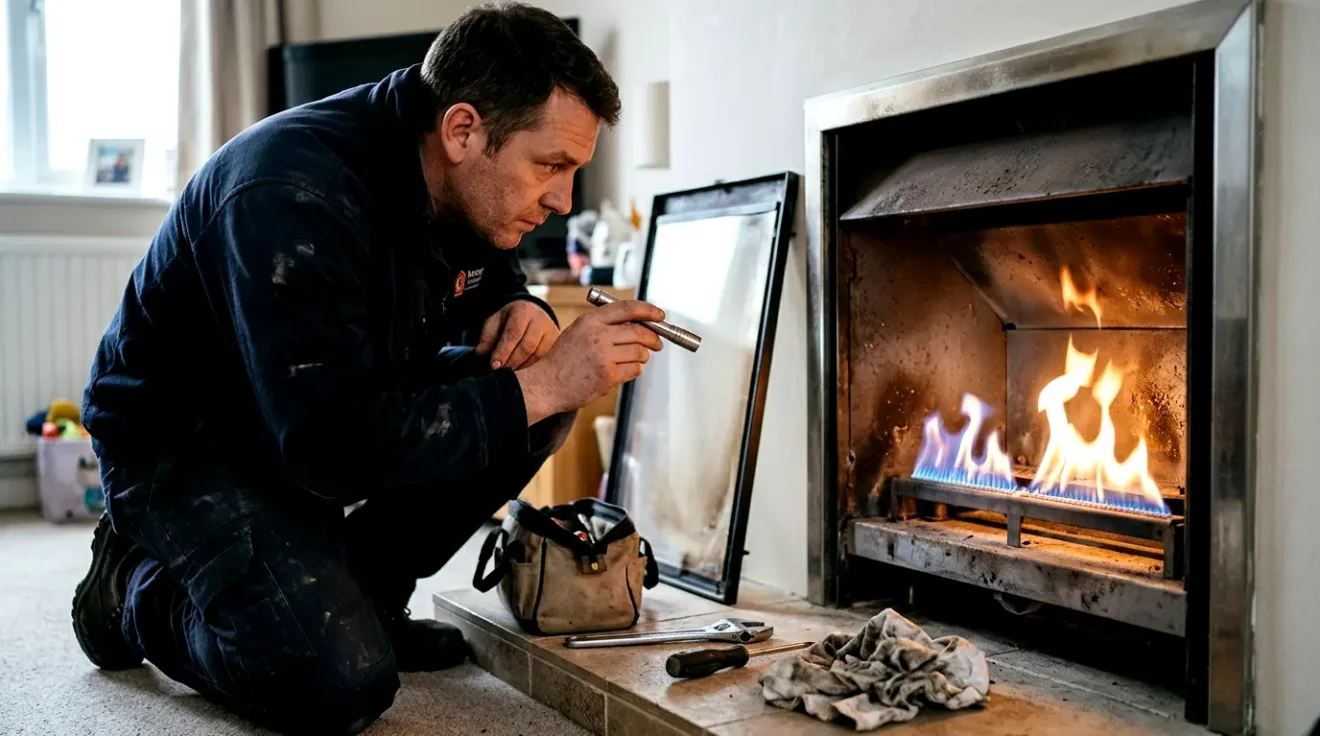
Different faults can create similar symptoms. Dust or debris in burner ports may interfere with gas distribution. Incorrectly positioned decorative components can disturb flame movement on certain models. A misadjusted air shutter may change the combustion mixture, while a regulator or gas supply problem may affect flame intensity.
Vent restriction can produce burner symptoms without a burner defect. If combustion air intake or exhaust discharge is compromised, the resulting changes in airflow and pressure may affect flame stability.
This overlap explains why replacing or cleaning burner components without examining the ventilation system can fail to resolve the underlying problem.
A technician should consider the complete combustion arrangement, including the burner, fuel supply, air controls and flue. The manufacturer’s specifications determine how the flame should look and which measurements are appropriate.
Lazy or unusually orange flames accompanied by soot, burning odours or abnormal operation deserve prompt attention. Switch off the appliance and arrange inspection rather than adjusting the air shutter, moving gas logs or opening a sealed firebox.
When flame instability is associated with poor exhaust movement or recurring shutdowns, the investigation may need to extend beyond the burner to chimney draught and flue integrity.
When Should a Fireplace Draft Problem Be Investigated by a Chimney Specialist?
A gas fireplace draught problem requires professional investigation when it recurs, causes abnormal appliance operation or raises concerns about combustion products entering the room. Exhaust odours, soot, repeated safety shutdowns or a carbon monoxide alarm activation require particular attention. The appropriate specialist depends on the appliance and flue system, and gas-related work must be performed by suitably qualified personnel.
Chimney draught is the pressure-driven movement that carries combustion products through a suitable flue. In naturally draughted systems, this movement depends on factors such as flue height, temperature differences, chimney geometry and pressure conditions inside and outside the building.
Wind may temporarily influence a chimney’s performance, but repeated disturbances should not be dismissed as ordinary weather effects. A persistent draught problem can indicate an unsuitable flue configuration, a partial obstruction, insufficient combustion ventilation or structural deterioration.
Direct-vent and fan-assisted fireplaces operate differently from conventional natural-draught appliances. Their exhaust performance must be assessed according to the system’s design rather than by applying a generic chimney draught test.
A qualified chimney specialist may inspect chimney liners, visible deterioration, obstructions and structural integrity. Where the installation includes a gas fireplace, a suitably qualified gas technician should assess combustion performance, relevant safety controls and the appliance-to-flue connection. Depending on local qualifications, one professional may be competent to perform both aspects.
The investigation should cover the complete exhaust pathway, not only the chimney outlet. A blocked terminal, displaced vent joint or alteration made during roof repairs may produce symptoms similar to those associated with poor chimney draught.
Where appropriate, the specialist may use calibrated instruments to evaluate draught pressure, combustion conditions and the possibility of exhaust spillage. The inspection method must be suitable for the particular appliance and its operating instructions.
Improvised wind deflectors, unapproved chimney caps or alterations to flue dimensions should never be used as trial-and-error solutions. A component intended to improve draught can create additional resistance or interfere with exhaust dispersal if it is incompatible with the system.
Any suspected exhaust spillage requires the fireplace to remain off until it has been assessed. A carbon monoxide alarm activation or symptoms suggesting exposure require immediate evacuation and emergency assistance, rather than routine scheduling of a chimney inspection.
Once the venting arrangement and draught conditions have been considered, the final decision is whether the remaining problem involves simple owner checks or components that require a qualified gas technician.
Key takeaways before arranging a repair
- A recurring burner or ignition fault should not be attributed to one component until combustion air supply and exhaust integrity have been considered.
- Visible cleaning and operating checks have strict limits: internal gas controls, burner adjustments and flue repairs require appropriate technical qualifications.
- Provide the technician with the appliance model, recent building-work history, warning signs and photographs so the inspection can address the complete system.
What Causes Gas Fireplace Burner Problems and When Should You Call a Technician?
Gas fireplace burner problems can arise from ignition component faults, contaminated burner ports, gas valve or regulator issues, incorrect burner adjustments and ventilation defects. Homeowners can perform only the external checks permitted by their appliance manual. Persistent ignition failure, abnormal flames, soot, gas odours or suspected vent damage require a qualified technician rather than repeated attempts to restart or adjust the fireplace.
The most useful approach is to separate ordinary user checks from technical diagnosis. A flat remote-control battery, an incorrect thermostat setting or a user-control issue may be resolved without accessing the gas system, provided the manufacturer’s instructions permit the action.
By contrast, difficulties involving ignition components, gas delivery, combustion or exhaust removal should be investigated professionally.
Several burner-related components can produce overlapping fault patterns.
| Possible fault | Typical observation | Appropriate action |
|---|---|---|
| Thermocouple, thermopile or flame-sensing fault | Pilot or main burner fails to remain operating on applicable models | Professional testing of the ignition and safety system |
| Dirty or obstructed burner ports | Irregular flame distribution or unreliable ignition | Qualified burner inspection and cleaning |
| Gas valve malfunction | Burner does not respond correctly to an ignition command | Professional valve and control diagnosis |
| Air shutter or burner alignment problem | Flame pattern differs from manufacturer specifications | Technician adjustment using the approved procedure |
| Gas pressure or regulator fault | Weak, unstable or otherwise abnormal burner operation | Qualified gas supply and pressure assessment |
| Restricted or damaged venting | Potential flame disturbance, soot or safety shutdowns | Inspection of the full combustion-air and exhaust system |
These patterns are diagnostic possibilities, not proof of a particular failure. For example, a pilot that will not stay lit may result from more than one component or operating condition. Repeatedly attempting ignition without identifying the cause is inappropriate when a fault persists.
Safe owner activities may include checking accessible user controls, consulting the troubleshooting section of the manual and cleaning approved exterior surfaces after the appliance has cooled completely. Glass cleaning must follow the manufacturer’s instructions, particularly for sealed-front appliances.
Homeowners should not dismantle burners, remove sealed glass panels for troubleshooting, adjust gas pressure, modify air shutters or replace safety components without the appropriate qualifications.
Gas odours require immediate precautions. If a gas leak is suspected, follow the local gas emergency authority’s instructions, leave the affected area, avoid flames and electrical switches, and contact the appropriate emergency service from a safe location. Do not use the fireplace until it has been declared safe.
For other potentially unsafe conditions, such as persistent soot or suspected exhaust leakage, leave the appliance off and arrange a qualified inspection. Professional servicing should follow the appliance manufacturer’s schedule and applicable local requirements.
Qualifications vary internationally. Gas Safe registration applies to relevant gas work in Great Britain, while other English-speaking countries use their own licensing, certification and inspection arrangements. Homeowners should verify that the professional is authorised for the particular appliance and jurisdiction.
If the fireplace shows persistent abnormal operation, visible flue deterioration or any concern about combustion safety, stop using it and arrange an inspection of the appliance and venting system. Provide the technician with the recorded symptoms, photographs and history of recent work. The practical rule is straightforward: burner adjustments, gas supply faults and venting integrity are professional responsibilities, not homeowner maintenance experiments.
How often should a gas fireplace and its venting system be inspected?
The inspection interval depends on the manufacturer’s instructions, appliance condition and local requirements. Annual professional servicing is a useful general safety reference and is recommended by the UK’s HSE. Some manufacturers specify additional vent checks. Follow the instructions applicable to the installed fireplace rather than assuming one interval covers every model.
Can a carbon monoxide alarm confirm that a gas fireplace vent is working correctly?
No. A carbon monoxide alarm provides an important warning if detected concentrations meet its activation criteria, but it cannot verify vent integrity, combustion quality or the absence of intermittent leakage. Professional inspection remains necessary when venting damage or abnormal operation is suspected.
Is condensation on gas fireplace glass always a sign of blocked ventilation?
No. Some gas fireplaces develop temporary condensation during startup as cool glass encounters moisture in combustion products. Persistent, excessive or newly occurring condensation may justify investigation, particularly alongside soot or operational problems. The appliance manual should establish what is normal for the specific model.
Can an exterior fireplace vent terminal be covered to prevent birds nesting?
Do not install an improvised cover, mesh or screen over a gas fireplace terminal. Additional material may restrict combustion air intake or exhaust discharge. Ask a qualified technician whether the manufacturer provides an approved protection solution compatible with the fireplace and its installation requirements.
Can a gas fireplace be used during a power outage?
Some gas fireplaces are designed to operate without mains electricity or have approved battery-backup features, while others require electrical power for ignition, controls or exhaust fans. Operation depends on the specific model. Consult the manufacturer’s instructions and never bypass an electrical interlock or powered venting component to keep the fireplace operating.