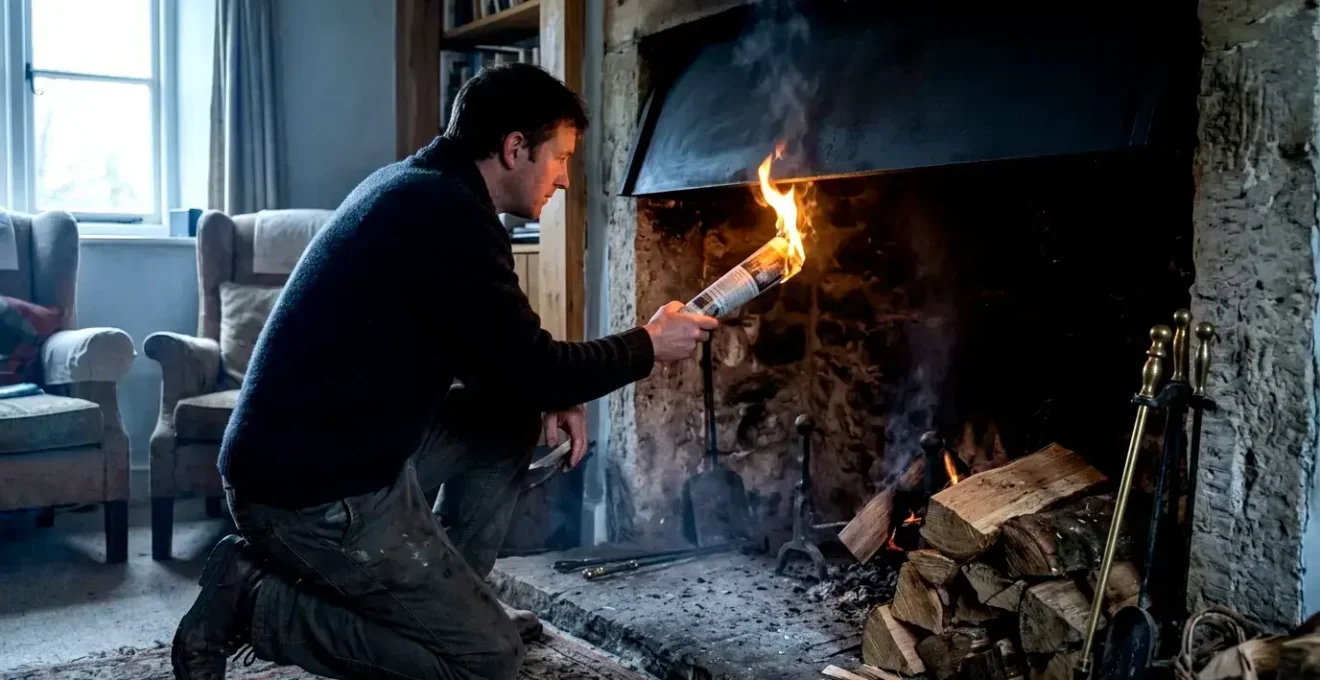
A fireplace has poor draft when its chimney cannot maintain enough upward airflow to carry smoke and combustion gases safely outdoors. The problem may begin with a cold flue, insufficient combustion air, competing extractor fans, incorrect chimney dimensions, or a physical obstruction. Identifying which condition is responsible matters more than simply building a hotter fire.
Chimney draft depends on temperature differences, pressure relationships inside the house, flue geometry, and outdoor conditions. A fireplace that smokes only during lighting requires a different investigation from one that backdrafts whenever the kitchen extractor starts. Sudden smoke spillage after years of reliable operation may instead indicate a blocked or damaged chimney.
Repeated smoke entering the room is a safety warning, not a normal fireplace inconvenience. Stop using the fireplace until the cause has been identified and safe operation confirmed. If a carbon monoxide alarm sounds, follow its emergency instructions, move everyone to fresh air, and contact the appropriate emergency service. The following diagnostic approach separates simple observations from problems requiring professional testing.
Fireplace Draft Problems: What Matters Most
- Cold chimneys and negative indoor pressure can reverse airflow, especially during lighting or when exhaust fans operate.
- Flue height, diameter, insulation, chimney caps, and internal obstructions determine whether smoke can escape reliably.
- Persistent smoke spillage, suspected blockage, carbon monoxide warnings, or damaged chimney components require professional investigation before further use.
- Why Does a Cold Chimney Struggle to Draw Smoke Upwards?
- How to Investigate Fireplace Backdrafting in a Modern Airtight House?
- Chimney Height or Flue Diameter: Which Has More Influence on Fireplace Draft?
- Why Bird Nests and Debris Can Cause Sudden Fireplace Draft Problems
- When Should a Fireplace Draft Problem Be Investigated by a Chimney Specialist?
- Why Can an Extractor Fan Interfere With Fireplace Ventilation?
- Why Connecting a New Wood Stove to an Unsuitable Chimney Can Be Dangerous
- How Often Should You Have Your Chimney Swept for Safe Wood-Burning?
Why Does a Cold Chimney Struggle to Draw Smoke Upwards?
A cold chimney struggles to draw smoke upwards because the air inside its flue has not yet been warmed enough to establish reliable upward draft. Cold flue gases provide little buoyancy, while pressure differences within the house may pull outdoor air down the chimney. Pre-warming can help with temporary startup problems, but persistent downdrafts require further investigation.
Chimney draft develops when warm combustion gases rise through the flue, producing a pressure difference that draws replacement air into the fireplace. During winter, an unused chimney may contain a column of cold air. If the house is negatively pressurized near the hearth, this condition can result in downward airflow rather than the expected upward movement.
The effect is particularly pronounced in chimneys built against exterior walls. Unlike chimneys passing through heated rooms, exterior masonry remains exposed to outdoor temperatures and may lose heat quickly between fires.
As explained in Woodheat.org’s article on planning a fireplace, the building’s own stack effect can pull air downward through a cold chimney. This means the problem is not simply that cold air is heavier: indoor and outdoor pressure differences play a central role.
Before lighting a fire, check that the damper is fully open and use a suitable non-flame smoke indicator near the fireplace throat to observe airflow. If the indicator moves toward the room, the chimney is not establishing reliable upward draft.
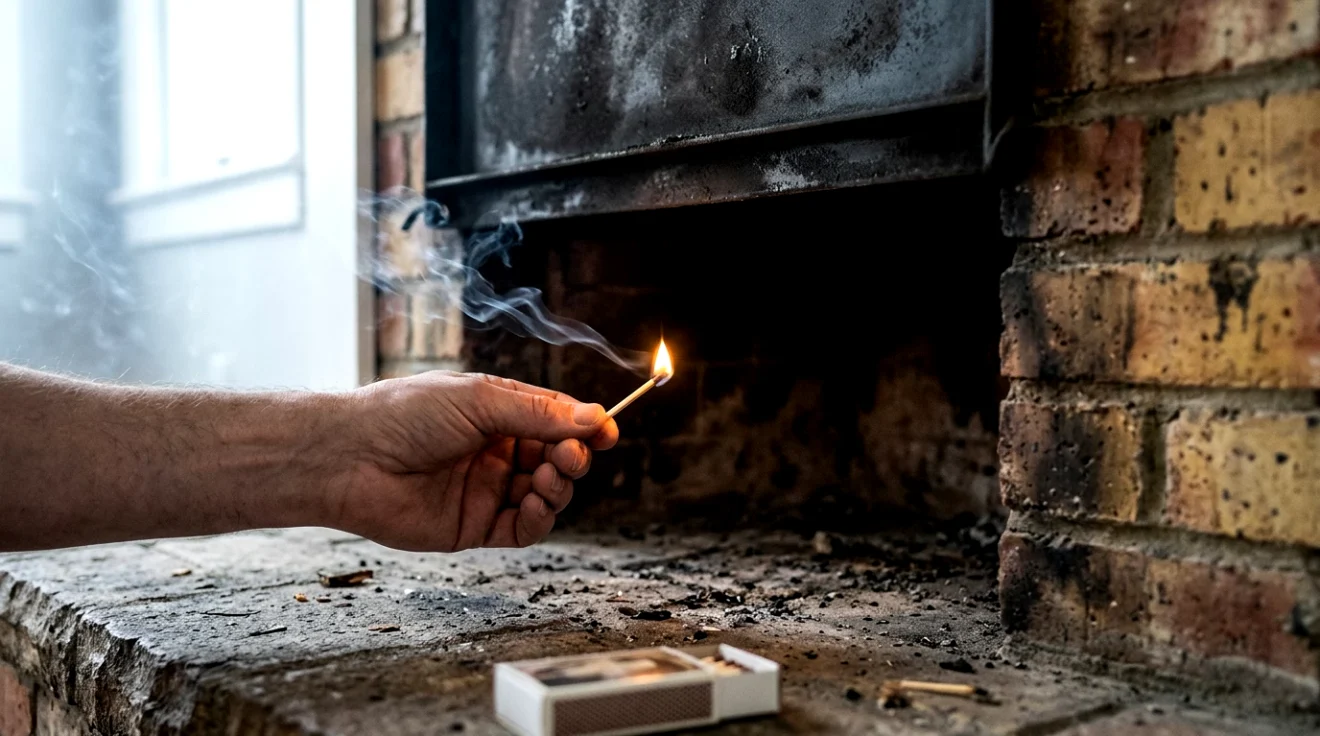
For an otherwise sound fireplace, traditional flue priming involves briefly warming the flue with a tightly rolled, burning sheet of newspaper held high inside the firebox, or a small kindling fire, before adding larger logs. This method is described in the CSIA-hosted homeowner handbook. However, burning newspaper is not suitable for every installation and can release embers or ignite deposits. It should never be attempted where backdrafting, blockage, creosote accumulation, or chimney condition is uncertain.
Distinguish between a chimney that needs help establishing draft only during an occasional cold start and one that repeatedly experiences cold downdrafts. The second condition may require professional assessment of chimney location, liner insulation, and house pressure rather than repeated preheating.
If the chimney continues to move air downward after reasonable conditions for safe startup have been established, do not add more fuel. The next issue to investigate is whether the building itself is preventing the fireplace from drawing adequate air.
How to Investigate Fireplace Backdrafting in a Modern Airtight House?
Fireplace backdrafting in an airtight house often occurs because indoor air pressure becomes lower than the pressure needed to sustain upward chimney flow. The fireplace must receive replacement air as combustion gases leave the building. When mechanical ventilation or exhaust appliances remove air faster than it can enter, the chimney may become an unintended outdoor air inlet.
Modern energy-efficient homes have fewer uncontrolled air leaks than older buildings. This improves heating efficiency but can expose ventilation deficiencies in traditional open fireplaces, which require substantial airflow during operation. The actual volume depends on the fireplace opening, chimney design, fire conditions, and other factors; no single airflow requirement applies to every installation.
A nearby window can provide a useful preliminary diagnostic clue. If a fireplace previously showed weak draft and its airflow improves with a window open, insufficient replacement air or depressurization becomes more likely. However, opening a window is a diagnostic indication, not proof of a complete or permanent solution.
For a safe investigation, observe the conditions under which the problem occurs without deliberately creating smoke spillage. A qualified technician can test the system under controlled operating conditions and measure the pressure difference between the combustion-appliance area and outdoors.
The U.S. Department of Energy’s combustion-appliance safety technical brief describes worst-case depressurization testing, including the influence of kitchen exhaust fans, bathroom extractors, and clothes dryers. It also explains the use of pressure measurements and combustion-safety checks to identify hazardous venting conditions.
Five Checks to Document a Fireplace Backdraft Problem
- Check the damper. With the fireplace cold and unused, verify that it is fully open and record its position.
- Record the airflow direction. If safe to access, use a suitable non-flame smoke indicator near the fireplace opening and note whether airflow moves inward or upward.
- Document the window effect. During a non-burning airflow check, note whether opening a nearby window changes the observed airflow direction.
- Identify operating exhaust equipment. Record which kitchen fans, bathroom extractors, dryers, and ventilation systems were running when problems occurred; leave controlled worst-case testing to a professional.
- Verify safety alarms and document symptoms. Check smoke and carbon monoxide alarms according to their instructions, and prepare a written description of smoke incidents for the chimney specialist.
Possible remedies include appropriately designed replacement-air ventilation, changes to exhaust-system operation, or an appliance-approved outdoor combustion-air connection. An ash-pit inlet is not automatically an acceptable solution, and some outdoor-air arrangements can introduce additional pressure or fire-safety problems. Installation must follow local requirements and the appliance manufacturer’s instructions.
Depressurization also matters when the home contains a naturally drafted gas furnace or water heater. Pressure imbalances may cause combustion products, including carbon monoxide, to enter occupied spaces. Confirm that CO alarms are installed in the locations required by local guidance, and have all affected fuel-burning appliances assessed.
When a window appears to improve airflow, avoid assuming that the chimney itself is defective. Conversely, a successful window test does not rule out flue damage or obstruction. Both pressure conditions and chimney geometry must be considered before choosing corrective work.
Chimney Height or Flue Diameter: Which Has More Influence on Fireplace Draft?
Chimney height and flue diameter influence different parts of fireplace draft performance. Height contributes to the pressure difference that drives exhaust gases upward, while flue diameter determines flow capacity, gas velocity, and resistance. Neither dimension can be selected independently of the fireplace or stove, and correcting one will not necessarily compensate for a serious mismatch in the other.
A taller chimney can generate stronger natural draft when temperature conditions and other design factors are favorable. However, added height also introduces frictional resistance, and the improvement may be limited if the flue is oversized, obstructed, excessively cold, or affected by building depressurization.
For roof termination, a frequently used U.S. screening reference is the 3-2-10 rule: the chimney generally extends at least three feet above the roof penetration and two feet above any building portion within ten feet horizontally. These measurements are not universal requirements across English-speaking countries and do not guarantee satisfactory draft. Appliance listings, local codes, nearby structures, and roof conditions may require different arrangements.
Diameter can be equally decisive. An oversized masonry flue connected to a small wood-burning stove may allow gases to move too slowly and cool excessively. Lower flue temperatures can weaken draft and promote creosote condensation.
An undersized flue creates another problem: greater flow restriction may prevent the chimney from evacuating the appliance’s exhaust at the required rate. Correct sizing follows the appliance manufacturer’s instructions and the applicable chimney standards, not a general preference for larger or smaller passages.
The following diagnostic comparison helps determine which dimension deserves attention first.
| Observed condition | Likely area to investigate | Professional verification |
|---|---|---|
| Smoke spillage mainly during particular wind conditions | Termination position, nearby obstructions, wind exposure | Roof clearance and termination assessment |
| Persistent weak draft with an oversized masonry flue | Low exhaust velocity, heat loss, diameter mismatch | Flue sizing and liner suitability |
| Weak draft after installing a different stove | Appliance-to-flue compatibility | Manufacturer specifications and chimney inspection |
| Draft problems after surrounding construction changes | New roofline turbulence or pressure interactions | Site-specific airflow and chimney assessment |
| Draft weakness associated with a cold exterior chimney | Flue temperature, insulation, house pressure | Liner condition and thermal performance |
When a suitable chimney is too exposed or has an incorrectly sized passage, a properly specified insulated liner may improve performance. Stainless steel liners are commonly used for approved installations, but their suitability depends on the appliance, chimney condition, and local requirements. Adding chimney height or changing the liner should follow inspection and calculations rather than trial and error.
Before paying for structural changes, establish whether the symptoms are persistent, weather-dependent, or linked to a recent appliance replacement. A sudden loss of performance in an otherwise unchanged system points toward a different possibility: a physical obstruction inside the flue.
Why Bird Nests and Debris Can Cause Sudden Fireplace Draft Problems
Bird nests, leaves, deteriorating masonry, and other debris can cause sudden fireplace draft problems by reducing or blocking the passage available for exhaust gases. Unlike gradual changes caused by accumulating deposits, a new obstruction may make a previously reliable fireplace smoke unexpectedly. Because blockages can trap hot gases and ignite combustible material, suspected obstructions require inspection before the fireplace is used again.
A chimney that worked normally during the previous heating season but smokes at its first autumn use should raise suspicion of debris. Birds and other animals may enter inactive chimneys during warmer months, while weathering can loosen masonry fragments that fall into the flue.
Not every abrupt change means that an animal has nested inside the chimney. A damaged liner, dislodged chimney component, or blocked cap can produce similar symptoms. The important diagnostic clue is the change in behavior, not an assumption about the exact object causing it.
The CSIA-hosted homeowner handbook identifies nesting material, foliage, masonry deterioration, creosote, and clogged chimney-cap screens among potential obstructions. It also distinguishes gradual restriction from accumulated deposits and sudden interference caused by deteriorating chimney components.
Before the heating season, a homeowner can make a limited visual assessment of an accessible fireplace opening and inspect the chimney cap from a safe ground-level position. Binoculars may help identify obvious exterior debris or cap damage. Do not climb onto a roof, lower improvised camera equipment into an unverified flue, or attempt to dislodge material from below.
A blocked flue must not be cleared by lighting a fire. Nesting material can ignite, and trapped smoke may spill into the living area. Burning an obstruction away can create a chimney-fire hazard rather than restore safe ventilation.
A properly designed chimney cap can help exclude birds, animals, and falling debris. However, caps require maintenance because soot and creosote can collect on protective screens. The screen design must suit the appliance and local requirements rather than being selected solely for the smallest mesh openings.
Professional removal should include checking for remaining material, liner damage, and combustible deposits. If an active nest is suspected, local wildlife protection rules may also affect when and how it can be removed.
Even if visible debris is removed, the chimney should not be assumed safe without checking its interior condition. Hidden restrictions, deterioration, and heavy deposits are reasons to involve a qualified chimney specialist.
When Should a Fireplace Draft Problem Be Investigated by a Chimney Specialist?
A fireplace draft problem should be investigated by a qualified chimney specialist whenever smoke repeatedly enters the room, airflow remains unstable, an obstruction is suspected, or chimney deterioration is visible. Immediate action is necessary if a carbon monoxide alarm activates or a chimney fire is suspected. Professional assessment is also appropriate when the system has never been inspected or its appliance configuration has changed.
Homeowners can document symptoms, check whether an accessible damper is open, confirm alarm operation, and observe external conditions without starting a fire. These observations support diagnosis but cannot establish that a chimney is structurally sound or safe to use.
Arrange professional inspection before further use if any of the following conditions occurs:
- Smoke repeatedly spills into the room during lighting or normal burning.
- A carbon monoxide alarm activates or occupants experience symptoms consistent with possible combustion-gas exposure.
- Shiny tar-like creosote, loose masonry, cracks, or damaged flue components are visible.
- A bird nest, fallen debris, or another obstruction is suspected.
- The fireplace has been altered, a stove has been installed, or the chimney’s inspection history is unknown.
In an immediate emergency, evacuate and contact emergency services. A roaring chimney, sparks or flames at the chimney top, or an unusually hot chimney structure may indicate a chimney fire. Do not attempt to extinguish it by pouring water into the fireplace.
A specialist can examine more than the visible fireplace opening. Depending on the system and reported symptoms, the inspection may include flue-camera imaging, deposit assessment, draft measurement, pressure testing, and examination of the liner, joints, chimney termination, and clearances to combustible materials.
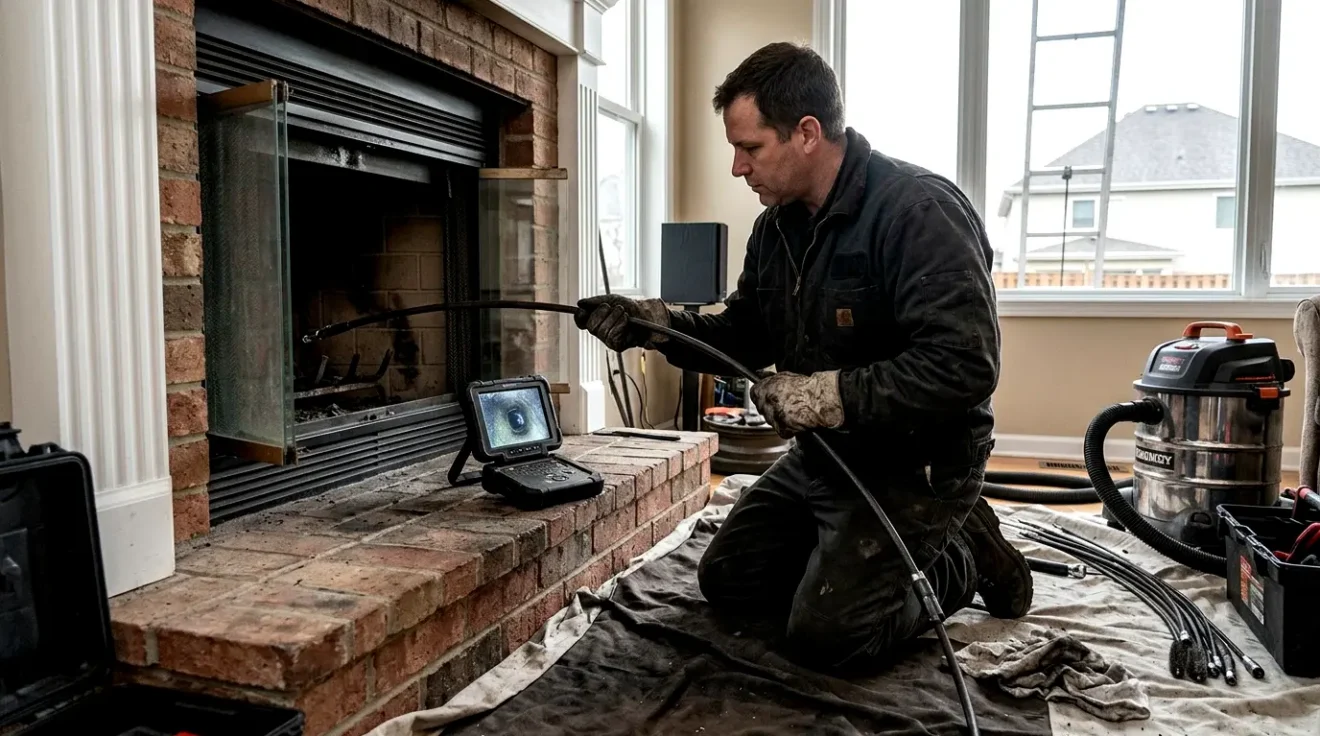
A camera inspection is particularly valuable when the fireplace opening provides no view of internal damage or partial blockage. However, imaging alone does not measure the building’s pressure balance or prove that combustion gases are being vented safely. Additional tests may be needed to reproduce intermittent problems.
Repeated poor draft also creates a maintenance concern. Lower flue temperatures and incomplete combustion can contribute to creosote accumulation, which increases chimney-fire risk. Using better-seasoned wood may reduce future deposits, but it cannot repair a cracked liner, remove existing heavy creosote, or resolve a serious ventilation defect.
Before the appointment, prepare a brief record of the weather, wind direction, approximate outside temperature, fireplace operating stage, and which household fans or appliances were running when smoke appeared. Mention whether the symptoms began after building renovations or an appliance replacement.
Ask the specialist to explain the diagnosis, provide inspection findings, and identify which repairs are necessary for safe operation. This makes it easier to distinguish essential corrective work from optional modifications.
Once structural defects and blockages have been assessed, the investigation should also consider mechanical ventilation. A chimney can be in good physical condition yet fail to draw properly whenever other equipment creates excessive negative pressure.
Why Can an Extractor Fan Interfere With Fireplace Ventilation?
An extractor fan can interfere with fireplace ventilation because it removes indoor air and may lower the pressure around the hearth. When the building cannot admit enough replacement air, the chimney may become a path for outside air to enter. This can weaken or reverse natural draft, particularly in airtight homes and when powerful exhaust equipment operates.
A kitchen range hood, bathroom extractor, or clothes dryer discharges air outdoors. Under normal conditions, incoming air replaces what has been removed. In a tightly sealed building, however, available air paths may be insufficient to maintain the pressure conditions required by a naturally drafting fireplace.
The chimney then competes with the fan. Instead of carrying combustion products out, it may admit outdoor air, creating a downdraft at the fireplace opening.
The timing of the problem is often more useful than the visible appearance of the chimney. Smoke incidents associated with cooking, laundry, or simultaneous extractor operation suggest a pressure-related cause. A professionally conducted test can confirm whether those appliances contribute to unsafe depressurization.
Heat-recovery ventilation systems require particular attention because their effects depend on design, commissioning, airflow balance, and operating mode. A correctly balanced system is not equivalent to an exhaust-only fan, although imbalance or other pressure interactions may affect combustion appliances.
Where a fireplace shares a building with strong exhaust equipment, avoid operating the competing fan while the fire is burning until compatibility has been verified. A nearby open window may temporarily reduce negative pressure, but it is not a substitute for properly designed make-up air, and it should not be relied upon to make an unsafe installation usable.
A durable correction may involve adjusting exhaust capacity, providing a correctly sized make-up air system, or improving the combustion-air arrangement. These changes should be assessed together by appropriate chimney and ventilation professionals. Introducing an uncontrolled air opening can create new comfort, moisture, or combustion-safety issues.
When pressure testing identifies no significant ventilation conflict, attention can return to the fireplace and chimney connection. This is especially important after a new wood stove has been fitted to an older masonry chimney.
Why Connecting a New Wood Stove to an Unsuitable Chimney Can Be Dangerous
Connecting a new wood stove to an unsuitable chimney is dangerous because the flue may be incorrectly sized, damaged, inadequately insulated, or incompatible with the appliance’s operating requirements. An oversized passage can cool exhaust gases and encourage creosote formation, while an undersized or restricted flue may prevent safe evacuation. Either condition can contribute to smoke spillage and carbon monoxide exposure.
A traditional open fireplace and a modern enclosed wood stove do not necessarily require the same flue dimensions. An older masonry chimney may have been designed for a large fireplace opening, whereas a newer stove uses a specific outlet size and combustion arrangement.
Connecting the stove directly to a much larger flue can allow exhaust gases to cool before reaching the chimney termination. As temperatures fall, draft may weaken and combustible condensates can accumulate on the flue walls.
Conversely, connecting a stove to a passage that does not meet the manufacturer’s sizing requirements may cause excessive flow resistance. Reducing the connector diameter without authorization does not solve a draft problem and may compromise safe operation.
Flue compatibility is also a matter of containment and fire protection. Deteriorated masonry, defective joints, missing liners, and inadequate clearances can allow combustion gases or excessive heat to affect surrounding building materials.
Before purchasing or installing a replacement stove, verify the following:
- The manufacturer’s specified flue diameter, venting configuration, and installation clearances.
- The existing chimney’s internal dimensions, construction, height, and termination.
- Whether the chimney is suitable and approved for the intended solid-fuel appliance.
- The liner’s condition, compatibility, insulation requirements, and available inspection access.
- The applicable local installation rules, certification requirements, and any relevant insurance conditions.
A correctly specified stainless steel liner may be appropriate for an existing masonry chimney, particularly where resizing or thermal improvement is necessary. However, a stainless liner is not a universal substitute for verifying the entire chimney system. The liner’s material, diameter, insulation, support, connections, and clearances must meet the appliance requirements and local regulations.
Professional installation should be followed by appropriate inspection and operational checks. In jurisdictions with formal solid-fuel appliance certification or building-control procedures, the required documentation should be obtained before regular use.
Even a properly matched stove and chimney will deteriorate in performance if deposits accumulate. Routine inspection and sweeping therefore form the final part of a reliable fireplace draft strategy.
Key Takeaways Before the Next Fire
- Do not interpret weak draft as a reason to burn more wood: determine whether the cause is pressure, temperature, geometry, or obstruction.
- Flue changes and appliance replacements should be verified against manufacturer requirements and local installation rules.
- A safe maintenance schedule combines regular professional inspection with sweeping based on fuel use, deposit condition, and regional fire-safety guidance.
How Often Should You Have Your Chimney Swept for Safe Wood-Burning?
Wood-burning chimneys should be inspected regularly and swept whenever soot or creosote deposits make cleaning necessary. Annual inspection is a common U.S. recommendation, but sweeping frequency depends on how often the appliance is used, fuel quality, and local fire-safety guidance. In some regions, authorities recommend substantially more frequent sweeping during the heating season.
Wood combustion produces particles and vapors that can condense on cooler chimney surfaces. The resulting deposits may restrict airflow, reduce draft, and create a combustible layer inside the flue.
Frequent burning, smouldering fires, inadequate combustion air, and wet firewood can increase deposit formation. Consequently, a chimney used heavily throughout winter may require more frequent attention than one used occasionally under suitable operating conditions.
The CSIA-hosted homeowner handbook recommends annual inspections and cleaning when needed. Its third edition distinguishes between ordinary soot or creosote deposits approaching or exceeding 1/4 inch and glazed deposits exceeding 1/8 inch. The latter are particularly troublesome because hard, tar-like deposits may require specialized removal. These historical handbook thresholds should not be treated as universal current code requirements.
Quarterly
Recommended sweeping interval for a chimney serving a wood-burning fire while it is in use, according to Scottish public fire-safety guidance. This is a regional recommendation, not a universal legal rule.
This difference between annual inspection recommendations and quarterly sweeping guidance illustrates why maintenance advice should be interpreted geographically. Homeowners in the United States, Canada, the United Kingdom, Australia, New Zealand, and other English-speaking regions should check the requirements and professional guidance applicable to their particular installation.
Fuel condition also affects the schedule. Properly seasoned firewood should be stored off the ground with airflow around the stack and protection from direct rainfall. Covering the top while allowing the sides to ventilate helps drying; completely wrapping the pile can trap moisture. A moisture meter can assist with checking split wood before burning.
Professional sweeping should include evaluation of deposits and attention to cap screens, accessible connectors, and evidence of deterioration. A sweep may identify issues requiring a separate chimney inspection or repair.
Do not wait for the next planned sweeping if smoke begins entering the room, draft weakens unexpectedly, or deposits appear to be restricting the flue. A scheduled maintenance interval does not establish that the fireplace is safe between visits.
Before the next heating season, arrange an appropriate chimney inspection, review the sweeping interval for the appliance and local guidance, and document any previous draft problems. If smoke spillage or suspected blockage is already occurring, stop using the fireplace and seek professional assessment rather than attempting another test fire.
Can a fireplace have poor draft even when the chimney is clean?
Yes. A clean chimney may still draft poorly because of a cold flue, inadequate replacement air, competing extractor fans, incorrect chimney dimensions, or unfavorable wind conditions. Cleaning removes deposits but does not correct every pressure, design, or installation problem. Persistent smoke spillage requires further investigation even when a recent sweep found no significant blockage.
Why does smoke enter the room when the fireplace door is opened?
Opening a stove door changes airflow through the appliance and can allow smoke to escape if chimney draft is insufficient. Possible contributors include negative indoor pressure, a cold or restricted flue, and opening the door too quickly. Follow the stove manufacturer’s refueling instructions, and seek professional assessment if smoke repeatedly spills during normal operation.
Can windy weather push smoke back down a chimney?
Yes. Wind interacting with a roof, nearby structures, trees, or the chimney termination can create pressure conditions that interfere with upward draft. Wind-related smoke problems do not automatically mean the chimney needs extra height. A specialist should assess the termination, surrounding obstructions, chimney cap, and pressure conditions before recommending modifications.
Does opening a window make a backdrafting fireplace safe to use?
No. If opening a window improves chimney airflow, it suggests that insufficient replacement air or negative indoor pressure may be contributing to the problem. It does not prove that the flue is unobstructed, structurally sound, or capable of venting safely under all conditions. Repeated backdrafting should be assessed professionally before further use.
Will a chimney cowl or draft-enhancing cap solve poor fireplace draft?
A suitable cap may help with certain wind-related conditions or prevent animal and debris entry, but it cannot reliably correct an incorrectly sized flue, significant blockage, inadequate combustion air, or excessive building depressurization. Some caps can themselves become restricted by soot. The appropriate termination design should be selected after the underlying cause has been established.