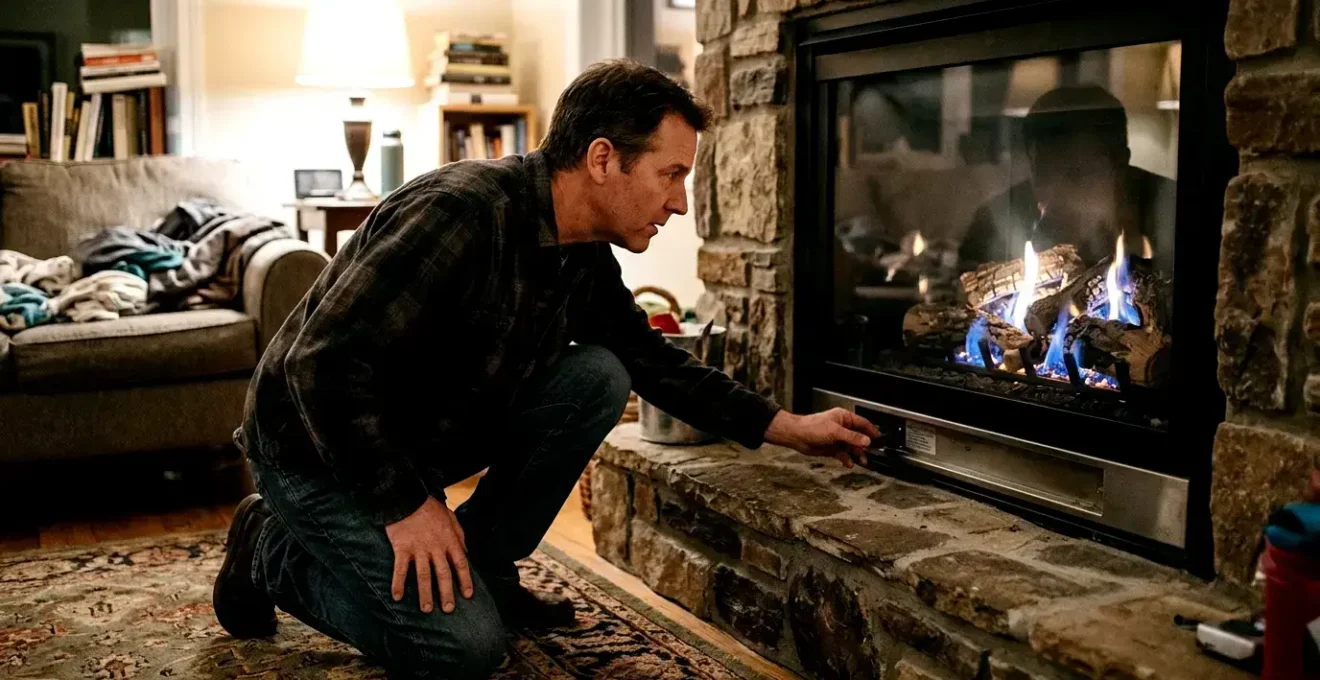
Gas fireplace burner problems often reveal themselves through uneven flames, delayed ignition, soot on the glass, or a burner that repeatedly shuts down. These symptoms may originate in the burner itself, but faulty ignition components, restricted ventilation, incorrect log placement, or gas supply problems can produce similar behaviour.
The important distinction is between an observation that warrants routine servicing and a warning sign that makes continued operation unsafe. A decorative yellow flame is not automatically dangerous, just as a blue flame does not guarantee correct combustion. Flame appearance must be assessed against the manufacturer’s specifications and the appliance’s usual operating pattern.
Homeowners can identify many warning signs without touching internal components. However, diagnosing gas pressure, adjusting combustion airflow, or repairing the ignition system requires an appropriately qualified gas appliance technician.
The following guidance explains what each symptom may indicate, which checks can be performed safely, and when the fireplace should remain switched off until professional inspection.
Gas fireplace burner problems: essential safety decisions
- Uneven flames, weak ignition, and unexpected shutdowns can indicate burner contamination, ignition faults, incorrect media placement, or ventilation problems.
- Observe flames through the glass, check accessible controls and batteries, and record symptoms without dismantling the appliance.
- Stop using the fireplace if soot appears, combustion fumes are suspected, flames escape their intended pattern, or anyone develops symptoms consistent with carbon monoxide exposure.
- Why Does a Gas Fireplace Burner Produce Uneven or Unusual Flames?
- How to Check Gas Fireplace Burner Symptoms Without Dismantling the Appliance?
- Ignition Fault or Burner Problem: Why Won’t a Gas Fireplace Light Properly?
- Why DIY Gas Burner Adjustments Can Create Carbon Monoxide Risks
- When Should You Stop Using a Gas Fireplace With an Unusual Flame Pattern?
- Why Can a Blocked Gas Fireplace Vent Cause Poor Operation?
- How to Check a Fireplace Firebox for Rust, Cracks and Loose Components?
- How to Recognise Ventilation System Problems in a Gas Fireplace?
Why Does a Gas Fireplace Burner Produce Uneven or Unusual Flames?
A gas fireplace burner can produce unusual flames when combustion airflow changes, burner ports become obstructed, decorative logs are incorrectly positioned, or gas pressure is unsuitable. The resulting flames may look lazy, uneven, excessively forceful, or detached from the burner. Their significance depends on the appliance design, manufacturer specifications, and whether soot or other warning signs accompany them.
A properly operating fireplace should produce a stable flame pattern consistent with its manufacturer’s reference illustrations. Blue combustion flames are common, particularly near burner ports, while many decorative gas fireplaces deliberately produce visible yellow flames resembling a wood fire.
Consequently, flame colour alone cannot establish whether combustion is safe. Shape, stability, location, soot formation, and changes from the usual appearance are more useful observations.
Different flame behaviours suggest different conditions:
- Lazy or excessively yellow flames: may indicate insufficient combustion air, restricted burner openings, or incorrect decorative media placement, particularly when accompanied by soot.
- Flames lifting away from burner ports: may be associated with excessive primary air or other combustion-setting problems.
- Uneven flames across the burner: can result from obstructed ports, contamination, or other gas distribution issues.
- Unusually aggressive or roaring flames: may indicate excessive gas flow, incorrect combustion conditions, or a problem involving the appliance’s sealed combustion system.
The Napoleon Haliburton installation and operation manual explains that restricting an air shutter can produce yellower flames and carbon deposits, while increasing primary air can cause flames to lift from burner openings. These observations apply to the specified appliances and should not be treated as universal flame-colour standards.
Dust and lint can accumulate around fireplace components during periods of disuse. Obstructed burner ports may prevent uniform gas distribution, while incorrectly positioned logs can redirect flames onto surfaces where they should not burn.
Persistent flame impingement and incomplete combustion can leave carbon deposits on glass, logs, and combustion-chamber surfaces. Accumulation may progressively interfere with normal operation and increase maintenance requirements.
Homeowners can notice these conditions, but determining whether a burner requires cleaning, pressure testing, or combustion adjustment is a professional task.
If a flame pattern has changed, the next useful step is careful observation without disturbing the burner, logs, glass, or gas controls.
How to Check Gas Fireplace Burner Symptoms Without Dismantling the Appliance?
Homeowners can check gas fireplace burner symptoms by observing the flame through intact glass, listening during ignition, noting unusual smells, and checking for soot or persistent condensation. These observations require no tools and can help identify problems before a service visit. They cannot confirm combustion safety, however, and suspected gas leaks or carbon monoxide exposure require immediate action rather than further testing.
Begin with the fireplace switched off and completely cold. Inspect only surfaces that are normally visible and accessible without removing panels, logs, burner media, or sealed glass assemblies.
Look for deposits on the glass, changes in log positioning, damaged visible components, and any unusual staining around the fireplace enclosure.
If there are no warning signs and operation is otherwise normal, compare the next startup with the appliance’s documented or previously observed behaviour. Note whether ignition occurs promptly, whether the flame stabilises, and whether its appearance changes after several minutes.
Some decorative gas fireplaces require a warm-up period before their final flame appearance develops. The appropriate observation period must come from the particular appliance manual rather than a universal timing rule.
The following decision grid helps convert observations into practical action.
| Severity | Observation | Recommended action |
|---|---|---|
| Cosmetic | A stable flame with expected decorative yellow tips and no other symptoms | Compare with the manufacturer’s normal flame reference. |
| Monitor | A minor appearance difference without soot, odours, or unstable combustion | Record the observation and arrange advice if the change persists. |
| Call soon | Repeated ignition failure, intermittent shutdowns, or unexplained changes in flame distribution | Stop attempting repeated starts and schedule qualified servicing before further operation. |
| Stop using now | New soot, suspected exhaust spillage, gas odour, flames outside their intended area, or possible carbon monoxide symptoms | Discontinue operation and follow the relevant emergency precautions. |
The distinction matters because removing the glass or rearranging decorative logs can invalidate the observation. Many direct-vent fireplaces rely on a sealed combustion chamber, and disturbing its components may alter airflow or flame contact.
Five safe observations to record before contacting a technician
- Identify the appliance’s make and model from accessible documentation or an externally accessible identification label; record the model reference.
- Inspect the cold fireplace through its glass without opening the combustion chamber; record any visible deposits, damage, or displaced media.
- If operation is free of warning signs, observe one normal startup according to the manufacturer’s instructions; record whether ignition is prompt or delayed.
- Compare the established flame pattern with the manufacturer’s reference and previous normal behaviour; write down any persistent differences.
- Document whether symptoms occur immediately, after warming, or alongside household exhaust-fan operation; prepare a concise symptom report for the technician.
A dated record or photograph taken safely through the glass can be useful, but do not continue operating a malfunctioning fireplace simply to gather additional evidence.
If observation reveals that the burner does not light reliably, the next diagnostic question is whether the fault begins with ignition or develops after the flame is established.
Ignition Fault or Burner Problem: Why Won’t a Gas Fireplace Light Properly?
A gas fireplace may fail to light because its ignition system cannot produce a spark, gas is not igniting correctly, or the flame-sensing system prevents continued operation. These failures can look similar to homeowners but involve different components. Battery checks may be appropriate on some models; persistent ignition failures require qualified servicing rather than repeated attempts to relight the appliance.
The first distinction is whether the fireplace produces an ignition spark. On electronically controlled models, discharged remote-control or receiver batteries may prevent normal startup. A defective igniter, control module, or electrical connection can produce similar symptoms.
If a spark is present but no flame develops, possible causes include a pilot ignition problem, a gas supply fault, or an ignition component that is not functioning correctly. Hearing ignition attempts does not prove that gas is flowing.
A different fault occurs when the pilot lights but the main burner does not activate, or when a flame establishes and subsequently disappears.
Some older pilot systems use a thermocouple or thermopile to detect heat from the pilot flame and help maintain safe gas-valve operation.
A thermopile generates a small electrical signal, commonly measured in millivolts, when heated. If the pilot flame does not adequately contact the sensor or the signal is insufficient, the valve may not operate as intended.
Other fireplaces use electronic flame rectification rather than thermocouple-based sensing. A technician must identify which system is installed before diagnosing the fault.
| Observed symptom | Possible explanation | Homeowner response |
|---|---|---|
| No ignition response or spark | Control batteries, power supply, igniter, or electronic controls | Check only user-accessible power and battery provisions. |
| Spark occurs but no ignition | Pilot assembly, ignition components, or gas supply fault | Stop repeated attempts and arrange servicing. |
| Pilot lights but main burner stays off | Flame-sensing, valve, or control-system problem | Request professional diagnosis. |
| Burner lights then shuts down | Flame detection, control lockout, or another protective shutdown | Discontinue operation until the cause is established. |
Some electronic ignition systems enter a safety lockout after unsuccessful attempts. This helps prevent uncontrolled repetition of the ignition sequence.
Do not bypass the lockout or assume every model has the same reset procedure. Follow only the user instructions supplied for the installed fireplace. If the fault returns, discontinue ignition attempts.
The Napoleon Ascent Deep Series installation manual distinguishes spark, gas supply, flame-sensing, receiver, and ignition-lockout issues in its troubleshooting guidance.
Repeated failed starts are therefore useful diagnostic evidence, not an invitation to continue pressing the ignition control. An abnormal ignition sequence may also be accompanied by delayed flame establishment or soot, which requires assessment of the combustion system.
Once ignition or flame-sensing components are suspected, internal adjustments should be left to qualified personnel because apparently small changes can affect combustion safety.
Why DIY Gas Burner Adjustments Can Create Carbon Monoxide Risks
DIY gas burner adjustments can increase carbon monoxide risk by changing the balance between fuel, combustion air, and flame placement. Altering an air shutter, regulator, burner orifice, or decorative log arrangement may cause incomplete combustion. Carbon monoxide has no smell or colour, so a fireplace cannot be considered safe merely because no unusual odour is present.
Gas burners are designed to operate within specific combustion conditions. Fuel must mix with sufficient air, ignite correctly, and release combustion products through the intended exhaust system.
Changing an air shutter affects the amount of primary air entering the burner. Reducing that supply can produce longer, yellower flames and increase the likelihood of carbon deposits. Excessive primary air can cause flames to separate from their ports.
Incorrect gas pressure or burner-orifice selection can also change combustion characteristics. These settings are not appropriate for trial-and-error adjustment by homeowners.
Decorative log placement creates another risk. Logs and burner media are arranged to guide flames through specified spaces. Moving them can cause flames to strike glass or internal surfaces, potentially producing soot and localised overheating.
Some manufacturers provide user-accessible flame-height controls or explicitly permit limited media handling. Such permissions are model-specific and should not be confused with authorisation to modify combustion settings.
Before touching any component, establish whether the appliance’s owner manual specifically permits the action. If it does not, treat the component as service-only.
Unauthorised adjustments can also create warranty, compliance, and insurance complications. Whether a particular consequence applies depends on the manufacturer’s warranty terms, local gas-safety requirements, applicable certification rules, and insurance policy. No universal loss of coverage should be assumed.
The immediate safety concern is carbon monoxide. According to the CDC guidance on carbon monoxide poisoning, exposure can cause headaches, dizziness, weakness, nausea, chest pain, and confusion. Severe exposure can be fatal.
“Carbon monoxide (CO) is an odorless, colorless gas that kills without warning.”
Carbon monoxide alarms provide an important additional warning layer. Install and maintain alarms according to local requirements and the alarm manufacturer’s instructions, including appropriate locations near sleeping areas.
However, an alarm does not measure whether a burner is correctly adjusted and cannot replace professional combustion inspection. A silent alarm is not proof of safe operation.
If headaches, dizziness, unusual drowsiness, or other possible exposure symptoms occur while the fireplace operates, stop using it, get everyone into fresh air, and seek urgent medical or emergency assistance. Do not remain inside to investigate.
Rather than attempting to correct an abnormal flame manually, the safer decision is to recognise which symptoms justify immediate shutdown and which require scheduled professional attention.
When Should You Stop Using a Gas Fireplace With an Unusual Flame Pattern?
Stop using a gas fireplace when unusual flames are accompanied by soot, suspected combustion fumes, gas odours, visible damage, or possible carbon monoxide symptoms. Flames burning outside their intended area and repeated abnormal ignition also require attention. A fireplace showing these signs should remain off until the underlying cause has been assessed and corrected by a qualified technician.
Some flame variations are part of normal decorative operation. However, new soot deposits, flame impingement, and signs of exhaust spillage should not be dismissed as harmless differences in appearance.
Stop operation and arrange an assessment if any of the following occur:
- Floating or unusually lazy flames accompanied by black soot on glass or logs.
- Flames striking areas outside the manufacturer’s intended burner or log arrangement.
- Unusual combustion-related odours, fumes, or persistent smoke-like deposits.
- Visible firebox cracking, damaged glass, or deterioration affecting the combustion enclosure.
- Repeated delayed ignition, hard ignition, or unexpected burner shutdowns.
- Headaches, dizziness, confusion, or unusual drowsiness while the appliance is running.
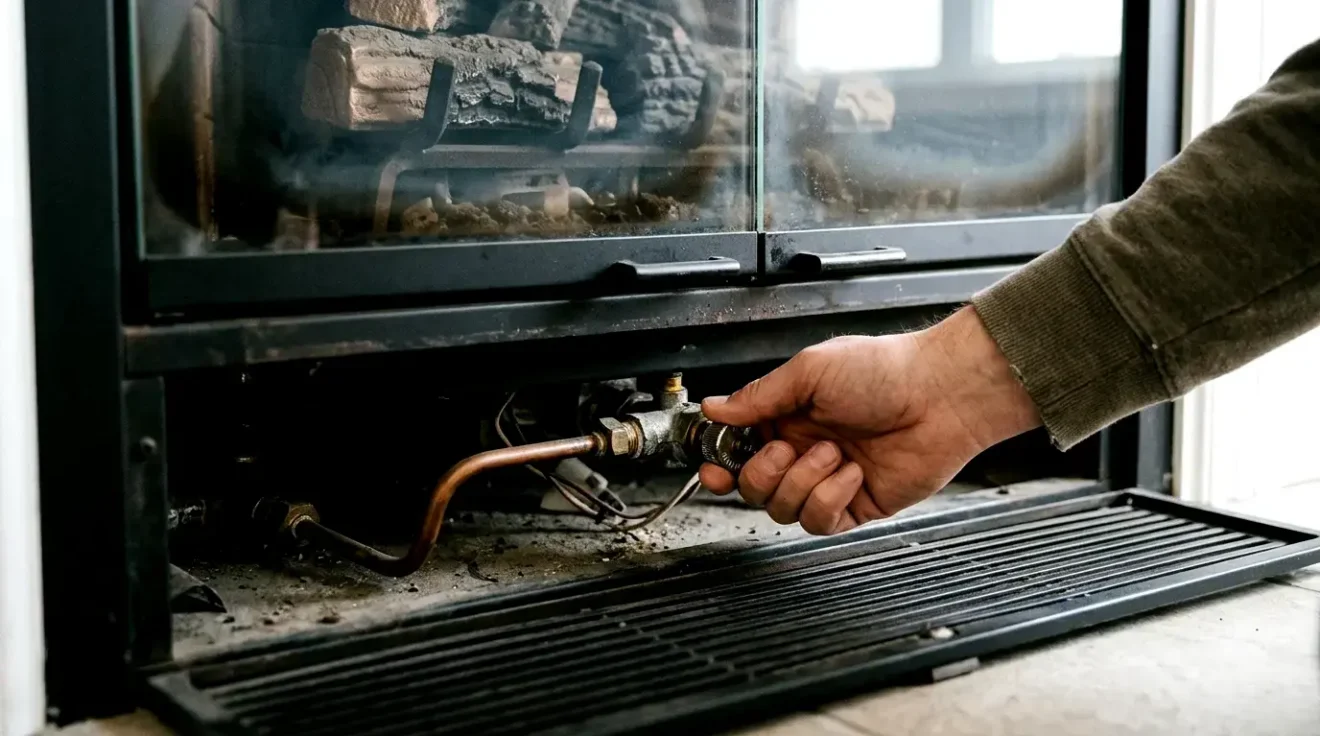
The appropriate shutdown depends on the hazard. For an abnormal flame without suspected gas leakage or exposure symptoms, use the manufacturer’s normal off control. If the appliance instructions permit safe access to a dedicated shut-off valve, it may also be closed without dismantling anything.
Do not reach into a hot compartment, remove a sealed panel, or manipulate unfamiliar valves.
If gas is smelled, do not attempt to operate the fireplace, electrical switches, or nearby equipment. Leave the building, avoid ignition sources, and contact the gas emergency service or supplier from a safe location outside.
If carbon monoxide exposure is suspected or an alarm activates, evacuate to fresh air and contact emergency services. Do not stay inside to ventilate the building, locate the fault, or shut off gas.
The property’s main gas supply shut-off is separate from the fireplace’s appliance valve. It should only be operated when appropriate to the emergency and safely accessible, in accordance with local emergency instructions. It is not a substitute for evacuation.
There is an important distinction between an appliance awaiting routine maintenance and one that should not be relit. A fireplace showing only expected decorative flame variation may continue to be operated according to its manual. A fireplace with unexplained soot, unsafe ignition behaviour, or suspected venting problems should not be used while awaiting service.
Intermittent operation does not make a serious fault less important. A problem that disappears after restarting may still involve an unstable combustion or safety-control condition.
When professional inspection is arranged, the technician should consider not only the burner but also the venting system, because restricted exhaust or combustion airflow can produce similar symptoms.
Why Can a Blocked Gas Fireplace Vent Cause Poor Operation?
A blocked gas fireplace vent can disrupt the movement of combustion air and exhaust gases, causing unstable flames, soot formation, ignition problems, or protective shutdowns. Bird nests, debris, snow accumulation, and damaged vent terminals are possible causes. Because these symptoms resemble burner faults, a technician should evaluate the venting arrangement before assuming the burner itself needs adjustment or replacement.
Gas fireplaces use different ventilation arrangements. A direct-vent appliance generally draws combustion air from outside and discharges exhaust through a designed vent system. A conventional B-vent appliance typically relies on indoor combustion air and natural draft to evacuate combustion products.
These systems operate differently, but both depend on appropriate airflow and unobstructed exhaust paths.
When intake or exhaust flow is restricted, combustion conditions may change. Flames can appear lazy, combustion deposits may develop, and safety devices may interrupt operation on appliances equipped with relevant protection systems.
The difficulty is that these observations do not identify the exact obstruction. A dirty burner, incorrect decorative media position, unsuitable gas pressure, and venting restriction can all produce overlapping symptoms.
For this reason, vent inspection is part of burner diagnosis, not an unrelated maintenance task.
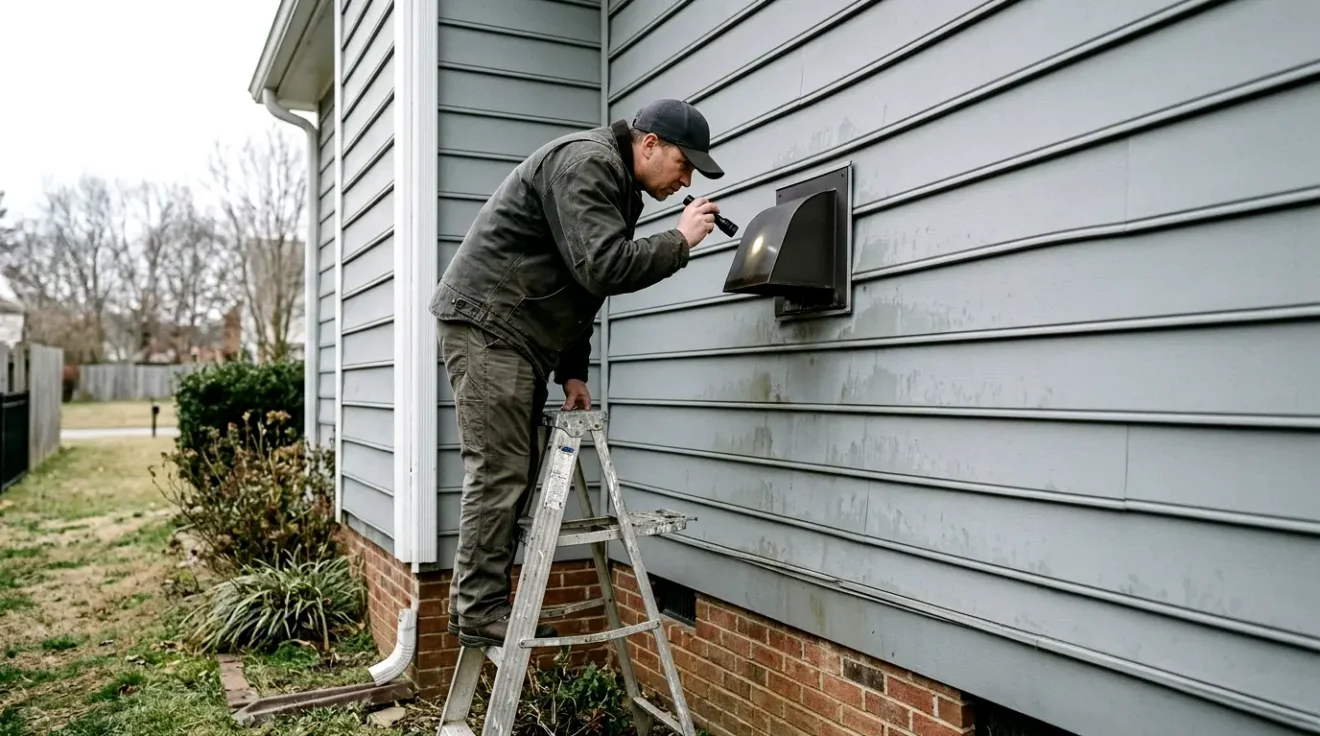
Where an exterior vent termination is safely visible from ground level, homeowners can look for:
- Debris, vegetation, nests, or snow obstructing visible vent openings.
- Discolouration or apparent overheating around the termination.
- A loose, corroded, damaged, or displaced vent cap.
- Moisture staining around the exterior wall penetration.
- Symptoms that become more noticeable during windy weather or particular outdoor conditions.
These clues are not proof of a blocked vent. Moisture staining can have other causes, and wind-related behaviour may involve terminal placement, draft characteristics, or a separate appliance problem.
Do not insert objects into vent openings, remove vent caps, climb onto roofs, or attempt to clear inaccessible restrictions. A venting technician should determine whether airflow, installation, or component integrity is responsible.
A suspected obstruction becomes particularly serious when accompanied by combustion odours, soot, or possible exhaust spillage. Under these conditions, continued use is inappropriate because combustion products may not be leaving the appliance as intended.
The same external conditions that affect venting can also cause moisture-related deterioration inside the fireplace, making a cold firebox inspection another useful part of seasonal maintenance.
How to Check a Fireplace Firebox for Rust, Cracks and Loose Components?
A fireplace firebox can be checked for visible rust, cracks, and displaced components by inspecting it through the glass while the appliance is completely off and cold. Rust streaks may indicate moisture exposure, cracks can signal damaged heat-resistant materials, and shifted logs may disrupt combustion. The urgency depends on the component affected, the extent of damage, and the manufacturer’s maintenance criteria.
Start by looking at the firebox floor, visible rear and side panels, burner surroundings, and decorative logs. Use ordinary room lighting and a safe viewing position without removing the sealed glass assembly.
Three groups of findings deserve separate consideration.
- Rust and mineral deposits: rust streaks may indicate moisture entering or accumulating within the appliance. White deposits can also be associated with moisture or material changes, but their cause cannot be confirmed visually.
- Cracks and panel deterioration: fine surface lines may result from normal thermal cycling in certain refractory materials. Growing cracks, displaced sections, or damage exposing underlying components require professional assessment.
- Loose logs or burner media: displaced decorative components may redirect flame contact, contribute to deposits, or obstruct intended combustion paths.
Not every visible line in a refractory panel means immediate replacement is required. Some manufacturers accept limited surface crazing, while others specify replacement criteria for damaged liners.
However, a homeowner should not assume that every hairline crack is cosmetic. The material type, crack depth, location, and relationship to the appliance’s heat shielding matter.
A crack in structural metal, damage to the combustion enclosure, or deterioration affecting glass seating or seals is more concerning than superficial marking on a decorative liner. If the integrity of a critical component is uncertain, leave the fireplace off until it has been inspected.
Similarly, minor discolouration should not automatically be treated as proof of severe corrosion. Persistent rust, moisture intrusion, or deterioration near burner and valve components warrants investigation because corrosion can eventually affect mechanical and gas-control assemblies.
Do not reposition logs to improve flame appearance unless the manufacturer’s homeowner instructions explicitly permit it. Their arrangement may determine how flames travel through the firebox.
The annual pre-season inspection provides a useful opportunity to compare the appliance with its previous condition. A record of visible changes, first ignition behaviour, and established flame appearance can help a technician investigate emerging defects.
Visible firebox deterioration also raises a broader question: whether moisture, air movement, or exhaust-system defects are contributing to the appliance’s changing performance.
Key takeaways before assessing the complete ventilation system
- A flame problem may originate in the burner, firebox, ignition controls, or venting system; appearance alone cannot locate the fault.
- Wind-related changes, exterior vent damage, and moisture deposits are useful clues to record together rather than treating as separate issues.
- Suspected exhaust spillage or occupant symptoms override routine troubleshooting: evacuate when exposure is suspected and obtain appropriate professional assistance.
How to Recognise Ventilation System Problems in a Gas Fireplace?
Gas fireplace ventilation problems can be recognised through abnormal combustion, soot, moisture staining, exhaust odours, or changes in operation linked to wind and household air pressure. Causes may include partial vent restrictions, deteriorated components, disconnected vent sections, or backdrafting. These symptoms require assessment in the context of the fireplace’s vent design and should never be diagnosed from flame colour alone.
A completely blocked vent is only one possible failure. Partial restrictions can reduce airflow without entirely preventing operation, while damaged or incorrectly connected sections may compromise the intended exhaust path.
Atmospheric or naturally drafted fireplaces may also be affected by negative indoor air pressure. Powerful kitchen range hoods, bathroom extractors, and other exhaust systems can remove air from a building faster than replacement air enters.
Under certain conditions, this pressure difference can interfere with chimney draft or encourage combustion gases to spill into occupied spaces.
Direct-vent appliances generally separate their combustion circuit from indoor air, so their response to house depressurisation differs from that of open-combustion or B-vent systems. Nevertheless, damaged seals, incorrect vent installation, and other defects can undermine their intended operation.
A safe observation for a fireplace that has otherwise been operating normally is to note whether previously observed symptoms coincide with normal household ventilation activity. For example, a homeowner may have noticed that ignition or flame behaviour changes when a range hood is running.
This relationship is a clue, not a diagnostic test. Do not deliberately reproduce an unsafe symptom by operating the fireplace with additional exhaust fans. If combustion instability, fumes, or possible spillage have been observed, discontinue use and report the conditions to the technician.
Other ventilation-related warning signs include:
- Persistent or unusual condensation on the fireplace glass during operation.
- Moisture staining around a vent route or nearby interior surfaces.
- Heat damage or discolouration above the fireplace enclosure.
- Exhaust-related odours or unexplained indoor air-quality changes.
- Headaches, dizziness, or other possible exposure symptoms occurring while the fireplace operates.
Some brief glass condensation may be normal during a cold startup on particular models. Persistent condensation is not automatically evidence of exhaust spillage, and wall staining can have unrelated causes. Nevertheless, new or persistent changes justify professional examination, particularly when multiple symptoms appear together.
The technician’s assessment may need to cover vent integrity and termination, combustion-air availability, burner condition, gas pressure, ignition performance, flame sensing, and the correct positioning of internal components.
These checks are connected: an obstructed vent can change combustion behaviour, a misplaced log can produce soot, and an ignition-control fault can prevent stable burner operation. Identifying the actual cause prevents a visible symptom from being treated as the entire problem.
For practical decision-making, normal decorative flame variation belongs in routine observation, unexplained ignition or flame changes justify a service appointment, and suspected combustion-product spillage calls for immediate discontinuation of use and appropriate emergency precautions.
If the fireplace has developed unexplained soot, abnormal ignition, unstable flames, or ventilation-related warning signs, leave it switched off and arrange an inspection by a technician qualified under the rules applicable in your country or region. Provide the appliance model, maintenance history, and recorded symptoms so the technician can assess the complete combustion system rather than adjusting the burner in isolation.
Is a yellow flame always a sign of a faulty gas fireplace burner?
No. Many decorative gas fireplaces are designed to produce yellow flames, particularly after warming up. The relevant comparison is the manufacturer’s specified flame appearance. New soot, unusually lazy flames, or an unexpected change in flame distribution may indicate a combustion problem and should be assessed by a qualified technician.
Can a gas fireplace produce carbon monoxide without a noticeable smell?
Yes. Carbon monoxide is colourless and odourless. An absence of gas or exhaust smells does not establish safe combustion. Properly maintained carbon monoxide alarms provide an additional detection measure, while qualified appliance servicing and correct venting remain essential. If an alarm activates or exposure is suspected, evacuate and seek emergency assistance.
How often should a gas fireplace burner and venting system be inspected?
Annual inspection and servicing by an appropriately qualified professional is a common manufacturer and public health recommendation. The technician should follow the requirements of the installed appliance and applicable local regulations. Additional servicing may be necessary when ignition faults, soot, corrosion, damaged vent components, or other abnormalities appear between scheduled inspections.
Can replacing remote-control batteries fix a gas fireplace that will not light?
Sometimes. Certain electronic ignition systems depend on batteries in the remote control or receiver, and replacing depleted batteries may restore normal operation. Follow the appliance instructions and use only user-accessible battery compartments. If ignition still fails, repeated resets are not an appropriate substitute for professional fault diagnosis.
Should a gas fireplace be used while waiting for a technician?
Not when an unresolved safety-related fault is suspected. Soot, abnormal ignition, unstable flames, damaged combustion components, or possible venting problems warrant discontinuing use until the appliance has been assessed. If there is a gas smell or suspected carbon monoxide exposure, follow the relevant emergency evacuation procedures rather than continuing routine troubleshooting.