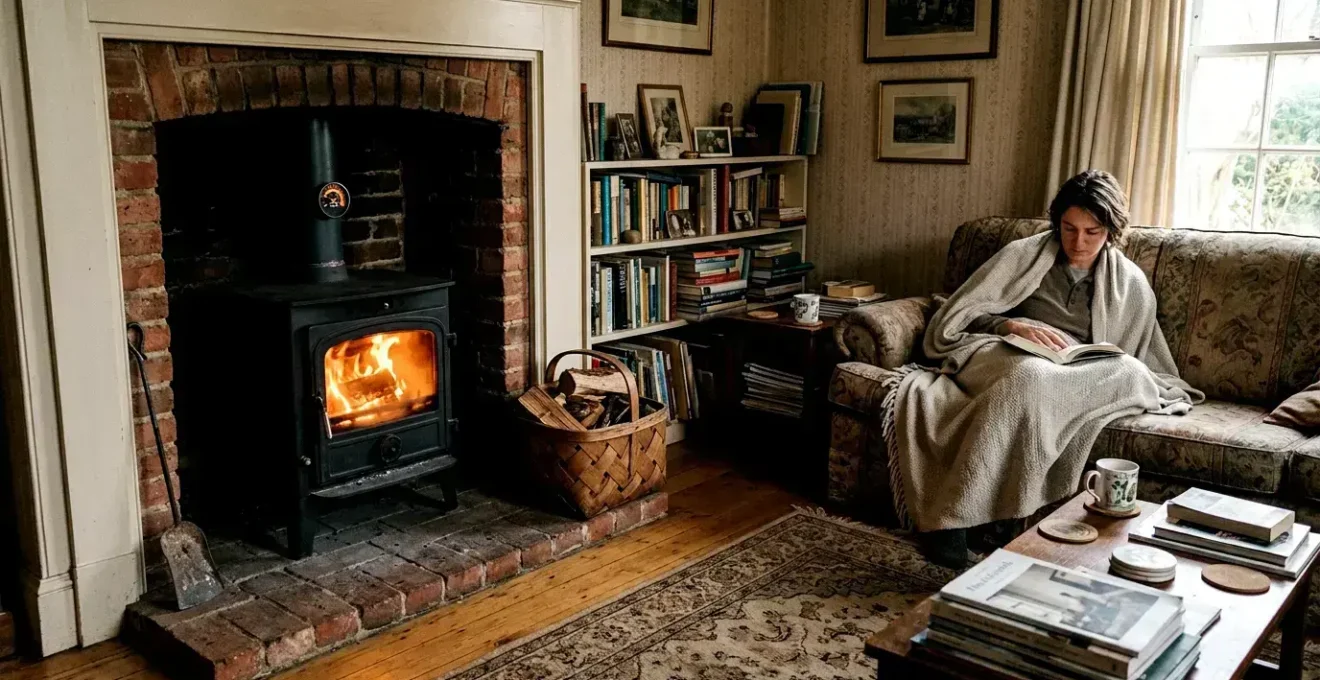
The right fireplace heat output is the amount of usable heat your living room needs to stay comfortable under the conditions in which you actually use it. It is not necessarily the highest kilowatt or BTU rating available, and it cannot be determined reliably from floor area alone.
A compact, well-insulated living room may need relatively little supplementary heat, while an equally sized room with draughty windows, exposed walls and poor insulation can lose heat much faster. Open-plan layouts, high ceilings and the way warmth circulates also influence the capacity that makes sense.
For a reliable choice, estimate the room’s heat loss, establish which spaces the fireplace should warm, and compare that demand with the appliance’s sustainable operating output. In the UK and other countries using metric specifications, output is commonly expressed in kilowatts (kW). North American specifications may also use British thermal units per hour (BTU/h). One kilowatt is approximately 3,412 BTU/h.
1 kilowatt is approximately 3,412 BTU/h.
The goal is straightforward: enough heat for comfort, without buying an appliance that must constantly be restrained to prevent overheating.
Fireplace heat output: the essentials
- Calculate heat demand, not just room size. Insulation, air leakage, glazing and outdoor conditions determine how much heat the room loses.
- Compare normal operating output. A fireplace’s nominal output and usable operating range matter more than an impressive maximum rating.
- Account for where heat travels. Open layouts, tall ceilings and nearby rooms can change whether fireplace heat actually reaches the occupied area.
- Why Does a Well-Insulated Room Need Less Fireplace Heat Than an Older Room?
- How to Estimate Fireplace Heating Capacity for an Open-Plan Living Area?
- Nominal or Maximum Heat Output: Which Fireplace Rating Matters More?
- Why an Oversized Wood Stove Can Make a Small Living Room Uncomfortable
- How to Adjust Fireplace Heat Requirements for a Double-Height Living Room?
- Radiant or Convection Heat From a Fireplace for a High-Ceilinged Room?
- When Should You Use Fireplace Zone Heating Instead of Increasing the Main Thermostat?
- Are High-Efficiency Fireplace Inserts Worth Installing in an Older Home?
Why Does a Well-Insulated Room Need Less Fireplace Heat Than an Older Room?
A well-insulated living room needs less fireplace heat because it loses warmth more slowly through its walls, roof, windows and uncontrolled air leaks. Two rooms with identical floor areas can therefore have substantially different heating requirements. The appropriate fireplace capacity depends on the rate of heat loss, not simply on how much space the room occupies.
Heat loss is normally expressed in watts or BTU/h. It represents the heating power needed to replace the warmth escaping from a room under specified indoor and outdoor conditions. Better insulation reduces heat transfer through building materials, while improved airtightness limits unwanted movement of cold outdoor air into the home.
An older house may have single glazing, poorly insulated external walls, gaps around window frames or an uninsulated roof space. By contrast, a renovated property with effective insulation and modern windows can retain much more of the heat produced by the same appliance.
A practical first assessment is to classify the room as recently built to a suitable energy standard, substantially renovated, or older and largely unimproved. This is a preliminary description rather than a verified heat-loss rating.

Check window condition, visible gaps around doors, loft insulation where accessible, cold wall surfaces and obvious thermal bridges. A carefully performed smoke observation can reveal draughts around closed frames, provided the test is conducted safely and away from combustible materials. The U.S. Department of Energy‘s Consumer Guide to Air Sealing the Home identifies common leakage locations and explains why insulation, airtightness and ventilation must be considered together.
Ceiling height adds another consideration. Multiplying floor area by ceiling height gives room volume, which helps describe the space and air distribution. However, volume alone does not determine heat loss: the exposed surfaces, their thermal performance and air exchange remain essential.
Combustion air is a separate safety requirement. An airtight room may require a specifically designed air supply for a wood stove or fireplace insert. The arrangement depends on appliance design, building conditions and local installation rules.
A professional room-by-room heat-loss calculation provides a firmer basis than building age or a general insulation category. Once that demand is understood, the next question is how much of the surrounding living space the fireplace should actually heat.
How to Estimate Fireplace Heating Capacity for an Open-Plan Living Area?
Estimate fireplace capacity for an open-plan living area by identifying the entire connected space that may receive heat, then deciding whether the appliance should warm all of it or primarily serve one occupied zone. Floor-area rules designed for enclosed rooms become less reliable when warm air can move freely into adjacent kitchens, dining areas, hallways or mezzanines.
Begin by measuring the connected floor areas and their ceiling heights. For a space with a uniform ceiling, multiply floor area by height to obtain its volume. Where ceiling levels differ, calculate each section separately and add the volumes.
Volume is a useful description of the space, but the required heat output still depends on heat losses through exposed surfaces and ventilation. A large interior area surrounded by heated rooms may need less additional heat than a smaller extension with extensive external glazing.
Hypothetical example: an open-plan living space
Consider a living room measuring 5 m by 4 m, connected without doors to a 4 m by 3 m kitchen. Both have a hypothetical ceiling height of 2.5 m. The combined floor area is 32 m² and the connected volume is 80 m³.
If the fireplace is intended to warm the entire connected space, both areas must be assessed for heat loss. If its purpose is mainly to provide comfort around the living-room seating area, the practical solution may instead involve targeted radiant heating and appropriate circulation. The measurements alone do not establish a required kW rating.
Next, observe how air actually moves. Open staircases can carry warm air towards upper floors. Mezzanines may collect heat above the occupied area. Wide passages allow temperature differences to diminish across connected rooms, although the resulting distribution is rarely uniform.
A useful observation is to compare room temperatures and draught sensations with connecting doors in their normal positions. Record whether neighbouring areas become noticeably warmer when the existing heating operates. This helps identify where fireplace heat may travel, although it does not replace a thermal assessment.
In an open layout, heat distribution can matter as much as rated output. Where central heating already supports adjoining rooms, a modest supplementary appliance with effective heat circulation may provide better comfort than a powerful stove that overheats the seating area before distant rooms warm up.
The HETAS consumer FAQs on stove sizing and installation reinforce the importance of assessing the space and property-specific conditions rather than relying on a simple room-size figure.
The resulting heating target should describe a real use case: whole-area heating, supplementary warmth or localized comfort. That distinction makes the technical output ratings on competing fireplaces much easier to interpret.
Nominal or Maximum Heat Output: Which Fireplace Rating Matters More?
Nominal heat output is generally the more useful rating when choosing a fireplace for everyday heating because it describes a declared operating output under defined test conditions. Maximum output usually represents a higher level achievable under particular conditions, not necessarily a sustainable or desirable operating point. The appliance’s usable output range is equally important.
For example, a manufacturer may advertise a high peak output while specifying a lower nominal rating. That does not mean the appliance will deliver its maximum output continuously, nor that it will remain efficient and clean at any arbitrarily low setting.
Wood-burning appliances behave differently from fully modulating gas or electric heaters. Their heat production depends on fuel loading, wood moisture, combustion conditions and the manufacturer’s permitted air-control settings. A stated range should therefore be understood in the context of the test procedure and operating instructions.
When comparing product specifications, use the following criteria rather than selecting the largest printed figure.
| Specification | What it tells you | How to use it |
|---|---|---|
| Nominal heat output | Declared output under specified operating or test conditions | Compare with the expected normal heating demand |
| Maximum heat output | Higher output achievable under defined conditions | Check its meaning; do not use it alone for sizing |
| Operating output range | Outputs the appliance is designed to deliver | Check whether normal and lower-demand conditions are covered |
| Efficiency | Proportion of fuel energy converted into useful heat under the stated test method | Compare only using compatible measurement conventions |
| Test standard | Conditions and procedures used to establish performance figures | Confirm that competing ratings are reasonably comparable |
Efficiency figures require particular care. Some North American wood-heater specifications use the higher heating value (HHV) of fuel, while other specifications may use a different convention. Apparently different percentages are not always directly comparable.
A proper comparison also considers seasonal operation. If a living room frequently needs only gentle supplementary warmth, the appliance must be capable of operating appropriately under those conditions rather than performing well only during a high-output test.
Do not assume that any advertised minimum output represents clean, continuous operation. Request the manufacturer’s operating documentation and verify what its stated figures actually represent.
Selecting a fireplace around an unusually high peak output creates a predictable risk: the room may become too warm during normal operation. Understanding the effects of oversizing helps prevent that mistake.
Why an Oversized Wood Stove Can Make a Small Living Room Uncomfortable
An oversized wood stove can make a small living room uncomfortable because it delivers more heat than the space can absorb without overheating. Occupants may respond by restricting combustion air to suppress the fire. If this pushes the stove outside its intended operating conditions, incomplete combustion, dirty glass, increased emissions and creosote formation can become concerns.
The underlying mismatch is between the heat the room loses and the heat the appliance produces. A stove designed to serve a larger heating load may quickly raise temperatures near the hearth while leaving occupants with limited control over the rate of heat delivery.
The symptoms can include an excessively warm seating area, repeated window opening to release heat, noticeable temperature differences across the room and frequent attempts to keep the fire burning very slowly. These signs are not conclusive individually, but together they can indicate inappropriate sizing or poor heat distribution.
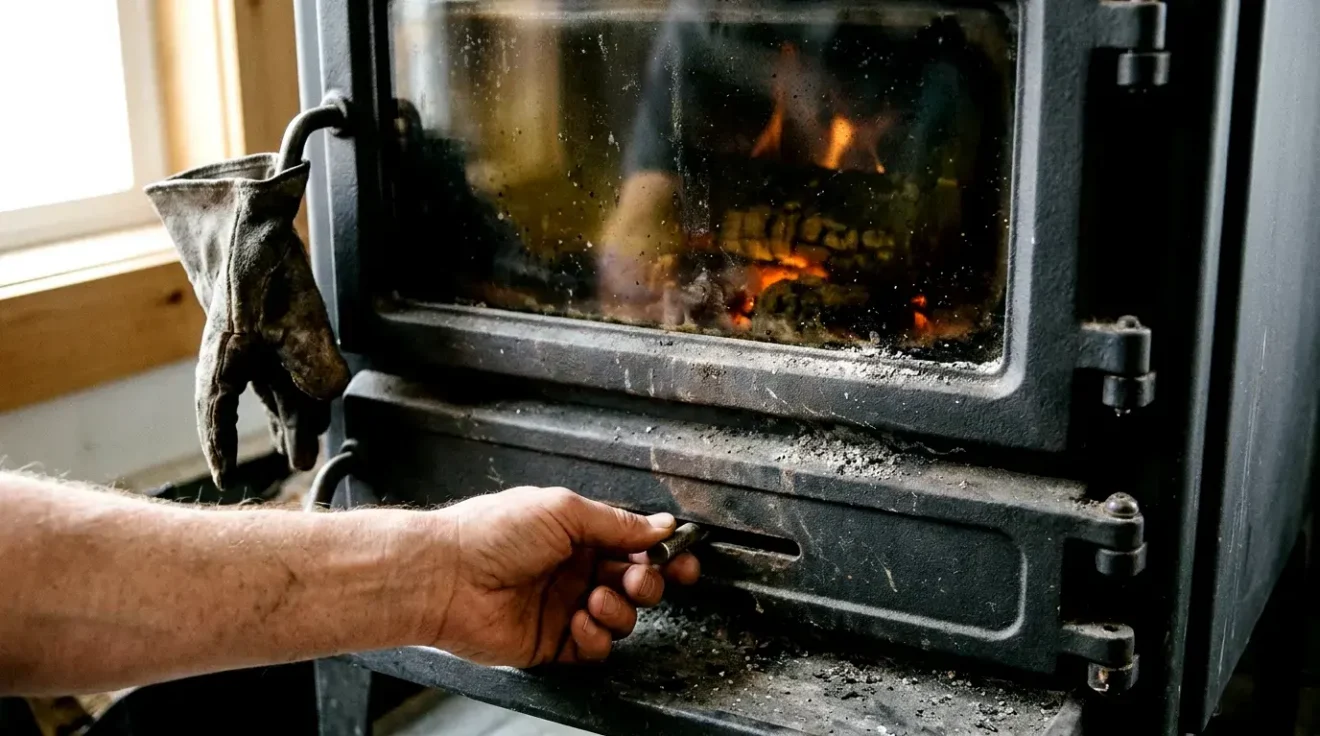
Reducing the combustion air excessively can lower firebox temperatures and prevent gases released by the wood from burning completely. Under unfavourable conditions, unburned substances can condense inside the flue as creosote. Wet fuel, cool flue gases and inadequate maintenance can compound the problem.
The U.S. EPA‘s FAQs on wood-burning appliances describe the relationship between combustion conditions, wood-heater performance and creosote. This archived technical guidance remains useful for explaining combustion principles, although it is not a current statement of international appliance regulations.
Oversizing may also undermine the economics of a purchase. A larger appliance can involve a higher initial cost, and repeatedly wasting heat through open windows or inefficient operation can offset potential fuel savings. A correctly sized stove operated within its intended range is preferable to one that must continually be suppressed.
This does not mean running every stove at its maximum output. Safe and efficient operation requires following the manufacturer’s fuel-loading instructions and permitted controls.
A practical post-installation check is to record room temperature, fuel loading and air-control settings during typical use. If comfortable temperatures repeatedly require the air supply to be restricted beyond recommended operating conditions, request a professional assessment of sizing, draught and combustion performance. Never defeat safety controls or block the required air supply.
Where the living room has unusually high ceilings, however, apparent overheating or uneven comfort may not come from appliance capacity alone. Warm-air stratification can create a different distribution problem.
How to Adjust Fireplace Heat Requirements for a Double-Height Living Room?
A double-height living room requires a heat-loss assessment that accounts for its taller walls, elevated glazing, roof exposure and air circulation. Warm air naturally tends to accumulate above the occupied area, so increasing fireplace output does not necessarily improve comfort at sofa level. Heat distribution and reducing losses may be more effective than selecting a larger appliance.
Ceiling height changes the geometry of the room. A taller space contains more air and may have substantially more exposed wall or window area. However, the amount of air is not a sufficient measure of steady-state heating demand: heat escaping through the building envelope and through air exchange determines the required replacement heat.
Thermal stratification becomes particularly important where much of the fireplace’s output is convective. Heated air rises towards the ceiling, potentially leaving the occupied zone cooler than the upper part of the room.
Increasing stove capacity without addressing that imbalance can make the ceiling zone hotter while producing only a limited improvement where people sit.
Several measures can improve heat delivery:
- Ceiling fans: A suitable low-speed winter setting can help mix accumulated warm air with cooler air below, subject to the fan’s design and room layout.
- Assisted heat distribution: Compatible fans or professionally designed ducting can move warmth towards occupied areas.
- Appropriate appliance positioning: Placement affects direct radiant comfort and the path of circulating air.
- Improved envelope performance: Better high-level glazing, roof insulation and airtightness can reduce the heating load itself.
A room with extensive upper-floor glazing may lose considerable heat through those surfaces, even when the area around the fireplace feels warm. A proper calculation should include the thermal performance and dimensions of the windows, walls and roof, as well as local design temperatures.
It is also important to separate two different goals: warming the entire double-height space and keeping the lower occupied zone comfortable. The first calls for adequate overall heating capacity and distribution; the second may benefit more from direct radiant heat.
A raw room-volume calculation cannot determine either outcome reliably. A large volume does not automatically justify proportionally increasing appliance output, and ignoring the additional exposed surfaces can underestimate genuine heat loss.
Once heat loss and stratification are understood, the balance between radiant and convective heating becomes a useful criterion for selecting the appliance itself.
Radiant or Convection Heat From a Fireplace for a High-Ceilinged Room?
Radiant fireplace heat is often particularly useful in high-ceilinged rooms when the priority is comfort near the fire, because it warms people and surfaces directly. Convection is more useful when the objective is to raise the general air temperature, but warm air may accumulate overhead. Many modern appliances combine both forms of heat transfer.
Radiant heat travels from warmer surfaces and the fire towards cooler objects through thermal radiation. A person facing the fireplace can feel warmer even when the surrounding air temperature changes relatively little.
Convective heating transfers energy to the surrounding air. As this air warms, its buoyancy encourages upward movement. In a high-ceilinged room, circulation patterns may leave some of the supplied warmth concentrated above the occupied zone.
A traditional open fireplace can provide noticeable radiant warmth to people directly in front of it. Nevertheless, that immediate sensation should not be confused with efficient whole-room heating. Open fireplaces can draw substantial indoor air into the chimney, sometimes increasing the heating burden elsewhere in the home.
Modern enclosed stoves and fireplace inserts can deliver both radiation through their hot surfaces and glass, and convection through air movement around the appliance. Designs vary considerably, so the presence of a large visible flame does not by itself establish heating performance.
| Decision factor | Radiant emphasis | Assisted convection |
|---|---|---|
| Main purpose | Comfort in a defined occupied area | Warming a broader connected space |
| Immediate sensation | Direct warmth when facing the appliance | More dependent on air circulation |
| High-ceiling challenge | Limited coverage outside the radiant zone | Potential accumulation of warm air overhead |
| Practical compromise | Furniture placement and line of sight | Fan noise, airflow and distribution design |
A hybrid approach can work well where both local comfort and room-wide heating matter. For example, an enclosed insert may supply radiant warmth near the hearth while a compatible circulation system distributes some of its convective output.
Forced-air accessories introduce their own considerations, including sound, air movement, maintenance and compatibility with the appliance. Any heat-distribution modification must follow the manufacturer’s requirements and applicable installation standards.
The most suitable heat-transfer approach depends on when and where the living room is occupied. That same occupancy pattern also determines whether supplementary fireplace heating can reduce demand on the home’s central system.
When Should You Use Fireplace Zone Heating Instead of Increasing the Main Thermostat?
Fireplace zone heating is most useful when people regularly occupy one living area while other rooms can safely remain at a lower temperature. Instead of raising the central thermostat for the entire home, a suitably sized fireplace supplies supplementary warmth where it is needed. Actual savings depend on fuel costs, system efficiency, occupancy and thermostat control.
Consider a household that spends most evenings in the living room while bedrooms and other spaces are unoccupied. If the central heating system allows those areas to operate at appropriate lower temperatures, a fireplace may provide localized comfort without heating every room to the same level.
This strategy is less attractive when the entire building needs substantial heating, when the fireplace’s fuel is expensive relative to the existing system, or when the central heating cannot be controlled separately from the occupied zone.
It may also be unsuitable to allow unused rooms to become excessively cold. Humidity, condensation risks, vulnerable occupants and exposed plumbing can impose minimum temperature requirements that outweigh potential savings.
Thermostat location is critical. If the main thermostat is in the fireplace-heated living room, the additional warmth may cause the central heating to switch off even though distant rooms remain cold. Independent heating zones or appropriately positioned sensors can help, but control changes should be evaluated for the particular system.
To assess the economics, compare the current heating system’s energy consumption with the expected fuel use and useful heat delivered by the fireplace. Use actual tariffs, locally relevant fuel prices and the appliance’s tested efficiency rather than assuming that wood heat is automatically cheaper.
For a fair comparison, record heating-system consumption over comparable periods, accounting as far as possible for outdoor temperature, occupancy and thermostat settings. Changes in the main thermostat’s setting should be evaluated against whole-home consumption rather than one room’s temperature alone.
Five checks before choosing your fireplace heat output
- Measure the living room’s length, width and ceiling height, including connected open-plan sections. Deliverable: a dimensioned room sketch with floor areas and volumes.
- Record glazing type, exposed walls, insulation condition and visible draught locations. Deliverable: a room heat-loss inspection checklist for a qualified assessor.
- Identify which areas need fireplace heat and when they are occupied. Deliverable: a written heating-zone and occupancy plan.
- Compare candidate appliances’ nominal output, documented operating range, efficiency basis and test standard. Deliverable: a completed specification comparison table.
- Check central thermostat location, combustion-air provisions and installer requirements. Deliverable: a list of installation and control questions to resolve before purchase.
These checks make it easier to distinguish a genuine heating requirement from an attempt to compensate for unsuitable controls or uneven heat distribution.
For older properties with an existing open fireplace, the decision also depends on whether a modern insert can deliver useful heat efficiently and whether the building is ready for that installation.
Key takeaways before upgrading an existing fireplace
- A high-efficiency insert may improve useful heat delivery, but its output still needs to match the room’s actual heat loss.
- Existing chimney condition, flue compatibility and combustion-air arrangements can determine whether an upgrade is feasible and safe.
- Compare the value of improving insulation with the value of replacing the fireplace; the most effective investment may involve both.
Are High-Efficiency Fireplace Inserts Worth Installing in an Older Home?
A high-efficiency fireplace insert can be worthwhile in an older home when an existing open fireplace wastes heat and the chimney can be safely adapted for a closed appliance. Inserts generally retain more useful heat indoors and offer better combustion control than traditional open fires. However, installation costs, heat loss, fuel use and flue condition determine the actual benefit.
An open fireplace sends substantial heat and combustion gases up the chimney. It can also draw previously heated indoor air out of the house, encouraging replacement air to enter through gaps and openings elsewhere.
A properly designed enclosed insert changes this balance by controlling combustion more effectively and transferring a greater share of available fuel energy into useful room heat. Its efficiency and output must still be assessed using the manufacturer’s stated test conditions.
In an older property, the biggest obstacle may be the existing chimney. A masonry flue that worked with an open fireplace is not automatically suitable for an insert. Chimney dimensions, condition, deposits, structural integrity and flue-gas requirements all need professional evaluation.
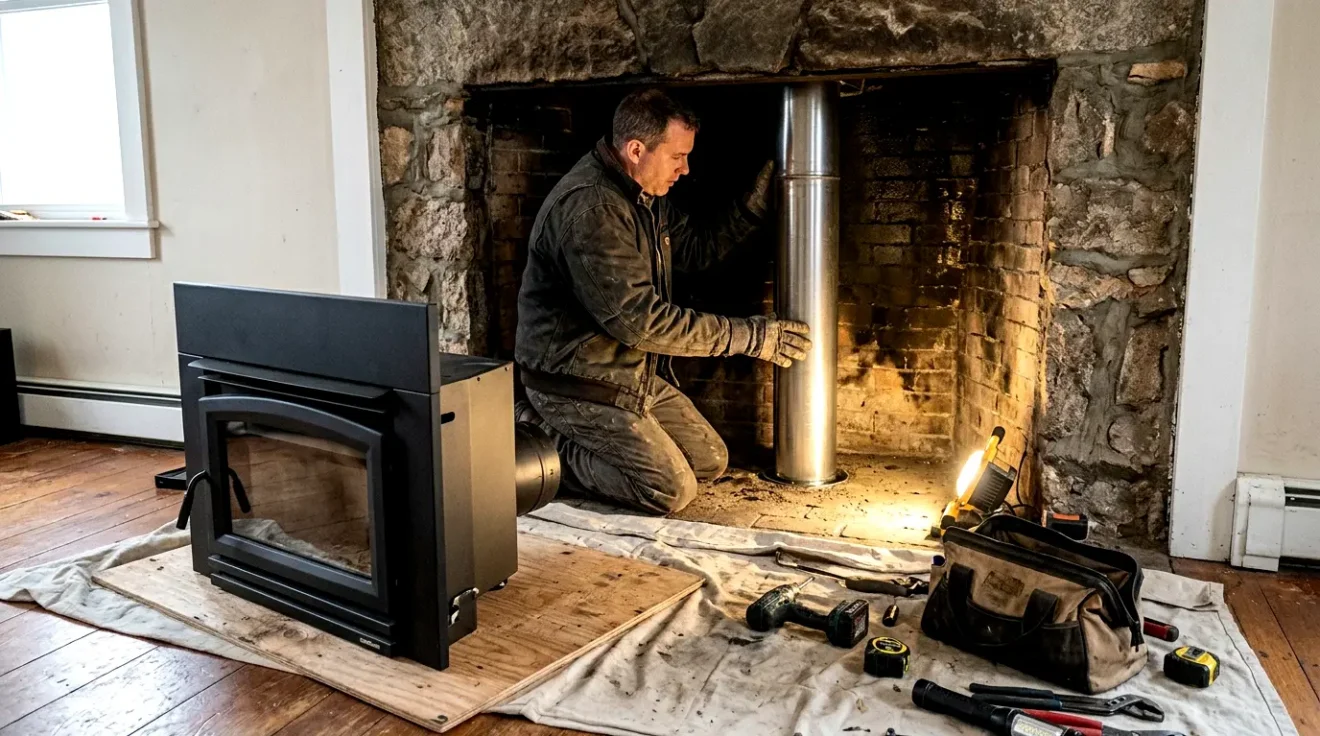
A suitable flue liner may be necessary depending on the insert, existing chimney and applicable requirements. Incorrect connections or an unsuitable flue can compromise draught, combustion performance and safe removal of exhaust gases.
Before buying, have a qualified installer assess the fireplace opening, hearth dimensions, chimney height and cross-section, possible liner requirements, appliance clearances and available combustion air. The installer should also confirm appropriate carbon monoxide protection and arrangements for inspection and cleaning.
For England, the UK Government’s Approved Document J on combustion appliances provides technical guidance concerning ventilation, flues and combustion-appliance installations. It is not a universal regulation for all English-speaking countries. Requirements in Scotland, Wales, Northern Ireland, the United States, Canada, Australia and New Zealand must be checked within their respective jurisdictions.
There is also a practical investment question. In a poorly insulated older house, an efficient insert may improve comfort near the fireplace while leaving major heat losses unchanged. Addressing draughts, roof insulation or defective glazing first can reduce the heating demand that the new appliance must meet.
If energy improvements are planned, size the proposed insert against the expected condition of the building after those improvements, not simply its current heating difficulties. Otherwise, the appliance may become unnecessarily powerful once the home retains heat more effectively.
Financial incentives, permitted appliance types and installation qualifications vary by country and sometimes by region. Their current availability and eligibility should be verified with the relevant local authority or official programme before committing to a purchase.
The most useful next step is to arrange a room-specific heat-loss assessment alongside a professional fireplace and chimney inspection. With both results, compare suitably sized appliances using nominal output, permitted operating range, efficiency and installation requirements rather than choosing the largest available insert.
How do you convert fireplace output from kilowatts to BTU per hour?
Multiply the output in kilowatts by approximately 3,412 to obtain BTU/h. For example, a hypothetical 5 kW fireplace produces a rated heat output equivalent to approximately 17,060 BTU/h. This converts units only; it does not establish whether that capacity is suitable for your room.
Should fireplace capacity cover the coldest day of the year?
That depends on whether the fireplace is the primary heat source or supplementary heating. Primary heating capacity should be evaluated against an appropriate local winter design condition and the building’s calculated heat loss. A supplementary fireplace may be selected for normal occupied conditions, with central heating covering more demanding weather. The intended role must be clear before sizing.
Can an electric fireplace replace a wood stove with the same rated heat output?
Equal stated useful heating output means equal rates of heat delivery under the conditions represented by those ratings, but real comfort can still differ because of heat distribution, controls and operating patterns. Electric fireplaces commonly offer controllable resistance heating, while wood appliances deliver heat through combustion cycles. Compare usable output, not flame appearance or decorative size.
Does a fireplace need an outside air supply in a modern airtight house?
An airtight home may require a dedicated or otherwise appropriately designed combustion-air provision, but the requirement is not identical for every fireplace. It depends on the appliance, ventilation arrangements, building airtightness and local regulations. A qualified installer should assess combustion air and interactions with extractor fans before installation.
What information should you give an installer for an accurate fireplace size recommendation?
Provide room dimensions, ceiling heights, connected spaces, glazing details, insulation condition, existing heating arrangements, intended occupancy and whether the fireplace is supplementary or primary heating. Mention planned renovation work, unusual draughts and any existing chimney. These details allow an installer or heating specialist to assess actual heat loss and recommend an appropriate output range.