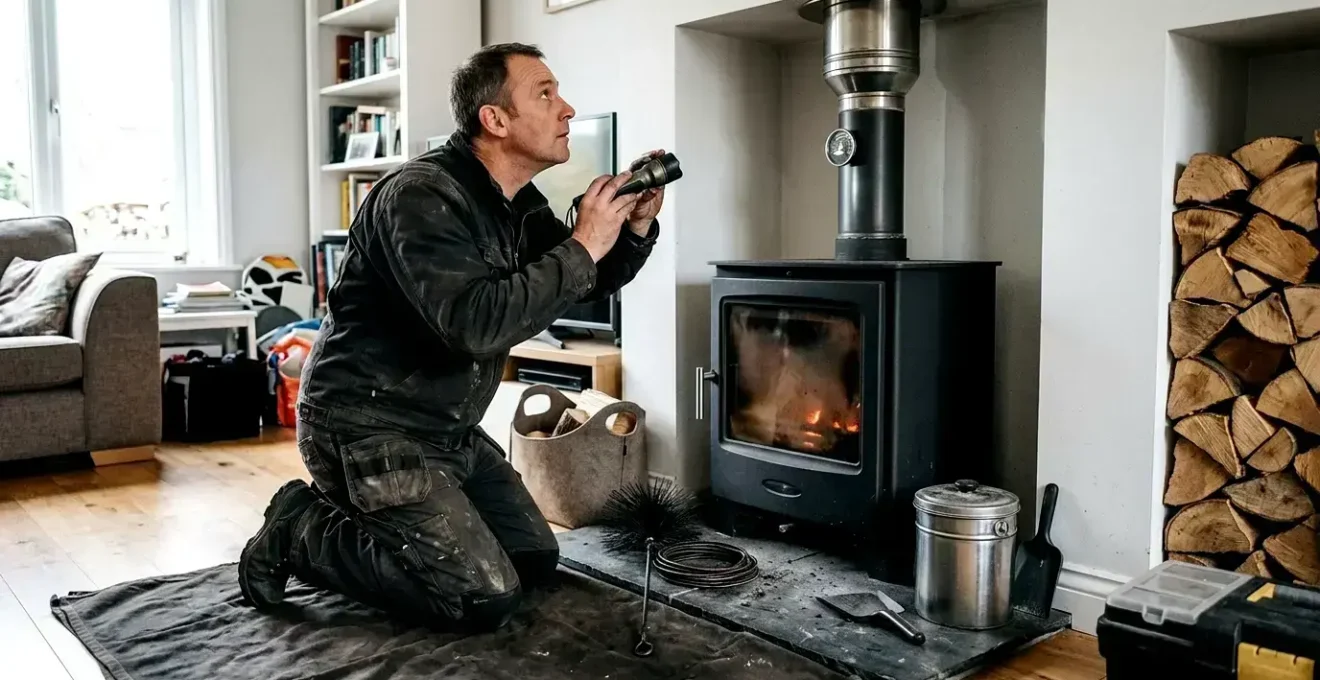
A modern wood-burning fireplace is only as safe and effective as the complete heating system supporting it. The stove or fireplace insert burns the fuel, but the chimney creates the draft that removes combustion gases, while the air supply provides oxygen for the fire. If any of these elements is poorly matched, even a high-efficiency appliance can produce disappointing heat, excessive smoke or unsafe operating conditions.
This relationship matters particularly in modern homes, where improved insulation, airtight windows and mechanical ventilation can change how a chimney behaves. An installation that worked in an older, leakier building may require a different combustion-air arrangement after renovation.
Homeowners evaluating wood heating should therefore consider more than appliance appearance and advertised efficiency. Flue dimensions, chimney condition, combustion-air availability, properly seasoned firewood, safe clearances and regular maintenance all influence the outcome. Understanding these connections makes it easier to compare equipment, anticipate installation costs and recognise when professional assessment is essential.
Wood-burning system essentials
- Chimney performance determines combustion quality. Adequate draft depends on compatible flue dimensions, temperature, height and configuration.
- Every component contributes to safety. Door seals, air controls, baffles, liners and chimney terminals must function together.
- The building and fuel matter as much as the stove. Airtightness, ventilation, dry firewood and maintenance directly affect real-world performance.
- Why Does a Wood-Burning Stove Depend on the Performance of Its Chimney?
- How to Identify the Key Components of a Closed Wood-Burning Fireplace System?
- Built-In Wood Fireplace or Freestanding Wood Stove for a New Living Space?
- Why Connecting a New Wood Stove to an Unsuitable Chimney Can Be Dangerous
- When Should a Wood-Burning System Be Reassessed After Home Insulation Upgrades?
- How to Plan an Outside Air Supply for a Fireplace in a Sealed Living Room?
- Chimney Height or Flue Diameter: Which Has More Influence on Fireplace Draft?
- Is a Wood-Burning Fireplace Right for Your Home and Lifestyle?
Why Does a Wood-Burning Stove Depend on the Performance of Its Chimney?
A wood-burning stove depends on its chimney because chimney draft creates the pressure difference that draws combustion air into the firebox and carries smoke and combustion gases outdoors. Without sufficient draft, the stove cannot burn fuel consistently or evacuate exhaust safely. Effective heating therefore requires the appliance and chimney to operate as a matched system rather than independent components.
As hot combustion gases rise through the flue, their lower density relative to cooler outdoor air helps produce upward flow. This creates a pressure difference that pulls replacement air through the appliance’s combustion-air passages. The process is commonly called the stack effect.
The United States Environmental Protection Agency describes the chimney as the engine of the wood-burning process in its EPA wood-burning installation and maintenance guidance. The agency identifies flue sizing, height, configuration, location and protection from extreme cold as important installation considerations.
Three practical factors help explain why apparently identical stoves can behave differently:
- Effective chimney height: A suitable vertical flue provides the pressure difference needed to support natural draft, subject to its design and operating conditions.
- Flue temperature: Warm, adequately insulated flues generally maintain stronger thermal buoyancy than cold, exposed flues.
- Appliance airtightness: Sound door seals and correctly functioning air controls help maintain the combustion conditions intended by the manufacturer.
These variables interact with building height, outdoor temperature, wind exposure and indoor pressure. Not all can be changed without substantial work.
A cold-chimney startup illustrates the relationship. During the first minutes after lighting, the flue may contain cold air, producing little upward movement or even temporary reverse flow. Smoke may escape when the door is opened, and the fire can struggle to establish a stable flame.
Repeated startup difficulties are not necessarily evidence of poor lighting technique. They may indicate an exterior chimney that cools excessively, an unsuitable flue configuration, inadequate combustion air or adverse building pressure. Persistent smoke spillage warrants professional investigation rather than repeated attempts to overcome the problem by opening doors or operating controls differently.
A powerful stove connected to a deficient chimney can perform poorly, while a suitably sized appliance connected to a well-designed flue may provide more dependable heating. Nominal heat output alone cannot predict the result.
The next consideration is whether every component between the firebox and chimney outlet preserves that draft while controlling heat, smoke and combustible deposits.
How to Identify the Key Components of a Closed Wood-Burning Fireplace System?
A closed wood-burning fireplace system includes a sealed firebox, controlled combustion-air passages, internal heat-management components, a compatible flue connection, a suitable chimney or liner, and a properly designed termination. Each component performs a distinct safety or efficiency function. Identifying these parts helps homeowners recognise deterioration and understand why maintenance must address the entire installation.
The operating sequence begins with air entering the appliance, continues through controlled combustion and heat transfer, and ends with exhaust gases leaving through the chimney.
- Firebox and door gasket: The firebox contains the burning logs, while the door seal helps prevent uncontrolled air leakage. A deteriorated gasket may make the fire difficult to regulate.
- Combustion-air circuit: Primary and secondary air passages, where provided, regulate oxygen delivery and support the combustion process.
- Baffle or deflector: This component guides hot gases through the intended internal path, supporting heat transfer and, in suitable appliance designs, more complete combustion.
- Flue connector: The connecting pipe carries combustion products from the stove outlet into the chimney. Its joints, clearances and configuration must suit the appliance.
- Chimney liner and insulation: An appropriate liner provides a defined flue passage. Insulation, where required by the system design, helps reduce heat loss and maintain suitable gas temperatures.
- Chimney termination: The outlet, appropriate cap where fitted, and chimney crown or other weather protection help protect the installation from weather-related deterioration and certain obstructions without restricting exhaust flow.
In an older masonry chimney, a correctly specified stainless steel liner can be a substantial improvement when the original passage is oversized, damaged or otherwise unsuitable. Relining can provide a more compatible internal cross-section and improve temperature stability. However, it does not automatically solve problems caused by insufficient height, negative indoor pressure or incorrect appliance operation.
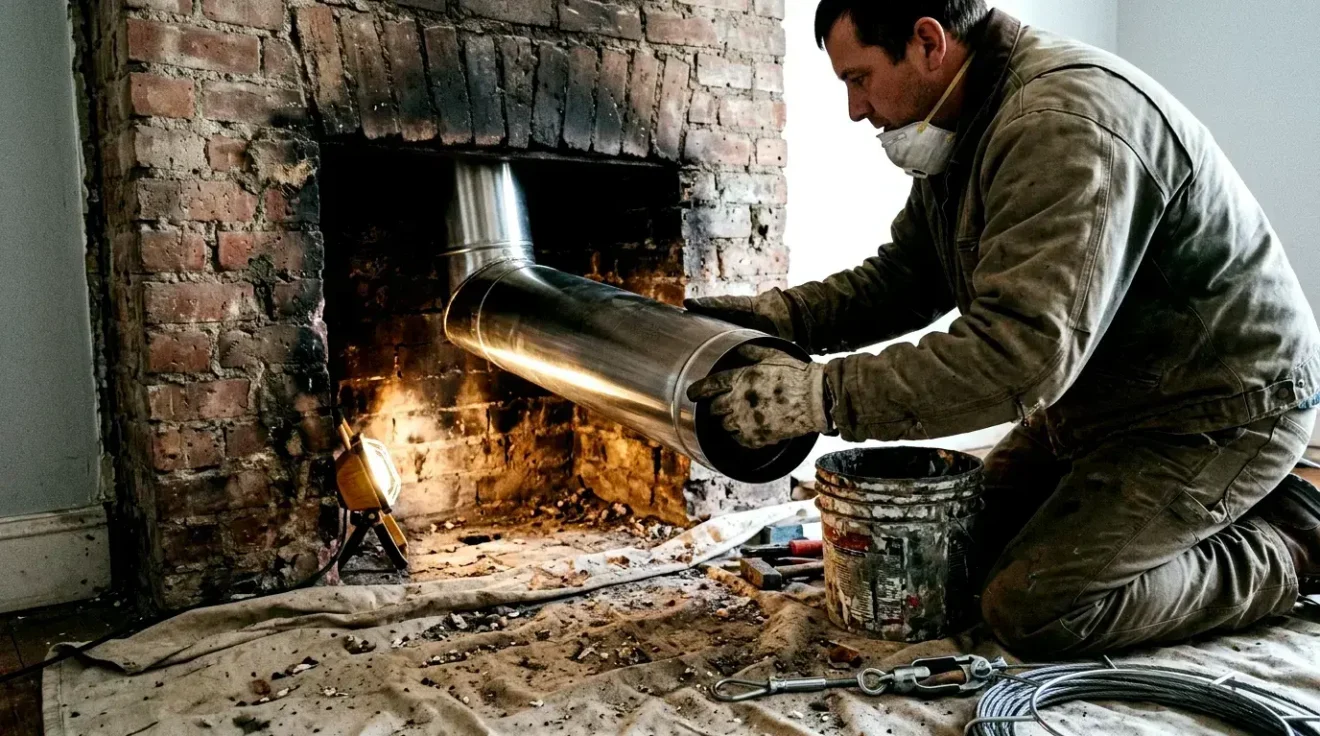
Some common warning signs point toward particular components. A visibly frayed or detached door gasket may indicate a sealing problem. Unusually rapid or difficult-to-control burning can also justify checking the gasket and air controls. Heavy soot or creosote deposits suggest that combustion conditions, fuel moisture and flue temperatures need assessment.
Deposits may accumulate around changes in direction, cooler chimney sections and other areas where gases slow or cool. Their location and severity should be evaluated during sweeping. A liner’s complete internal condition cannot reliably be judged from its visible end; professional inspection may require specialist equipment.
It is also important to distinguish combustion efficiency from overall heating efficiency. Combustion efficiency concerns how effectively fuel burns, while overall efficiency reflects how much of the fuel’s energy reaches the heated space.
The EPA’s energy-efficiency guidance makes this distinction and explains that installation, fuel moisture and operating practice affect actual results. A high laboratory efficiency rating cannot compensate for wet logs, poor draft or uncontrolled combustion air.
Once these components are understood, the choice between a built-in fireplace and a freestanding stove becomes a practical comparison of installation constraints, heat delivery and household use.
Built-In Wood Fireplace or Freestanding Wood Stove for a New Living Space?
A built-in closed wood fireplace or insert is often suitable when architectural integration and a discreet installation are priorities. A freestanding wood stove offers greater placement flexibility in many rooms, visible radiant surfaces and potentially easier servicing access. Neither format is automatically more efficient: the correct choice depends on appliance specifications, heat demand, installation conditions and intended use.
A fireplace insert is designed to fit an appropriate fireplace opening or constructed enclosure, depending on the model. A freestanding stove is installed as an independent appliance with its own required hearth, clearances and flue connection.
The comparison below concerns typical design considerations rather than guaranteed differences between every model.
| Decision criterion | Built-in fireplace or insert | Freestanding wood stove |
|---|---|---|
| Heat output control | Depends on appliance controls, combustion design and enclosure ventilation | Depends on appliance controls, combustion design and exposed heat-transfer surfaces |
| Installation budget | May require enclosure modifications, masonry work and chimney relining | May require a hearth, floor protection, dedicated flue and suitable clearances |
| Heat distribution | Often combines radiant heat through the glass with convection around the enclosure | Can deliver substantial radiant heat from exposed surfaces alongside room-air convection |
| Architectural integration | Typically offers a flush or recessed appearance | Remains a visible feature within the room |
| Servicing access | Some components may require access through the fireplace opening or dedicated panels | External surfaces and some connections may be more accessible |
| Placement flexibility | Constrained by the fireplace opening or designed enclosure | Constrained by chimney routing, floor protection and safety clearances |
Installation costs can reverse the apparent advantage of either option. A freestanding stove may involve limited structural alteration where a suitable chimney already exists. However, constructing a new flue route through floors or the roof can materially increase the scope of work.
An insert may reuse an existing fireplace opening but still require a complete chimney liner, adapter components, access provisions and modifications to the surrounding structure. Reusing a fireplace opening does not establish that the existing chimney is suitable.
Daily use introduces another distinction. Firebox volume, permitted log dimensions, manufacturer-rated burn characteristics and the appliance’s controllable output range influence how often fuel must be added. These characteristics vary between models and cannot be inferred from whether an appliance is built in or freestanding.
A household wanting prolonged daily heating should prioritise a model whose output range matches the room’s actual heat requirement and whose loading arrangement is convenient. For occasional evening use, flame visibility, aesthetics and ease of lighting may carry more weight.
In a new, tightly sealed living space, both formats also require a planned combustion-air strategy. A closed glass door does not necessarily mean the appliance is room-sealed or receives its air directly from outdoors.
Before committing to either appliance, the existing chimney must be assessed. An unsuitable connection can create risks that are not apparent in a showroom specification.
Why Connecting a New Wood Stove to an Unsuitable Chimney Can Be Dangerous
Connecting a new wood stove to an unsuitable chimney can cause smoke spillage, unstable combustion, excessive creosote accumulation and potentially dangerous heat transfer to surrounding building materials. The principal compatibility problems include incorrect flue dimensions, deteriorated chimney construction and inadequate draft. A chimney that previously served another appliance is not automatically suitable for a modern closed wood stove.
An oversized flue can allow exhaust gases to lose heat as they pass through a large, cold passage. Lower gas temperatures can weaken thermal draft and encourage the condensation of combustible deposits, particularly when fuel is damp or the stove is operated at low output.
An undersized flue can create excessive resistance to gas movement. This may interfere with combustion-air flow, impair appliance performance and increase the likelihood of smoke escaping through openings or during refuelling.
The assumption that a larger chimney is always safer is therefore incorrect. Flue dimensions should be selected to match the appliance and its installation conditions, not maximised independently.
Older unlined masonry chimneys require particular scrutiny. Their large internal passages, exposure to cold and possible deterioration can make them unsuitable for modern appliances. Cracked masonry or defective joints may also compromise the containment of combustion gases and heat.
However, an unlined masonry chimney is not automatically prohibited in every jurisdiction or application. Its suitability depends on its construction, condition, appliance compatibility and applicable standards.
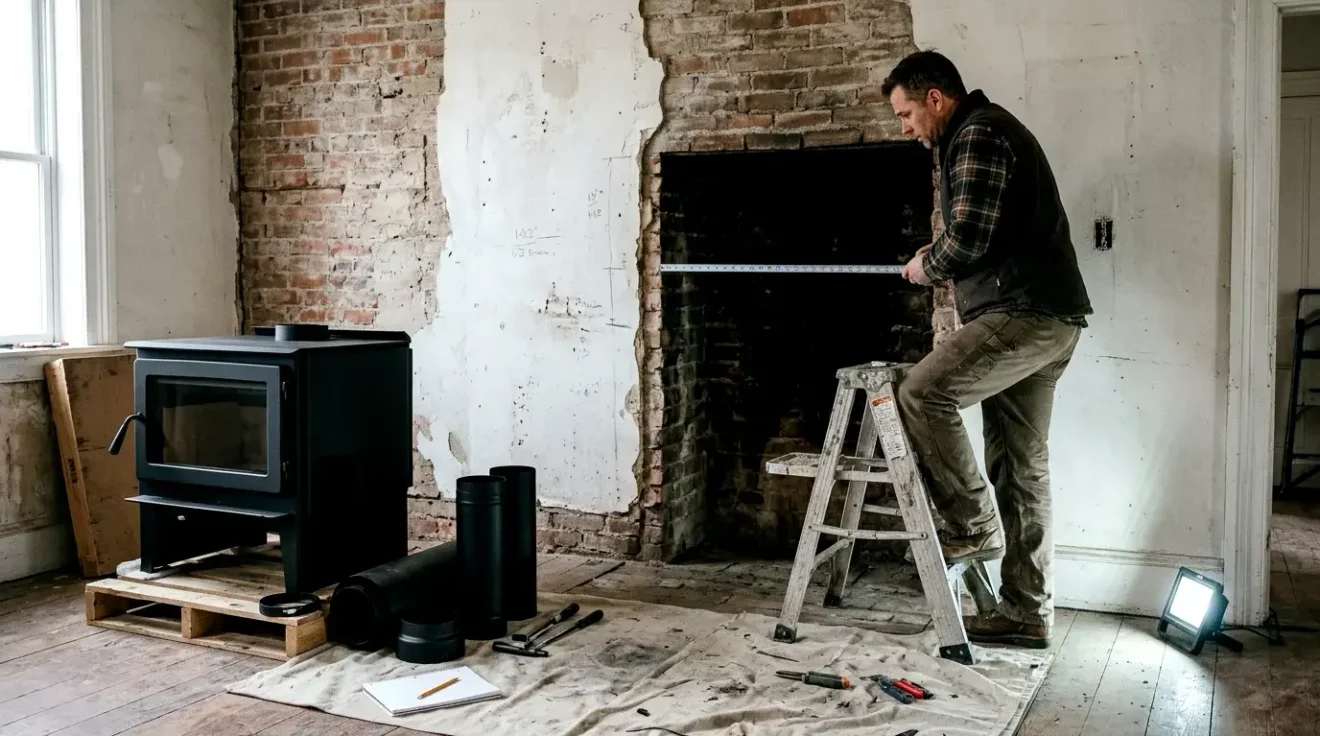
In England, England’s Approved Document J on combustion appliances and flues specifically identifies oversized flues as potentially unsafe and requires assessment of an existing chimney when it is reused with a different appliance type or rating. The guidance also addresses relining and compatibility with manufacturers’ specifications.
Approved Document J provides recognised routes to compliance with the Building Regulations in England. It should not be treated as an automatically applicable standard in Scotland, Wales, Northern Ireland, the United States, Canada, Australia or other jurisdictions.
Before purchasing a stove, a compatibility assessment should establish the chimney’s internal dimensions, height, material, liner type, condition, number of bends and location within or outside the building envelope. An older exterior masonry chimney may face different thermal conditions from an insulated interior flue.
Regulatory compliance and insurance documentation also deserve attention. Relevant codes, such as NFPA 211 in the United States or the applicable building regulations in England, may govern aspects of installation and inspection. Insurance requirements vary by provider and policy; homeowners should verify any notification, inspection or certification obligations instead of assuming that an undocumented installation is covered.
Five checks to complete before connecting a new wood stove
- Record the proposed appliance’s model, rated output and manufacturer-specified flue requirements. Deliverable: A copy of the installation instructions and specification sheet.
- Request an assessment of the chimney’s internal dimensions, effective height, bends and termination. Deliverable: A written chimney survey or inspection report.
- Confirm the chimney construction, liner presence, liner suitability and condition. Deliverable: An inspection record identifying any necessary repairs or relining.
- Check required clearances, floor protection, combustion-air arrangements and local installation rules with a qualified installer. Deliverable: An installation proposal identifying applicable requirements.
- Confirm the necessary commissioning documentation and insurance conditions before first use. Deliverable: A commissioning checklist and any applicable certificates or insurer confirmation.
Even a correctly matched installation can change behaviour when the surrounding building changes. Renovations affecting airtightness and ventilation deserve particular attention.
When Should a Wood-Burning System Be Reassessed After Home Insulation Upgrades?
A wood-burning system should be reassessed after renovations that substantially change building airtightness or ventilation, preferably once the work is complete and before the next heating season. New windows, air sealing and mechanical ventilation can alter indoor pressure and combustion-air availability. Consequently, a chimney that operated correctly before renovation may experience poor draft or smoke spillage afterwards.
In older homes, small gaps around windows, doors and building joints may have supplied some of the replacement air consumed by a wood-burning appliance. Improving the building envelope reduces uncontrolled air leakage, which is beneficial for energy efficiency but may change how readily replacement air enters the room.
When a stove draws air from indoors, the chimney’s natural draft must operate against the pressure conditions of the building. Extractor fans and other exhaust appliances can lower indoor pressure and oppose the chimney’s upward flow.
The following renovation events justify checking whether the existing combustion-air and venting arrangements remain suitable:
- Replacement of draughty windows with more airtight glazing systems.
- Attic insulation accompanied by sealing of ceiling penetrations and leakage paths.
- Comprehensive wall, floor or roof air-sealing measures.
- Installation or modification of mechanical ventilation equipment.
- Addition of kitchen extractors, bathroom exhaust fans or other equipment exhausting indoor air.
Insulation alone does not necessarily change building pressure substantially. The concern is greatest when insulation work includes air sealing or when several ventilation-related modifications occur together.
Potential symptoms include slow fire establishment, smoke escaping when the stove door is opened, unusual odours and changes in combustion when an extractor fan starts. These symptoms are not proof that airtightness is the only cause: chimney obstruction, fuel moisture and appliance defects may produce similar behaviour.
A qualified technician can investigate using appropriate draft measurements and combustion-safety testing, including assessment under relevant exhaust-fan operating conditions. A visual chimney inspection alone may not identify a building depressurisation problem.
Because smoke spillage can introduce hazardous combustion products, including carbon monoxide, persistent symptoms should be treated as a safety concern. Stop using an appliance that spills smoke indoors until the cause has been assessed and corrected. Suitable carbon monoxide alarms provide an additional precaution but do not replace safe installation or maintenance.
Where the building has become substantially more airtight, the long-term solution may involve a dedicated combustion-air arrangement designed alongside the home’s ventilation system.
How to Plan an Outside Air Supply for a Fireplace in a Sealed Living Room?
An outside air supply for a wood-burning fireplace should be planned alongside the appliance, chimney and mechanical ventilation system. In a tightly sealed room, combustion air must be provided through a suitable route that does not create unsafe pressure interactions. A dedicated connection to an appliance designed for external combustion air is often advantageous, but the appropriate solution depends on its specifications and local requirements.
A closed stove is not necessarily a room-sealed appliance. Many appliances have glass doors and controlled air inlets while still drawing combustion air from the room. Others support a dedicated outside-air connection, and certain designs are specifically intended to operate with greater separation from indoor air.
Two arrangements should be distinguished during design:
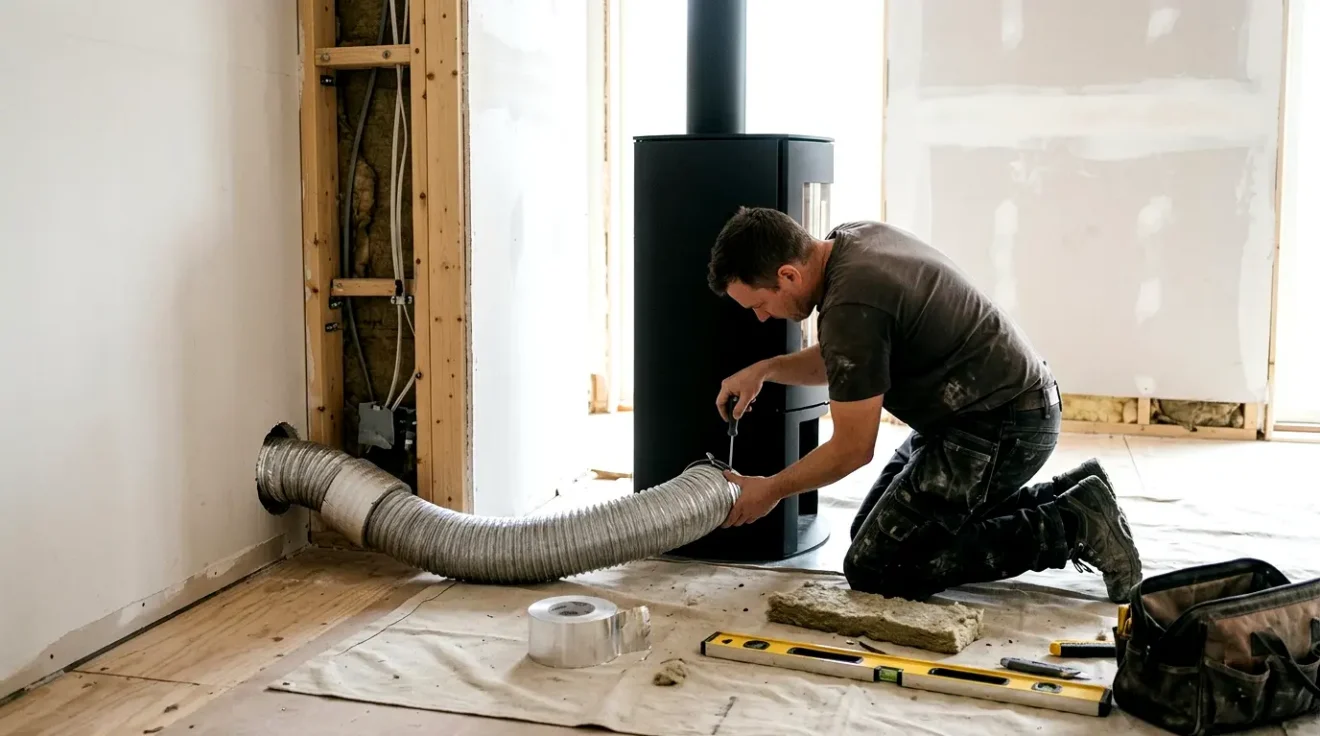
- Direct appliance connection: A compatible duct delivers outdoor combustion air to the appliance’s designated inlet. This can reduce reliance on room air, provided the connection is designed, installed and operated according to manufacturer instructions.
- Passive room air inlet: A permanent opening or duct supplies outdoor air to the living space, where it becomes available to the stove. Its effectiveness depends on the room, air pressure, inlet characteristics and required ventilation provision.
A passive room inlet and a direct-air connection are not interchangeable without design verification. A direct-air connection may reduce cold air entering the occupied room, while a passive inlet can introduce draughts and external noise. Both arrangements require consideration of weather exposure, obstruction and airflow resistance.
Mechanical ventilation introduces an additional consideration. Exhaust-only systems remove air from the home and can create negative pressure when adequate replacement air is unavailable. This can interfere with naturally drafted combustion appliances, even when extraction occurs in another room.
The United States Department of Energy addresses these interactions in its Department of Energy guidance on fireplace and stove ventilation, recommending attention to combustion-air supply and testing for backdrafting risks associated with exhaust fans.
A dedicated outside-air duct should therefore be coordinated with the complete ventilation design. Its route, allowed length, diameter, bends, exterior termination and any necessary condensation protection must follow the appliance manufacturer’s requirements and applicable codes.
The relative positions of outdoor air intakes, exhaust terminals and chimney outlets also matter. Poorly positioned openings can create opportunities for exhaust recirculation, wind interference or obstruction.
During new construction, these decisions are best resolved before walls and floors are closed. The installer and building designer should confirm the penetration location, duct compatibility, insulation details and access for future inspection.
For existing homes, any retrofit should include a review of the appliance’s approved air-supply arrangements rather than an improvised duct connection.
Once adequate combustion air is available, the chimney must still generate enough draft to move that air through the appliance. This leads to the balance between flue height and diameter.
Chimney Height or Flue Diameter: Which Has More Influence on Fireplace Draft?
Chimney height primarily influences the pressure difference that drives natural draft, while flue diameter affects exhaust-gas velocity and resistance to flow. Neither variable can be optimised independently. The correct combination depends on the appliance, flue temperature, route, building pressure and manufacturer specifications. A taller or wider chimney is not automatically a better chimney.
Increasing effective chimney height can increase the buoyancy-driven pressure difference when other conditions remain comparable. This is the basic principle behind the stack effect.
Flue diameter influences how gases travel through the chimney. A passage that is too narrow may restrict the required exhaust flow. A passage that is excessively large may allow gases to slow and cool, weakening thermal draft and increasing the conditions associated with tar and creosote deposition.
The significance of each variable therefore depends on the existing installation. A short chimney with correctly sized internal dimensions has different limitations from a tall chimney containing a wide, cold masonry passage.
| Variable | Main influence | Potential problem |
|---|---|---|
| Effective height | Contributes to the available buoyancy-driven pressure difference | Insufficient height may produce inadequate natural draft |
| Flue diameter | Influences flow resistance and exhaust-gas velocity | Oversizing can promote cooling; undersizing can restrict flow |
| Flue insulation | Helps maintain exhaust-gas temperature | Excessive cooling can weaken draft and encourage deposits |
| Bends and offsets | Introduce resistance and affect flow | Unsuitable configurations may reduce effective draft |
| Termination position | Influences exposure to wind and surrounding roof geometry | Poor positioning can contribute to unstable draft |
Greater height can be beneficial up to the point where the complete system achieves its intended operating characteristics. However, excessive draft can also occur, potentially increasing combustion rates beyond the appliance’s intended operating range.
For this reason, manufacturers specify compatible flue dimensions and may provide minimum height or draft requirements for particular appliance models. Local building rules may impose additional constraints.
There is no reliable universal chimney height or diameter that can be recommended for every residential wood stove. Dimensions should be selected through the appliance instructions and the applicable installation standard.
When draft problems occur, a professional diagnosis should consider the complete flow path. A practical investigation includes checking the appliance and combustion-air supply, the flue’s internal condition, possible obstructions, insulation, bends and termination position. Measurements under relevant operating conditions can help distinguish insufficient draft from other combustion problems.
Changing a flue diameter or extending a chimney without this assessment may fail to solve the underlying problem and could introduce new safety concerns.
With chimney geometry, air supply and appliance compatibility established, the final decision is whether wood heating is a practical fit for the household’s building, budget and daily routine.
Key considerations before choosing wood heating
- A suitable chimney is a prerequisite, not an accessory. Budget for inspection and any necessary repair or relining before selecting the stove.
- Airtight homes need an explicit combustion-air strategy that remains safe when mechanical extraction operates.
- Long-term satisfaction depends on available dry firewood, realistic maintenance commitments and an appliance matched to actual heating needs.
Is a Wood-Burning Fireplace Right for Your Home and Lifestyle?
A wood-burning fireplace can be appropriate when the home supports a compliant chimney and combustion-air arrangement, the household has access to suitable firewood, and occupants are prepared for regular manual operation and maintenance. It is less suitable where installation constraints cannot be resolved, fuel storage is impractical or convenient unattended heating is the overriding priority.
The decision should begin with four questions rather than a comparison of stove finishes or nominal heat outputs.
- Can the property accommodate a suitable flue? An existing chimney must pass a compatibility assessment, or the home must allow a compliant new installation. If neither is feasible, wood heating may not be a realistic option.
- Can adequate combustion air be provided? Airtightness and mechanical ventilation must be considered. If the building cannot support a safe, approved air-supply arrangement, installation should not proceed.
- Is a dependable supply of seasoned firewood available? Households need access to appropriately dried logs and suitable storage space. A lack of reliable fuel supply undermines both performance and convenience.
- Does the household’s routine suit manual heating? Lighting, monitoring, reloading and cleaning require regular attention. An appliance requiring active management may not meet expectations for automated primary heating.
Fuel quality deserves particular attention. According to EPA guidance on wood-burning appliance efficiency, properly dried firewood should have a moisture-meter reading of 20% or less. Wet wood can create excessive smoke, waste usable heat and contribute to deposits in the venting system.
Seasoning requires planning. Split logs should be stored off the ground with protection from precipitation and sufficient airflow. Drying time varies with species, log size, climate and storage conditions; the calendar alone cannot confirm that firewood is ready to burn.
Ongoing work also includes carrying and stacking logs, lighting fires, adjusting combustion controls, removing ash safely and arranging chimney sweeping and inspection. Ash should be handled using appropriate non-combustible equipment and kept away from combustible materials until fully cooled.
Annual professional inspection is a sensible baseline for maintenance planning, with additional sweeping or attention when use, deposits or operating conditions warrant it. Manufacturer instructions and local requirements may impose specific obligations.
Costs should be separated into three categories: initial installation, ongoing fuel supply and recurring maintenance. Installation may involve chimney construction, relining, hearth work, ventilation modifications and commissioning. Fuel prices vary substantially by region and by whether logs are purchased or responsibly self-supplied.
Maintenance expenses depend on the installation, inspection findings, cleaning frequency and component condition. A local quotation is therefore more informative than a generic cost estimate.
Wood heating also requires consideration of outdoor smoke and local air-quality restrictions. Modern efficient equipment and dry fuel can improve combustion performance, but wood smoke still contributes to air pollution. Local restrictions and the availability of cleaner heating alternatives belong in the final decision.
The most suitable system is not necessarily the appliance with the highest advertised output or most prominent flame display. It is the installation that safely meets the household’s actual heating requirements without depending on unrealistic operating habits.
For the next practical step, obtain an appliance-specific installation proposal from a qualified local professional, including chimney assessment, combustion-air provisions, required clearances, commissioning and anticipated maintenance. Compare that proposal with the household’s fuel availability and intended pattern of use before committing to wood heating.
Can a modern wood stove be installed in an existing open fireplace?
Often, but only after the fireplace opening, chimney, hearth and surrounding structure have been assessed for compatibility. A modern stove or insert may require an appropriately specified liner, connector components and changes to the installation. An existing open fireplace does not automatically provide a suitable flue for a closed appliance.
Does a closed wood-burning stove eliminate the risk of carbon monoxide?
No. Closed wood stoves still produce combustion gases, including carbon monoxide. Defective venting, inadequate combustion air, blocked flues or pressure-related backdrafting can create dangerous conditions. Correct installation, regular inspection, appropriate operation and suitable carbon monoxide alarms are essential safeguards.
Can a chimney liner solve every wood-stove draft problem?
No. A suitable liner may correct problems associated with an oversized, deteriorated or thermally unsuitable flue. It cannot by itself resolve every issue involving chimney height, terminal location, building depressurisation, obstructions or inadequate combustion air. The cause of poor draft should be established before relining is specified.
Can a wood-burning fireplace operate during a power outage?
Some naturally drafted wood stoves can operate without electricity, provided the complete installation is designed for that purpose and has adequate combustion air. Other appliances or heating arrangements may depend on powered fans, controls or circulation equipment. Homeowners should check the specific model’s operating instructions rather than assuming every wood-burning system is electricity-independent.
How can homeowners tell whether their firewood is dry enough to burn?
A suitable firewood moisture meter provides a more reliable indication than appearance or storage time alone. The EPA’s published guidance recommends a moisture reading of 20% or less for properly dried firewood. Measure freshly exposed interior wood according to the meter’s instructions, and avoid relying solely on the dryness of the log’s outer surface.