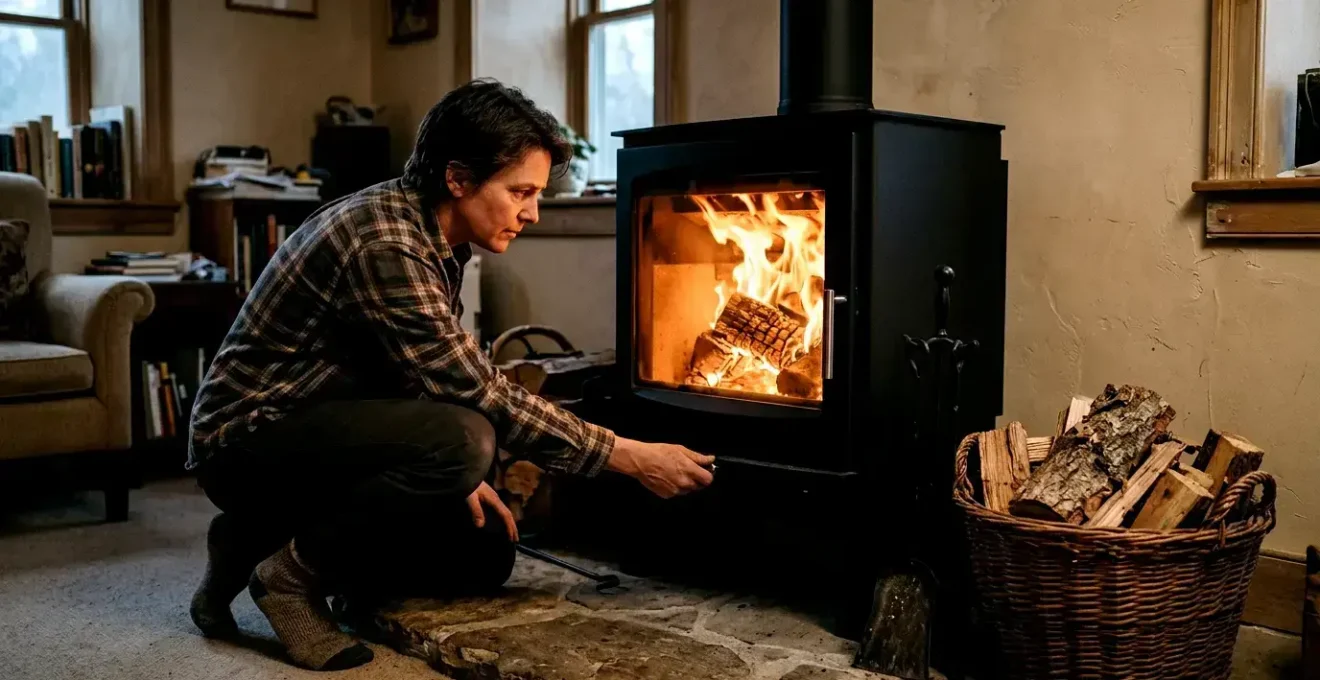
Reducing fireplace emissions does not necessarily mean abandoning the warmth and atmosphere of a real wood fire. The most practical improvements begin with three decisions: burn properly seasoned wood, maintain sufficient combustion air and use an appliance designed to burn wood gases efficiently.
Wood smoke is not harmless, even when the fire is made with natural logs. It contains fine particulate matter, carbon monoxide and other pollutants that can affect indoor air quality and nearby communities. A cleaner-burning fire reduces avoidable pollution, but it does not eliminate emissions or make wood heating equivalent to a non-combustion heating system.
The difference between a bright, stable flame and a slow, smoky fire matters. So do the moments when new logs are added, the condition of the chimney and the weather outside. Homeowners can therefore make meaningful operational improvements before considering a replacement stove, while recognising that local air-quality restrictions and household heating needs may determine when burning wood is appropriate.
Cleaner Wood Fires: The Essentials
- Burn dry, untreated firewood. Aim for a moisture content of 20% or less, measured on a freshly split surface, to support efficient combustion.
- Keep flames burning steadily. Adequate airflow, sensible log spacing and careful reloading help prevent smoky, oxygen-starved combustion.
- Match the appliance and its use to local conditions. Modern certified stoves can reduce emissions, but air-quality alerts and local regulations still matter.
- Why Does a Smouldering Wood Fire Release More Particulate Pollution?
- How to Add Logs to a Wood Stove Without Producing Excessive Smoke?
- EPA-Certified or Ecodesign Wood Stove: Which Emissions Standards Apply?
- Why Burning Painted Timber or Household Waste Can Make Fireplace Smoke More Toxic
- When Should You Avoid Using a Wood Fireplace During an Air Quality Alert?
- Why Does Damp Firewood Produce More Smoke and Less Useful Heat?
- Why Can Excessively Restricting Stove Air Controls Cause Dirty Combustion?
- How Does Modern Combustion Technology Make Wood Fireplaces More Efficient?
Why Does a Smouldering Wood Fire Release More Particulate Pollution?
A smouldering wood fire releases more particulate pollution because insufficient heat or oxygen prevents combustible gases from burning completely. Instead of converting those gases into useful heat, the fire releases a mixture of fine particles, carbon monoxide and unburned organic compounds. Keeping a wood fire hot enough to sustain stable flames helps limit this incomplete combustion.
When wood heats up, it releases moisture and then combustible gases through a process known as pyrolysis. In a well-established fire, those gases mix with oxygen and ignite above the logs. When the firebox is too cool or poorly supplied with air, some gases escape without fully burning, contributing to smoke and deposits inside the flue.
The combustion cycle is particularly important. Ignition and reloading can produce short periods of increased smoke while the firebox warms and fresh wood begins releasing gases. A stable, well-aerated flame generally offers cleaner combustion than prolonged smouldering, although actual emissions depend on the appliance, fuel and operating conditions.
A quiet-looking fire is not necessarily a clean one. Signs worth investigating include:
- Lazy, intermittent flames that struggle to remain established.
- Blackening stove glass shortly after cleaning.
- Persistent visible smoke leaving the chimney after the fire has warmed up.
- Rapid accumulation of soot or tar-like deposits.
These observations are useful indicators, not definitive measurements. Smoke may also reflect unsuitable fuel, weak chimney draught or a maintenance problem. A clear-looking exhaust does not establish that particulate emissions are zero.
The health implications extend beyond the fireplace itself. Fine particulate matter, particularly PM2.5, can penetrate deeply into the lungs. The EPA residential wood-heater emissions standards resource also identifies carbon monoxide, volatile organic compounds and other harmful constituents of residential wood smoke.
Even when most smoke exits through a chimney, emissions can affect neighbours and outdoor air quality. Smoke entering the home during lighting, reloading or through leaks creates an additional indoor exposure concern.
The practical objective is not to create the longest possible burn at any cost, but to sustain complete combustion within the appliance’s intended operating range. That becomes especially important when adding fresh logs.
How to Add Logs to a Wood Stove Without Producing Excessive Smoke?
To reload a wood stove with less smoke, increase the combustion air before opening the door, add suitably sized dry logs to a healthy bed of embers and allow the new fuel to ignite before reducing the air supply. Follow the stove manufacturer’s instructions throughout, particularly for door operation and air-control settings.
Reloading introduces relatively cool wood into a hot combustion chamber. As the new logs heat up, they release combustible gases. If the airflow is reduced too early, those gases may escape as smoke instead of burning as visible flames.
A practical reloading sequence is:
- Prepare the fire. Wait until there is a suitable bed of glowing embers and increase the relevant air controls according to the appliance manual.
- Open the door carefully. Follow the manufacturer’s recommended opening procedure to minimise smoke spilling into the room.
- Position the new logs. Place appropriately sized split logs on the embers without compacting them or obstructing air passages.
- Restore normal door operation. Close the door as instructed and maintain sufficient airflow while the new logs ignite.
- Adjust gradually. Once stable flames are established, reduce the air supply only to a setting that maintains effective combustion.
Some stove instructions allow a door to remain slightly ajar briefly during initial lighting or a specified ignition stage. That is not a universal reloading instruction. Never leave a stove door ajar unless the manufacturer explicitly permits it for that operating condition, and never leave an open door unattended.
Log size and placement influence the result. A tightly packed load can prevent air from reaching combustible gases, while an oversized load may exceed the appliance’s intended capacity. Smaller split pieces can help establish ignition, provided they are used in accordance with the stove’s instructions.
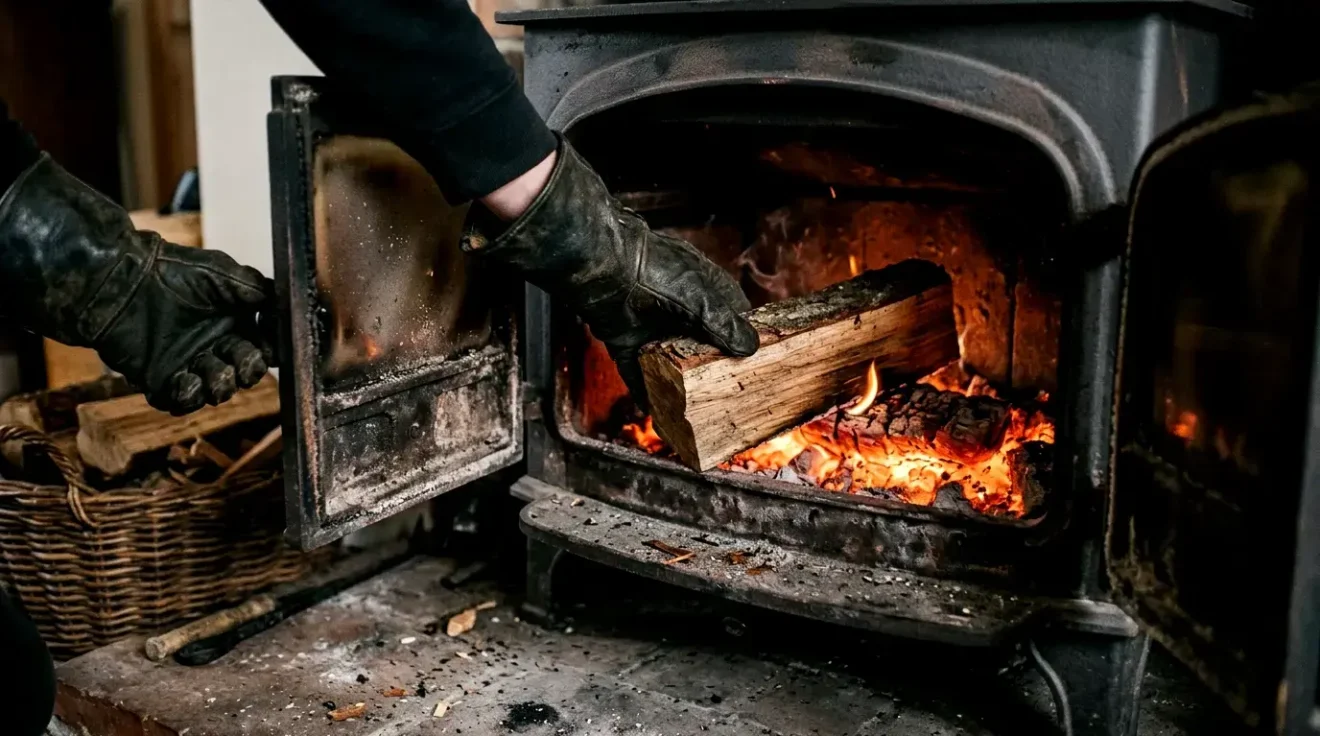
The traditional top-down lighting method can help establish a new fire in suitable appliances, but it is different from reloading an existing bed of embers. The correct arrangement depends on the combustion chamber, manufacturer guidance and available draught.
After reloading, watch whether visible flames become established and remain steady. If smoke persists, investigate three variables: air supply, wood moisture and load arrangement. Do not repeatedly open the door to inspect the fire if this risks spilling smoke into the room.
The EPA‘s guidance on cleaner wood burning recommends adequate airflow, spacing between logs and sustained flames in secondary-combustion appliances. Its Burn Wise programme has ended, so the resource should be treated as historical operating guidance rather than a current regulatory instruction.
Five Checks for a Cleaner Stove Reload
- Check the fuel. Measure a freshly split log with a moisture meter and record whether it meets the recommended moisture target.
- Check the ember bed. Confirm that glowing embers are present before preparing the next load.
- Check the air settings. Identify the manufacturer’s recommended reloading positions and keep a simple reference beside the stove.
- Check the load. Confirm that the logs fit within the permitted loading capacity and leave the required air passages unobstructed.
- Check combustion after reloading. Observe whether flames establish and record any persistent smoke, glass blackening or unusual behaviour requiring investigation.
Good reloading habits can improve combustion, but their effectiveness is limited by the appliance’s design, installation and condition. Certification provides another useful layer of information when comparing stoves.
EPA-Certified or Ecodesign Wood Stove: Which Emissions Standards Apply?
EPA certification and Ecodesign requirements are separate regulatory frameworks for wood-burning appliances. EPA certification applies to specified new residential wood heaters in the United States, while Ecodesign establishes product requirements for relevant appliances in the European Union and United Kingdom. Their laboratory tests and emission measurements differ, so certification results should not be treated as directly interchangeable.
For homeowners, the first question is not which label sounds more environmentally friendly. It is which standards apply where the appliance will be installed, what equipment those standards cover and whether additional local restrictions exist.
The following comparison provides a practical starting point.
| Criterion | EPA Certification | Ecodesign |
|---|---|---|
| Principal market | United States | European Union and United Kingdom |
| Regulatory focus | Emission requirements for specified categories of newly manufactured residential wood heaters | Energy efficiency and environmental performance requirements for relevant products |
| Performance assessment | Testing according to applicable US certification procedures | Assessment according to applicable Ecodesign product requirements and test methods |
| Existing appliances | Federal new-source requirements do not automatically require replacement of existing household stoves | New-product requirements do not automatically mean every older installed appliance must be replaced |
| Local considerations | State, regional and local installation or burning restrictions may also apply | National and local smoke-control requirements may apply separately |
In the United States, the EPA’s residential wood-heater standards cover specified new appliances, including certain wood and pellet stoves. Conventional indoor fireplaces are not automatically covered by those same federal requirements. Buyers should confirm the exact model’s certification status rather than assuming all products described as wood-burning fireplaces meet identical standards.
In the UK, Ecodesign requirements apply to relevant new solid-fuel heating products. However, Ecodesign compliance is not the same as Smoke Control Area exemption. A homeowner intending to burn wood in a designated area must also check whether the specific appliance is approved for that purpose.
The UK government Smoke Control Area rules explain the distinction between authorised fuels and exempt appliances. Local councils can confirm whether a property falls within a designated area. Requirements and enforcement arrangements can differ across UK jurisdictions.
Certification represents performance under specified test conditions. It does not guarantee equally low emissions when the appliance is incorrectly installed, poorly maintained, overloaded or operated with damp wood. Chimney draught, manufacturer-specified settings and fuel quality remain essential.
When comparing models, request the applicable certification documentation, the precise product identification and installation instructions. An approval associated with one model or configuration should not be assumed to cover an altered appliance.
Once the appropriate appliance has been identified, the next responsibility is choosing fuel that will not introduce avoidable toxic pollutants into its combustion chamber.
Why Burning Painted Timber or Household Waste Can Make Fireplace Smoke More Toxic
Burning painted timber, treated wood or household waste can make fireplace smoke more toxic because these materials contain substances not present in ordinary untreated firewood. Depending on the material, burning can release hazardous chemicals, contaminated particles and corrosive gases. Domestic fireplaces are not designed to control these emissions, even when combustion appears vigorous.
Paints, preservatives, adhesives and plastic coatings can introduce additional pollutants into the fire. Some older coatings or wood treatments may contain metals or other hazardous substances. Certain plastics can release harmful compounds when burned, particularly under poorly controlled combustion conditions.
The exact chemicals released depend on the material’s composition and combustion conditions. It is therefore misleading to assume that every painted board produces the same pollutants, or that a hotter fire makes waste burning safe.
Materials to keep out of domestic wood-burning appliances include:
- Painted, varnished, stained or chemically preserved timber.
- Old furniture, especially when its materials or coatings are unknown.
- Medium-density fibreboard, chipboard, plywood and other glued wood products not specifically approved as fuel.
- Pallets with uncertain treatment histories or visible contamination.
- Plastic packaging, coated materials and household rubbish.
- Printed or coated packaging used as a substitute for approved fire-lighting materials.
Discarded timber can be particularly deceptive. A piece may look like ordinary firewood while containing preservatives, glue or surface treatments. Pallet markings and appearances do not, by themselves, establish that a pallet is clean, uncontaminated or suitable for domestic burning.
There is also a maintenance consequence. Unsuitable materials can contribute to problematic deposits or corrosion within the stove and flue. Combined with incomplete combustion, deposit accumulation increases maintenance demands and can contribute to chimney-fire hazards.
For a safer supply, purchase untreated firewood intended for domestic heating. Ask the seller about its origin, whether it has undergone chemical treatment and how it was dried and stored.
In England, the Ready to Burn certification scheme offers a recognised way to identify qualifying firewood sold under the applicable small-volume sales rules. Elsewhere, ask for the local equivalent or independently verify that wood is untreated and sufficiently dry.
Even properly sourced wood still releases pollutants. Whether it should be burned on a particular day also depends on the outdoor conditions and the community’s air quality.
When Should You Avoid Using a Wood Fireplace During an Air Quality Alert?
Avoid using a wood fireplace during an air-quality alert whenever local restrictions prohibit burning, particularly if another safe heating source is available. Even where burning remains legal, postponing a recreational fire can reduce additional particulate pollution during stagnant weather. Households relying on wood for essential heating should check exemptions and minimise emissions without compromising safety.
Air-quality alerts frequently coincide with conditions that limit the dispersion of pollutants. During a temperature inversion, a layer of warmer air above cooler surface air can restrict vertical mixing. Smoke from domestic chimneys may then remain concentrated closer to where people live.
Wind conditions, terrain and the concentration of other pollution sources also affect the outcome. A stove operating in the same way can therefore contribute differently to local exposure under different atmospheric conditions.
Burn restrictions are geographically specific. Some US air districts impose temporary no-burn requirements or advisory measures during pollution episodes. Other jurisdictions use different systems, and there is no single international alert threshold that automatically determines whether every household may use its stove.
In the UK, standing Smoke Control Area rules are distinct from temporary air-quality alerts. A property may be subject to smoke-control restrictions even when no pollution warning is active.
A simple decision framework helps homeowners distinguish discretionary use from essential heating.
| Situation | Recommended response | Important condition |
|---|---|---|
| A local no-burn restriction applies | Do not burn unless an applicable exemption permits essential use | Check the exact local rule and exemption conditions |
| Air-quality alert, with alternative heating available | Postpone recreational or supplementary wood burning | Prefer a safe, lower-emission heating option |
| Air-quality alert, wood is essential heating | Check applicable restrictions and minimise necessary burning | Protect essential heating needs and follow legal requirements |
| No alert, but smoke is lingering around neighbouring homes | Reduce or postpone discretionary burning | Local smoke exposure may still be significant |
For households dependent on wood heating, prevention matters. Keep dry fuel available, maintain the stove and chimney, and avoid repeatedly starting poorly established fires. When burning is permitted and necessary, use appropriately sized loads and sufficient combustion air rather than forcing a long, smoky smoulder.
Do not overload the firebox in an attempt to compensate for fewer heating periods. A complete, manufacturer-appropriate load is different from filling the stove beyond its stated capacity. Likewise, do not operate an appliance unsafely in an effort to reduce smoke.
Check official air-quality information and local notices before lighting a fire. In the United States, relevant information may come from state or regional air-quality agencies. In the UK, government air-quality services and local authorities provide applicable guidance.
When conditions permit a fire, the quality of the wood remains one of the most accessible ways to reduce unnecessary smoke and improve useful heat output.
Why Does Damp Firewood Produce More Smoke and Less Useful Heat?
Damp firewood produces more smoke and less useful heat because part of the fire’s energy must evaporate the water contained in the logs. This reduces combustion temperatures and can prevent wood gases from burning completely. Properly seasoned wood supports steadier flames, more efficient heat release and lower avoidable particulate emissions.
Water in a log does not contribute useful combustion energy. Before much of the wood can burn effectively, that moisture must be heated and driven off as vapour. The associated energy demand cools the firebox, particularly during ignition and reloading.
In practice, wet wood can produce prolonged hissing, sluggish flames and visible smoke. However, surface appearance alone is unreliable. A log may feel dry outside while retaining considerable moisture internally.
Drying cracks at the ends, reduced weight and a relatively clear sound when logs are struck together can suggest seasoning. None of these observations provides a precise moisture reading.
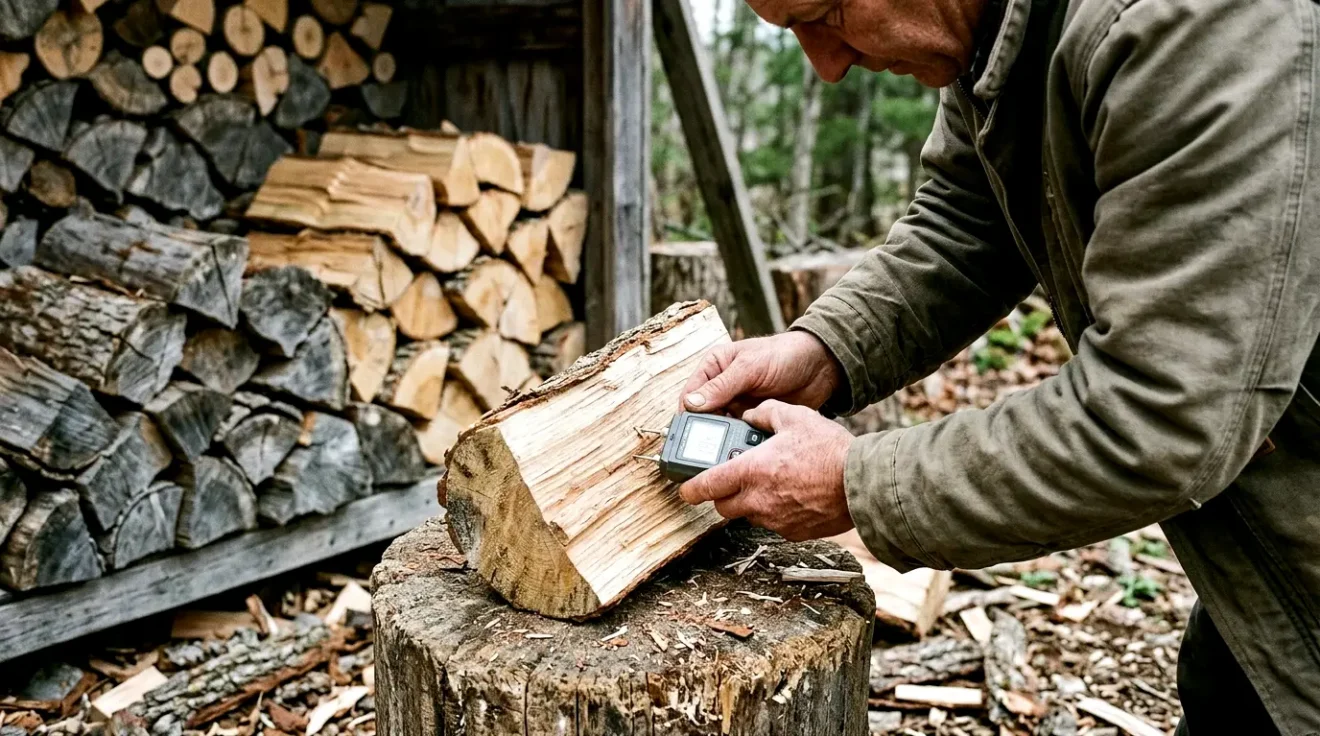
A moisture meter provides a more dependable check. Split a representative log and measure the freshly exposed interior using the meter’s instructions, including any settings required for wood type or temperature. Testing several logs helps reveal variation within a delivery.
20% or less
The recommended firewood moisture level for cleaner domestic burning, also used as the qualifying moisture threshold for firewood sold in volumes below 2 cubic metres under the applicable Ready to Burn rules in England. This is not a universal legal limit for every country or sale.
UK Department for Environment, Food & Rural Affairs (Defra), guidance on cleaner domestic wood burning.
Seasoning time varies with the species, log diameter, splitting method, climate and storage conditions. Dense hardwood logs may need more time to dry than smaller or more readily drying pieces. Simply knowing when a tree was felled does not establish that the resulting firewood is ready to burn.
For effective natural drying, keep split logs off the ground, protect them from direct rain and allow air to circulate around the stack. Avoid trapping moisture by tightly enclosing freshly cut wood in an unventilated space.
Once properly seasoned, wood still needs suitable storage. Prolonged exposure to rain or poor ventilation can increase moisture again. Bringing a small quantity of logs into a safe, designated storage area before use may help avoid burning rain-wet surfaces, but it cannot replace proper seasoning.
The practical purchasing question is therefore not simply whether the seller calls the wood seasoned. Ask how it was processed and stored, and verify its moisture where possible.
Dry fuel creates better conditions for combustion, but it still requires enough oxygen. Excessively restricting the stove’s air controls can undo much of the benefit.
Why Can Excessively Restricting Stove Air Controls Cause Dirty Combustion?
Excessively restricting stove air controls causes dirty combustion because the fire loses the oxygen needed to burn released wood gases. Although closing the controls may slow fuel consumption, severe restriction can increase smoke, soot and creosote formation. The correct setting maintains effective flames while keeping the stove within its manufacturer’s operating limits.
Wood stoves control the combustion process by regulating the supply and distribution of air. Different appliances use different air pathways, so control labels and functions are not necessarily interchangeable.
In many conventional designs, primary air supports combustion around the fuel bed, while secondary air helps burn gases released from the wood. Some stoves also incorporate additional air systems or automatic controls.
Secondary combustion can be particularly important for emissions. When combustible gases receive sufficient oxygen at a suitable temperature, they can ignite above the logs rather than escaping through the chimney as unburned pollutants.
Closing an air control too aggressively may prevent that process from continuing. Even if glowing embers remain visible, the fire may no longer be burning the gases effectively.
Potential warning signs include:
- Flames becoming unusually weak, lazy or repeatedly disappearing.
- Rapid darkening of the glass during ordinary operation.
- Persistent smoke from the flue after warm-up.
- Unusual accumulation of soot or sticky deposits.
Flame colour alone is not a reliable diagnostic. Some efficient combustion systems produce blue flames, so a blue flame should not automatically be interpreted as oxygen starvation. The complete burning pattern and the manufacturer’s guidance are more informative.
A sensible adjustment routine begins with the specified lighting or reloading settings. Once the fire is established, reduce the controls progressively within the approved operating range, observing whether flames remain stable.
Do not attempt to force a high heat output from a stove by opening controls beyond the recommended range. Excessive combustion rates can damage equipment and create overheating hazards. The aim is controlled, sustained combustion, not maximum airflow under every condition.
The longer-term consequences of persistent smouldering are also important. Incomplete combustion can contribute to creosote and soot accumulation inside the flue, increasing cleaning requirements and potentially the risk of chimney fire.
Regular inspection, suitable sweeping intervals and attention to unusual deposits are therefore part of emissions management, not merely routine housekeeping. A qualified professional should investigate repeated smoke problems or suspected draught faults rather than relying on increasingly extreme control adjustments.
Once fuel quality and everyday operation are under control, the remaining question is whether the appliance itself can provide cleaner and more efficient combustion.
Key Takeaways Before Choosing a Stove
- Check the real operating conditions. A modern stove is most effective when its installation, chimney draught and fuel quality support the manufacturer’s intended combustion process.
- Avoid oversizing. An appliance that regularly produces more heat than the home needs may encourage low-air, smouldering operation.
- Compare verified performance, not marketing claims. Look at applicable certification, stated efficiency, particulate emissions and installation requirements together.
How Does Modern Combustion Technology Make Wood Fireplaces More Efficient?
Modern wood-burning technology improves efficiency by extracting more useful heat from the fuel and encouraging wood gases to burn before leaving the appliance. Secondary combustion, preheated airflow and improved firebox insulation help achieve these results. A properly sized, certified modern stove can therefore offer cleaner operation than an older inefficient appliance, provided it is installed and used correctly.
Traditional open fireplaces provide direct radiant warmth and a visible flame, but much of the heat can escape through the chimney. They may also draw substantial amounts of warm room air into the flue.
Older enclosed stoves can improve heat retention compared with open fireplaces, but their combustion systems may be less effective at burning volatile gases. Modern appliances typically combine several design features to improve performance.
- Secondary combustion: additional air is introduced to help ignite combustible gases above the fuel bed, reducing the proportion that escapes unburned.
- Preheated secondary air: airflow is routed through hot parts of the appliance before entering the firebox, helping sustain gas combustion without unnecessarily cooling the flame zone.
- Improved firebox insulation: heat-resistant materials help maintain temperatures that support more complete combustion.
Some designs also use catalytic combustion systems to promote oxidation of wood-smoke compounds under appropriate operating conditions. The technology available depends on the market and appliance category.
The differences between fireplace types can be summarised without assuming that every product within a category performs identically.
| Appliance type | Combustion characteristics | Practical consideration |
|---|---|---|
| Traditional open fireplace | Combustion and heat recovery are relatively uncontrolled | Often provides limited useful room-heating efficiency and can produce substantial smoke |
| Older enclosed wood stove | Better heat containment, but combustion technology varies considerably | Condition, design and operating practices strongly influence performance |
| Modern certified wood stove | Engineered airflow and combustion systems designed to meet applicable performance requirements | Selection, installation, dry fuel and correct operation remain essential |
Replacing an inefficient open fireplace or older stove with an appropriately selected modern model can provide an important opportunity to reduce particulate emissions. However, the magnitude of improvement depends on the equipment being compared and how it is actually used. A certified appliance is not emission-free.
Before purchasing, review the manufacturer’s declared efficiency and particulate-emission results, confirming that they apply to the exact model and fuel type. Compare products assessed under the same relevant standard rather than placing unrelated test figures side by side.
Heating capacity is equally important. A stove that is too large for the space may routinely need to operate at an excessively low output. That can encourage the restricted-air conditions associated with smoke and deposits. A qualified installer can assess the property’s heating requirements, ventilation and flue suitability.
For renovation projects, establish whether the existing chimney can safely serve the selected appliance and what modifications are necessary. Professional installation and ongoing inspection are particularly important where older chimneys or fireplaces are being adapted.
Maintenance completes the picture. Keep door seals, baffles, air passages and other manufacturer-specified components in good condition. Follow the recommended servicing and chimney-sweeping schedule, adjusted where necessary to reflect actual use and professional advice.
Modern combustion technology works best as part of a wider household strategy: good-quality dry fuel, appropriate control settings, suitable heating demand and fewer discretionary fires during poor air-quality conditions.
The most useful next step is to assess the current fire in normal use: measure fuel moisture, check for persistent chimney smoke, review the appliance manual and arrange a professional inspection if combustion or draught problems remain. If replacement is justified, compare appropriately sized certified models and applicable local regulations. These actions can help preserve the benefits of real wood heat while reducing avoidable emissions.
Can a wood-burning fireplace ever be completely smoke-free?
No. Even efficient wood-burning appliances produce emissions, including fine particles and combustion gases. A clear chimney exhaust or clean-looking flame does not prove that no pollutants are present. Cleaner operation reduces avoidable emissions but does not eliminate the environmental or health impacts of burning wood.
Does a cleaner-burning stove need a carbon monoxide alarm?
Yes. A modern, certified stove can still produce carbon monoxide, particularly if ventilation, chimney draught, installation or combustion conditions are inadequate. Install suitable carbon monoxide alarms in the locations required by local regulations and manufacturer instructions, and maintain them according to the alarm manufacturer’s guidance. A smoke alarm does not replace a carbon monoxide alarm.
Can firewood become too dry to burn safely?
Very dry wood can ignite and burn rapidly, so fuel size, loading and air settings must remain within the appliance manufacturer’s specifications. Ordinary properly seasoned firewood is generally desirable for cleaner combustion. Avoid unsuitable manufactured or chemically treated fuels, and never exceed the stove’s permitted operating temperature or loading capacity.
Is a wood stove still appropriate in a densely populated neighbourhood?
That depends on local air-quality conditions, legal restrictions, the appliance and the household’s heating needs. Dense residential areas can create greater opportunities for neighbours to be exposed to wood smoke. Where cleaner alternative heating is available, reducing discretionary wood burning can further limit neighbourhood pollution, even when the stove itself complies with applicable standards.