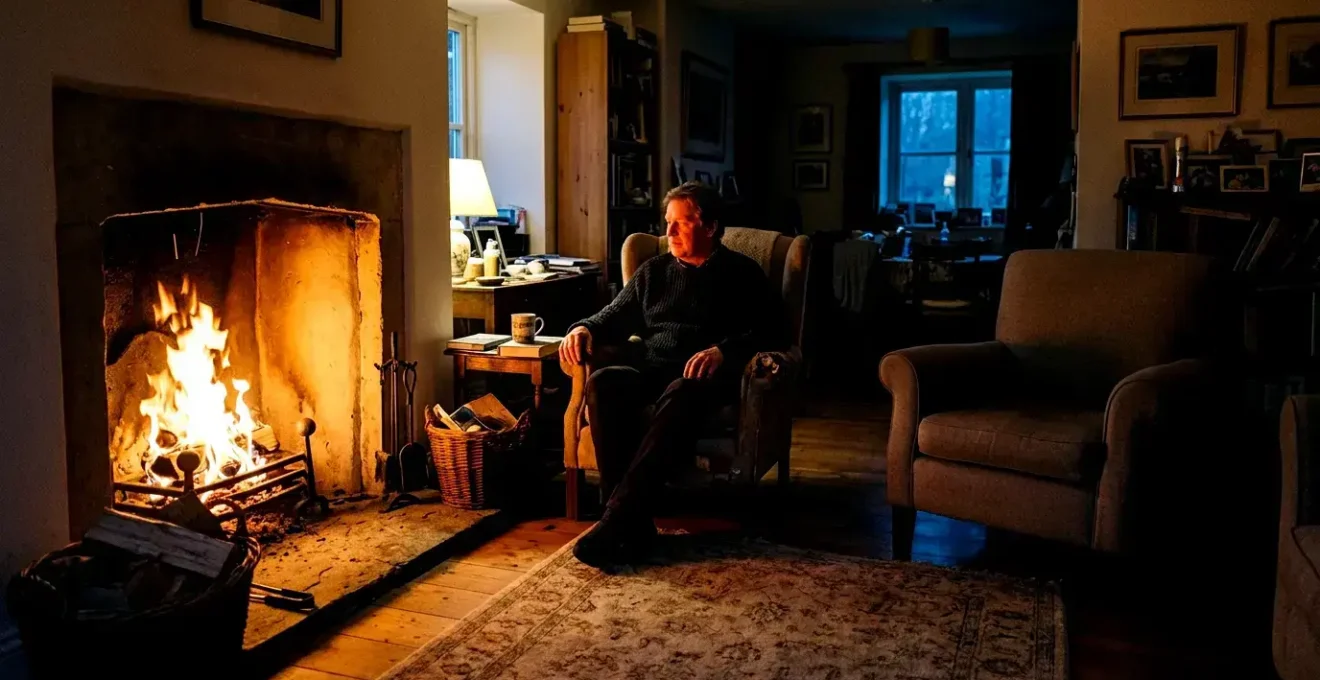
A fireplace can make one part of a living room feel comfortably warm while another remains noticeably cool, even when both seating areas are at approximately the same distance from the flames. The reason is that radiant heat travels directly from the fire to people and surrounding surfaces, rather than relying entirely on warm air circulating throughout the room.
This distinction matters when choosing where to sit, arranging furniture, or deciding whether a fireplace can provide enough heat for a large living space. A chair facing the flames receives direct radiant energy, whereas a chair positioned beside another occupant or behind an obstruction may receive considerably less. Ceiling height, floor temperature, insulation and air movement also influence the overall experience.
Understanding these factors makes it easier to improve comfort without unnecessarily increasing the fire’s output. It also helps homeowners distinguish between a fireplace that produces insufficient heat and one that produces useful warmth but distributes it unevenly. The most comfortable living room is not necessarily the one with the highest air temperature: it is the one where radiant and convective heating work appropriately for the occupied space.
Fireplace Radiant Heat: The Essential Points
- Radiant heat travels directly from the flames and hot fireplace surfaces to people and objects, making seating orientation and unobstructed exposure important.
- Convection distributes warmth through moving air, but high ceilings, poor circulation and cold surfaces can create uneven comfort.
- Furniture positioning, appropriate clearances, floor coverings and gentle air circulation can improve comfort without simply increasing the fire’s output.
- Why Do You Feel Warmer Facing a Fireplace Than Sitting Beside It?
- How to Position Armchairs to Benefit From Fireplace Radiant Heat Safely?
- Radiant or Convection Heat From a Fireplace for a High-Ceilinged Room?
- Why a Fireplace Can Feel Hot Nearby While the Rest of the Room Stays Cool
- How to Improve Fireplace Comfort in a Room With Cold Stone Floors?
- How to Adjust Fireplace Heat Requirements for a Double-Height Living Room?
- How to Create Flexible Seating Around a Fireplace in a Multipurpose Room?
- How Much Fireplace Heat Output Does Your Living Room Really Need?
Why Do You Feel Warmer Facing a Fireplace Than Sitting Beside It?
You feel warmer facing a fireplace because your body receives more direct infrared radiation from the flames and heated surfaces. This energy travels through the room without first needing to warm the surrounding air. Someone sitting beside the fireplace may therefore experience considerably less warmth, even at a similar distance, because their body receives a different amount of radiant energy.
The effect is comparable to standing in sunlight on a cool day. The surrounding air can remain relatively cold while exposed skin feels warmer because it absorbs energy directly from the sun. A fireplace produces a similar local sensation through infrared radiation, although the source, intensity and surrounding conditions are different.
Radiant heating is directional. Flames, embers and hot fireplace surfaces emit infrared energy that travels along unobstructed paths. When this energy reaches skin, clothing or furniture, the receiving surfaces absorb some of it and become warmer. The air between the fireplace and the occupant does not need to experience the same temperature increase.
Convection works differently. It transfers heat through moving air: air warmed near the fireplace becomes less dense and rises, while cooler air moves in to replace it. This process gradually changes the room’s air temperature, but the distribution can be uneven, particularly when circulation is restricted.
This explains why a thermostat may show a relatively modest room temperature while someone sitting directly in front of a fire feels comfortable. According to the ASHRAE Handbook chapter on thermal comfort, human comfort depends on air temperature, mean radiant temperature, humidity and air movement rather than air temperature alone. Operative temperature combines the influence of air temperature and radiant surroundings.
Another important mechanism is radiant shadowing. If a person, chair or other object stands between the fireplace and a seated occupant, it intercepts some of the radiant energy. A person sitting behind another chair may consequently receive less direct warmth than someone with an unobstructed view of the flames.
The body can also experience uneven radiant exposure. A face and hands facing the fire may feel hot while the back remains cool. This is an example of directional thermal asymmetry: different parts of the body exchange heat with different surrounding surfaces. It does not mean every occupant will experience the same sensation, because clothing, posture, exposure and individual thermal sensitivity also matter.
For practical purposes, the useful question is not simply how far a chair is from the fireplace. It is whether the occupant has a reasonably unobstructed view of the fire and whether the resulting warmth is comfortable across the body.
A well-positioned chair should provide comfortable warmth without creating excessive heat on one side of the body. That principle provides the starting point for arranging seating safely.
How to Position Armchairs to Benefit From Fireplace Radiant Heat Safely?
Position armchairs where occupants can receive direct radiant warmth without placing combustible furniture too close to the fireplace. The most useful arrangement generally keeps seating within an unobstructed viewing arc of the flames, while preserving the appliance’s required clearances and a practical walking route around the hearth. Comfort should never take priority over fire safety.
Start by identifying the area where people actually spend time: a reading chair, the main conversation seating arrangement or a sofa facing the fireplace. From there, assess which positions provide a direct view of the flames. A chair placed directly in front of the fireplace may receive more radiant energy than one positioned at the same distance but perpendicular to it.
Test the arrangement during normal fireplace operation. Sit in each position and notice whether warmth reaches both sides of the body. If the face feels excessively hot while the back remains cold, rotating the chair slightly may improve the balance. If another seat feels noticeably cooler, check whether an intervening object blocks its view of the fire.
However, a comfortable position is not automatically a safe position. The U.S. Fire Administration recommends keeping combustible materials at least 3 feet (approximately 0.91 metres) from heat sources, including fireplaces. This is a general preventive recommendation, not a universal installation clearance for every appliance.
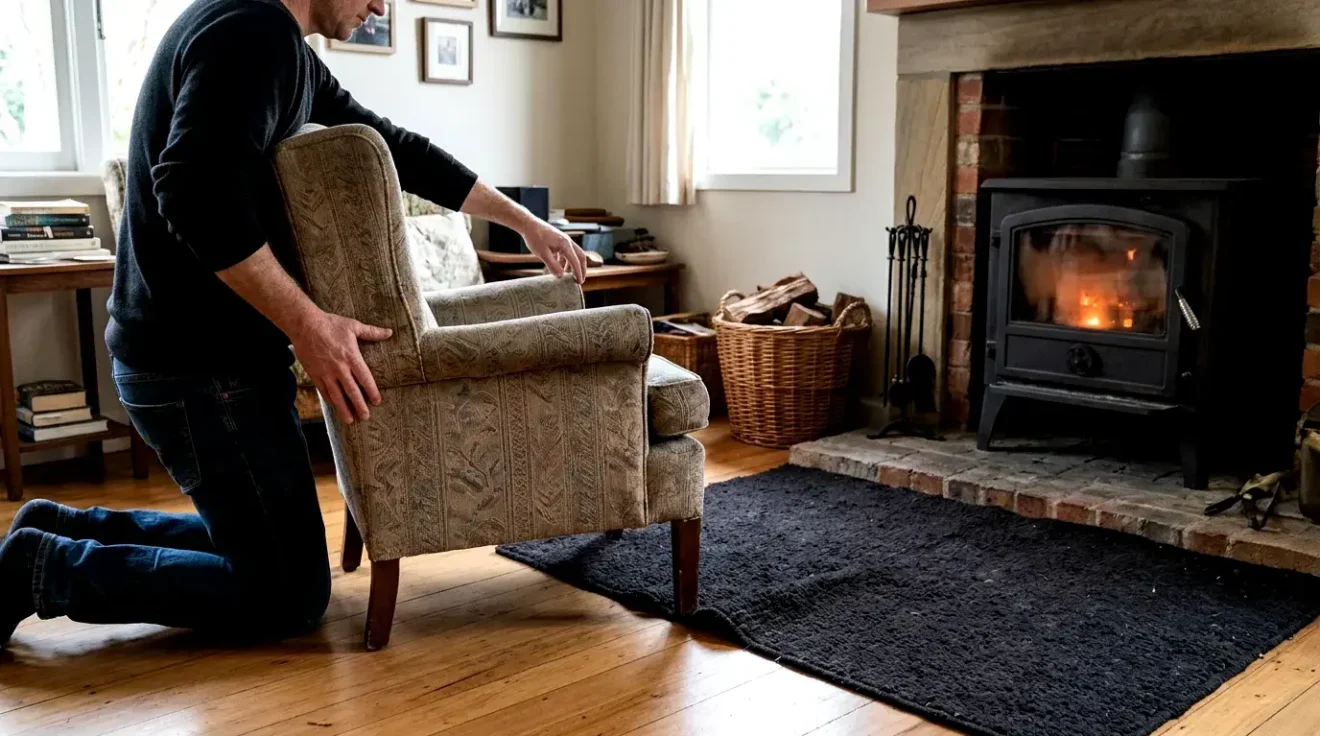
Always consult the fireplace manufacturer’s instructions and applicable local fire and building requirements. These take precedence over general furniture-placement advice and may require greater clearances depending on the appliance, installation and combustible materials nearby.
Furniture materials also deserve attention. Prolonged exposure to intense radiant heat can contribute to fading, drying or deterioration of upholstery and leather, particularly on the side facing the fire. Rotating cushions, monitoring exposed surfaces and choosing appropriate furniture materials can help reduce uneven wear. A decorative throw should never be assumed to provide fire protection or make an otherwise unsafe position acceptable.
Circulation matters just as much. The route between seating, doorways and other parts of the room should remain clear. Frequently moving a chair closer to the hearth must not create a trip hazard or obstruct access to an exit.
A Practical Fireplace Seating Safety Checklist
- Identify the fireplace model and consult its installation instructions. Deliverable: a written record of the manufacturer’s required clearances.
- Measure the existing distance between the hearth and upholstered furniture. Deliverable: a simple room sketch showing furniture positions and measured distances.
- Check direct radiant exposure from each occupied chair. Deliverable: a seating diagram identifying unobstructed and obstructed viewing positions.
- Inspect upholstery, leather and nearby combustible materials for signs of heat exposure. Deliverable: a short furniture-condition inspection record.
- Walk through the room and check access to doors and the hearth. Deliverable: a revised layout with unobstructed circulation routes.
The best arrangement is one that delivers useful radiant warmth while protecting occupants, furniture and circulation routes. Once seating is safe, ceiling height becomes the next important factor in determining how the room retains and distributes heat.
Radiant or Convection Heat From a Fireplace for a High-Ceilinged Room?
Radiant heating can provide a particular advantage in a high-ceilinged living room because it warms occupants and surfaces directly instead of relying exclusively on heated air reaching the seating area. Convection remains useful for increasing the room’s air temperature, but warm air naturally rises and can accumulate near the ceiling. A combination of radiant warmth and gentle air circulation often addresses both effects more effectively.
In a tall room, the temperature near the ceiling may become noticeably higher than the temperature around the seating area. This phenomenon, known as thermal stratification, occurs because warmer, less dense air tends to rise. If circulation is weak, the upper part of the room can become warm while people sitting below continue to feel cold.
Radiant heat does not depend on this vertical air movement to deliver energy to an occupant. A person facing a fireplace can receive warmth even when the surrounding air remains relatively cool. This makes direct radiant exposure useful in rooms with high ceilings, although it does not guarantee uniform comfort throughout the space.
Fireplace designs differ in how they deliver heat. An open fire provides substantial direct radiant exposure near the hearth, but it can lose considerable heat through the chimney. A closed wood-burning stove generally combines radiant heating from its hot surfaces with convection around the appliance. Some fireplace inserts use fans to move heated air into the room, placing greater emphasis on forced air circulation.
There is therefore no universal winner between radiant and convective heating. The appropriate balance depends on the fireplace’s construction, room geometry, insulation, circulation and intended use.
For example, a high-ceilinged living room used mainly as a sitting area may benefit from strong radiant comfort at occupant level. A room intended to maintain a more uniform air temperature may require a more deliberate distribution strategy, such as an appropriate insert or supplementary heating system.
A reversible ceiling fan can also help redistribute accumulated warm air. The U.S. Department of Energy recommends operating a suitable ceiling fan clockwise at low speed during winter, creating an upward airflow near the fan that helps move warmer ceiling air back into the occupied space. The manufacturer’s instructions should determine the correct direction and operating mode for the particular fan.
The important distinction is between gentle destratification and aggressive circulation. Running a fan too quickly can create unwanted drafts, making occupants feel colder even if the room contains more heat. Low-speed operation is a sensible starting point, followed by an assessment of comfort at seating height.
For many high-ceilinged living rooms, the most practical solution is to combine direct radiant comfort with controlled air movement. The next step is to identify whether uneven warmth comes from the fireplace itself or from the room’s heat distribution.
Why a Fireplace Can Feel Hot Nearby While the Rest of the Room Stays Cool
A fireplace can feel intensely hot nearby while the rest of the living room remains cool because radiant energy is concentrated in its direct path, warm air may accumulate near the ceiling, and circulation may not distribute heat effectively. Identifying which mechanism is responsible is more useful than immediately increasing the fire’s output, particularly when the seating area is already becoming too warm.
Three common causes explain this contrast.
First, radiant shadowing limits direct warmth. A chair outside the fireplace’s effective radiant field may receive much less energy than one facing the flames. Furniture, walls and other occupants can also interrupt direct exposure. The resulting cold area is often a positioning issue rather than evidence of insufficient fireplace output.
Second, air stratification separates warm and cool zones. Heated air rises and can collect above the occupied space. In rooms with high ceilings, this means the upper air may become warm while the lower seating area remains uncomfortable.
Third, restricted circulation limits heat distribution. Closed doors, awkward room geometry and limited air movement can prevent warmth from reaching distant parts of an open or divided living space. A fireplace may therefore provide pleasant local warmth without effectively heating the entire floor plan.
A simple diagnostic comparison can help distinguish these causes. If moving a chair into the direct view of the fire makes it warmer, radiant shadowing is likely contributing. If the upper part of the room feels warmer than the seating zone, stratification deserves attention. If opening an internal door changes the temperature or comfort of the distant area, restricted circulation may also be involved.
Comparing temperatures at different heights provides another useful indication. Measure the air temperature near ankle height and around seated head height, then compare both readings with a measurement taken higher in the room. A noticeable vertical difference suggests that warm air is not evenly distributed.
Thermostat placement can complicate the diagnosis. A thermostat positioned in a warm pocket near the fireplace may register conditions that do not represent the distant seating area. This can cause a central heating system to reduce its output even though occupants elsewhere remain uncomfortable. A separate thermometer in the main seating zone provides a more representative local measurement.
It is also important to avoid compensating for a cold distant area by continually adding fuel. Increasing the fire’s output may overheat the hearth zone without solving the underlying distribution problem. It can also increase fuel consumption and create additional safety concerns.
Instead, match the response to the actual cause: improve seating orientation for radiant shadowing, investigate gentle destratification for vertical temperature differences, or assess air circulation when the room’s layout restricts heat movement.
Once the source of uneven warmth is identified, the floor itself deserves attention. Even when the fireplace heats the air and provides direct radiation, a cold floor can continue to make the seating area uncomfortable.
How to Improve Fireplace Comfort in a Room With Cold Stone Floors?
A cold stone floor can make a fireplace living room feel uncomfortable even when the air temperature is reasonably warm. The floor affects the body’s thermal environment through contact with the feet and heat exchange with nearby surfaces. Improving comfort therefore involves addressing the temperature of the occupied floor area, rather than relying exclusively on additional heat from the fireplace.
Stone flooring is often perceived as cold because it can draw heat from the feet through direct contact. Its relatively high thermal conductivity and thermal effusivity can make it feel colder than materials such as carpet or wood when both are at similar temperatures. This sensation can persist even when the room air is comfortable.
Floor temperature also influences the room’s mean radiant temperature. ASHRAE identifies floor temperature as an important factor in thermal comfort and notes that excessively cold floors can cause local discomfort in the feet. The effect depends on the actual floor temperature, insulation, building construction and heating conditions.
A thick area rug is a straightforward way to improve the immediate seating environment. It reduces direct contact with the cold floor and provides an insulating layer between the feet and the stone surface. Positioning the rug beneath the main seating arrangement is generally more useful than covering an unrelated part of the room.
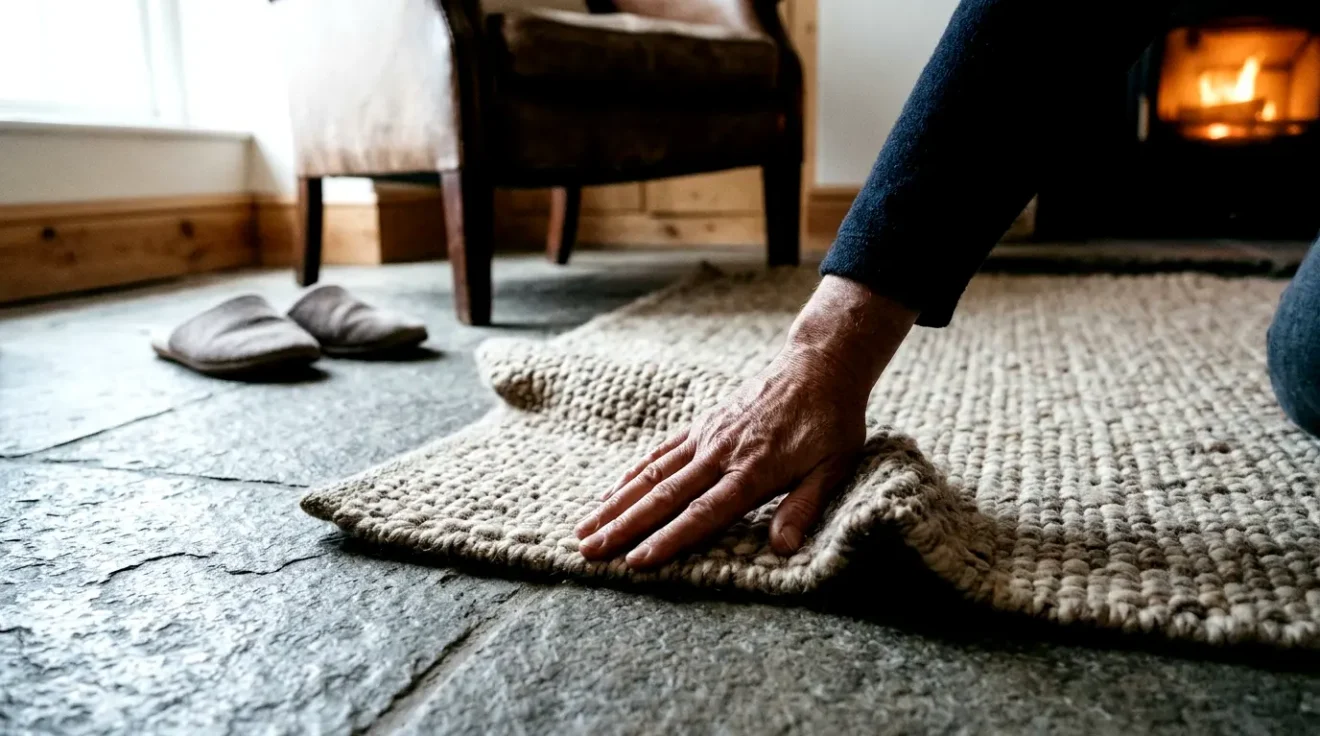
For a more extensive improvement, homeowners renovating the room can investigate underfloor insulation or a compatible underfloor heating system. These interventions address the floor’s thermal performance more directly, but their suitability depends on the existing construction, floor assembly and available installation space.
There is an important distinction between thermal mass and insulation. Stone can store heat and release it gradually, but this characteristic does not automatically make a stone floor warm. Its usefulness depends on whether heat reaches the material in sufficient quantities and whether the resulting temperature is comfortable for occupants. A fireplace that mainly provides direct radiant warmth to nearby people may not heat the entire floor evenly.
Homeowners can assess the situation by measuring the floor surface temperature in the seating area before and after the fireplace has been operating under normal conditions. Compare those readings with the air temperature around seated head height. An infrared thermometer can help with surface measurements, although readings depend on the surface emissivity and the instrument’s specifications.
If the floor remains substantially colder than the surrounding occupied environment, a rug or a building-fabric improvement may be more effective than simply increasing the fireplace output. This avoids using additional fuel to compensate for a problem that originates at floor level.
A warmer floor covering can make a noticeable difference without changing the fireplace itself. In rooms with much greater vertical volume, however, floor-level comfort must also be considered alongside the amount and distribution of heat required.
Key Considerations Before Sizing a Fireplace for a Double-Height Room
- Calculate the full room volume and consider whether an upper level or mezzanine forms part of the heated space.
- Distinguish between heating the occupied seating zone and maintaining a uniform temperature throughout the entire vertical space.
- Assess whether a fan-assisted appliance or gentle ceiling-fan circulation can improve comfort without introducing unwanted drafts.
How to Adjust Fireplace Heat Requirements for a Double-Height Living Room?
A double-height living room requires a different approach to fireplace sizing because its heated air volume is considerably greater than that of a standard-height room with the same floor area. The calculation should account for the full ceiling height, insulation, glazing and openness to adjoining spaces. However, choosing an appliance solely from the total volume can be misleading when warm air accumulates above the occupied zone.
The starting point is to calculate the room’s approximate volume:
Room volume = floor area × average ceiling height.
For a room with a uniform ceiling, the calculation is straightforward. Where the ceiling slopes or the space connects to a mezzanine, the geometry requires a more careful assessment. The important point is to avoid using floor area alone as though the room had a conventional ceiling height.
However, the resulting volume is not a complete fireplace sizing formula. Actual heat requirements also depend on insulation, air leakage, window area, outdoor design conditions and the temperature the occupants expect to maintain. A room with substantial glazing or an open connection to another level may behave differently from a similarly sized, well-insulated enclosed room.
Thermal stratification introduces another complication. Warm air rises toward the upper part of a double-height space, while the ground-floor seating area can remain relatively cool. Selecting a larger fireplace simply to heat the entire calculated volume may increase temperatures near the ceiling without delivering proportionate comfort where people actually sit.
Two approaches can help address this imbalance. The first is a suitable fireplace insert with an integrated fan that circulates heated air into the occupied part of the room. Its effectiveness depends on the appliance design and the way air is discharged into the space.
The second is a compatible reversible ceiling fan. The U.S. Department of Energy recommends low-speed clockwise operation during winter for suitable fans, helping circulate warm air accumulated near the ceiling. This redistributes existing heat rather than generating additional thermal energy.
Noise, electricity use and air movement must also be considered. A fan that creates noticeable drafts may reduce perceived comfort, particularly in a quiet living room where occupants sit close to the airflow. Gentle circulation is preferable to aggressive mixing, and the fan manufacturer’s instructions should always take precedence.
Finally, determine whether a mezzanine or upper floor is intended to be heated. If it is an occupied space requiring similar comfort, it must be included in the heating strategy. If it is only an occasional-use or buffer area, the requirements may be different. This distinction affects both the expected heat demand and the choice of appliance.
A fireplace should be selected to serve the intended occupied zones, not simply to compensate for every cubic metre above the seating area. That principle is equally important when a living room performs several functions throughout the day.
How to Create Flexible Seating Around a Fireplace in a Multipurpose Room?
A multipurpose living room benefits from a flexible seating arrangement that allows occupants to move chairs into the fireplace’s radiant field when warmth is needed, then reposition them when the room serves another function. Lightweight armchairs, ottomans and nesting stools can provide this flexibility, provided the hearth safety zone and circulation routes remain clear.
Unlike a dedicated sitting room, a multipurpose space may need to accommodate reading, television viewing, entertaining, dining or working. The fireplace cannot necessarily provide equally effective warmth to every activity zone, particularly when it is positioned against one wall or in a corner.
The first decision is therefore which area should receive the greatest benefit from radiant heating. For example, a homeowner may prioritise a reading nook in winter rather than the dining table or television area. Once that priority is established, the main seating arrangement can be designed around the fire’s unobstructed radiant field.
Modular furniture makes the arrangement adaptable. Lightweight armchairs can be brought closer to the main seating zone, while nesting stools and ottomans can be moved when additional floor space is required. This approach allows the room to change function without permanently sacrificing its most comfortable fireplace position.
However, frequent furniture movement creates a particular safety challenge. A chair that is safe in one arrangement may be too close to the fireplace after being moved. Establishing a permanent hearth safety zone makes this easier to manage. A clearly defined hearth extension, suitable floor marking or consistent furniture boundary can help occupants recognise where movable pieces must not be placed.
Furniture should never obstruct appliance access, required clearances or escape routes. Rugs and decorative accessories also need to remain outside the relevant safety zone. A visual boundary can help with everyday organisation, but it does not replace manufacturer instructions or applicable fire safety requirements.
A hybrid arrangement often provides the best balance. Keep one comfortable primary chair in a safe position with direct exposure to the fireplace. Add movable seating for guests or alternative activities, bringing it into the appropriate viewing arc only when the room layout allows.
Consider how the seating arrangement changes at different times of day. A reading chair may benefit from direct radiant warmth in the evening, whereas a television area may require a different orientation. If the fireplace is not intended to heat the entire open-plan room, identifying the primary comfort zone prevents unrealistic expectations about its performance.
By combining a permanent warm seating position with adaptable furniture, homeowners can preserve both comfort and usability. The final consideration is whether the fireplace produces enough useful heat for the room or merely creates a pleasant localised warm zone.
How Much Fireplace Heat Output Does Your Living Room Really Need?
The fireplace heat output required for a living room depends on its volume, insulation, windows, air leakage and connection to adjoining spaces. However, the rated output alone does not establish whether occupants will feel comfortable. The fireplace must deliver usable heat to the occupied zone, with an appropriate balance between radiant warmth and convection, rather than simply producing a high nominal output.
Start by estimating the room’s volume using its floor area and average ceiling height. Then consider the characteristics that influence heat loss and distribution:
- Insulation: poorly insulated walls, roofs and floors increase heat loss and can make the room difficult to keep comfortable.
- Windows and glazing: large window areas can influence heat loss and create cold radiant surroundings near seating positions.
- Ceiling height: high ceilings increase room volume and can encourage vertical temperature differences.
- Air leakage: draughts and uncontrolled air exchange can reduce comfort even when the fireplace produces substantial heat.
- Adjacent spaces: open doorways, mezzanines and open-plan layouts can increase the area that the fireplace is expected to serve.
These factors provide a useful framework for estimating demand, but they do not produce a reliable numerical output requirement without further building-specific information. A proper heat-loss assessment should consider local climate conditions, construction characteristics and the intended indoor temperature.
The next distinction is between rated output and perceived comfort. A fireplace may have an output that appears appropriate for the room’s estimated demand but still leave the far seating area cold. This can happen when convection dominates and warm air accumulates near the ceiling, or when radiant energy reaches only a limited part of the room.
Open fireplaces present a further complication. The U.S. Environmental Protection Agency reports that the fire’s heat lost through the chimney by traditional open fireplaces — most traditional open fireplaces lose over 90% of the fire’s heat through the chimney. This figure refers to traditional open fireplaces and should not be applied indiscriminately to modern stoves, sealed inserts or other fireplace technologies. The agency also notes that heated indoor air can escape through the chimney.
Over 90%
The U.S. Environmental Protection Agency reports that most traditional open fireplaces lose more than 90% of the fire’s heat through the chimney. This is a general statement about traditional open fireplaces, not a measured efficiency figure for every fireplace installation or modern appliance.
U.S. Environmental Protection Agency, EPA information on fireplace types and retrofit devices.
This distinction matters because visible flames and strong local radiant warmth do not necessarily mean that a fireplace efficiently heats the entire living room. An open fire can feel pleasant in front of the hearth while delivering relatively little useful heat to distant parts of the house.
Closed appliances and fireplace inserts operate differently, and their rated output, heat distribution and combustion characteristics must be assessed individually. Homeowners comparing products should look beyond the maximum output figure and examine the manufacturer’s declared performance, recommended room conditions and installation requirements.
There is also a practical question about intended use. A fireplace designed to provide supplementary warmth to a small seating area has different requirements from one expected to maintain comfortable conditions throughout an open-plan living and dining space. Selecting an appliance for the whole open-plan volume when only the seating zone requires direct warmth may result in unnecessary output and local overheating.
Conversely, an appliance selected only for the immediate hearth area may not provide enough useful heat for a larger occupied space. The correct balance depends on the heating objective and the room’s thermal behaviour.
Before choosing or replacing a fireplace, assess the room’s heat losses, intended occupied zones and heat distribution requirements. A building-specific heat-loss calculation, combined with the appliance manufacturer’s technical information, provides a more reliable basis for selection than floor area or nominal output alone.
Does radiant heat from a fireplace warm the air in a living room?
Radiant heat primarily warms people and surfaces that receive direct exposure to the fireplace. Those warmed surfaces can subsequently transfer heat to the surrounding air through convection. However, radiant heating does not require the air between the fireplace and an occupant to become equally warm before comfort improves. The balance between radiant and convective heat depends on the fireplace design and operating conditions.
Why does sitting in front of a fireplace feel warmer than sitting at the same distance beside it?
A person sitting directly in front of a fireplace generally receives more unobstructed infrared radiation than someone sitting beside it. The orientation of the body, intervening furniture and the angle of exposure all affect radiant heat exchange. Consequently, two people at a similar distance from the same fire can experience different levels of warmth.
Can a ceiling fan make a fireplace heat a high-ceilinged room more effectively?
A suitable reversible ceiling fan can help redistribute warm air that accumulates near the ceiling. The U.S. Department of Energy recommends clockwise operation at low speed during winter for compatible fans. This can improve air circulation around the occupied zone, but it does not increase the fireplace’s total heat output. Excessive airflow can also create uncomfortable drafts.
Does a thick rug make a living room with stone flooring feel warmer?
Yes. A thick rug provides insulation between the feet and a cold stone surface, reducing heat transfer through direct contact. It can improve local comfort around the seating area without requiring a higher fireplace output. The rug must nevertheless be positioned safely, away from the fireplace’s required combustible-material clearances.
Should a fireplace be sized according to floor area or room volume?
Room volume is an important starting point because ceiling height affects the amount of space being heated. However, floor area and volume alone are insufficient for accurate appliance sizing. Insulation, windows, air leakage, climate, adjoining spaces and the intended occupied zones must also be considered. A building-specific heat-loss assessment and the manufacturer’s technical guidance provide a more reliable basis for choosing an appropriate fireplace.