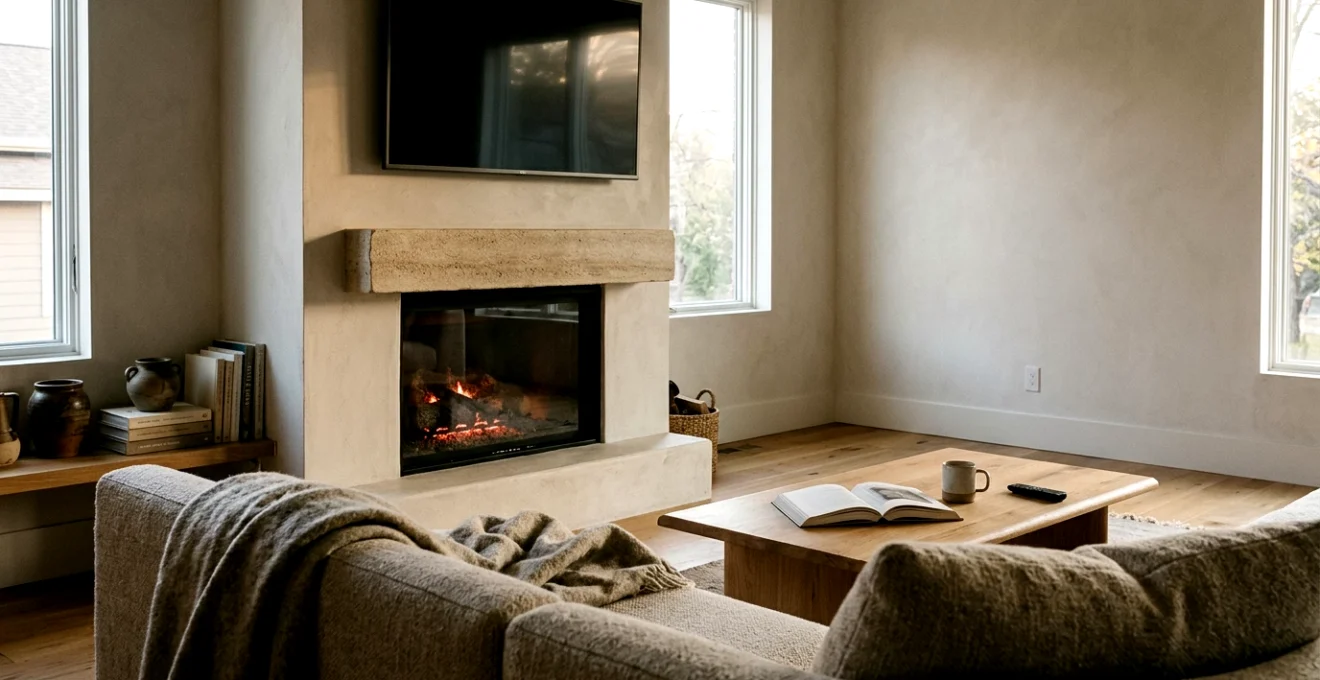
A fireplace creates atmosphere, while a television provides entertainment. Combining both in one living room seems straightforward until the screen ends up too high, flames reflect across the picture, or the furniture arrangement forces everyone to turn their heads. A visually impressive media wall is not necessarily comfortable to use.
The most effective fireplace and TV layout starts with the people sitting in the room, rather than the architectural symmetry of the wall. Keep the television close to seated eye level, protect it from fireplace heat, and position the main sofa for a relaxed viewing angle. The fireplace can remain an important focal point without determining the television’s height.
The right arrangement also depends on the room’s proportions. A wide wall may accommodate two adjacent focal points, while an L-shaped living room can support separate entertainment and conversation areas. Even a compact room can work well when screen position, fire visibility, lighting, and circulation are considered together.
Fireplace and TV placement: the essentials
- Prioritise the seated viewing position when choosing television height and orientation, even if a different arrangement looks more symmetrical.
- Check the fireplace and television manufacturers’ heat-clearance requirements before installing a screen near the fire.
- Use adjacent walls, furniture placement, and controlled ambient lighting to reduce uncomfortable viewing angles and distracting reflections.
- Why Does a Television Above a Fireplace Often Feel Too High?
- How to Position a Television Beside a Fireplace on a Wide Living Room Wall?
- Same Wall or Separate Walls for a Fireplace and Television in an L-Shaped Room?
- The Heat Clearance Mistake to Avoid When Mounting a TV Near a Fireplace
- How to Limit Fireplace Reflections on a TV Screen During Evening Viewing?
- How to Set Fireplace Glass Height for Comfortable Viewing From a Sofa?
- Low-Mounted or Eye-Level Electric Fireplace for a Contemporary Living Room?
- How to Improve Room Flow When a Fireplace Interrupts the Living Space?
Why Does a Television Above a Fireplace Often Feel Too High?
A television mounted above a fireplace often feels too high because the mantel lifts the screen above the natural viewing line of someone sitting on a sofa. Watching then requires an upward gaze and sometimes backward head movement. This may be tolerable for occasional viewing but uncomfortable during longer films, television programmes, or gaming sessions.
The problem begins with competing height requirements. Fireplace surrounds and mantels are positioned according to the appliance design, combustible-material clearances, and applicable installation requirements. Their height does not necessarily correspond to a comfortable television position.
Placing a screen above an existing mantel adds another vertical layer. The television’s centre can end up substantially higher than the eyes of a seated viewer.
Sony‘s recommendations for wall-mounted TV height generally favour positioning the screen’s centre at viewer eye level, while allowing for seating arrangements and differences between television models. That makes the main sofa a more useful reference than the top of a fireplace surround.
Ergonomic principles support the same concern. Looking upward for prolonged periods can encourage an awkward head-and-neck posture and contribute to muscular fatigue. However, guidance developed for office monitors should not be treated as a fixed mounting-height standard for domestic televisions.
A downward-tilting wall bracket can improve the screen’s orientation towards the sofa, but it does not lower the physical position of the screen. Viewers may still need to look upward. Significant viewing angles can also affect picture consistency, depending on the display technology and model.
Before buying a bracket, make a simple mock-up:
- Sit naturally in the main television-viewing position.
- Mark the proposed screen centre on the wall using removable tape.
- Look towards the mark without deliberately lifting your chin.
- Check whether the position remains comfortable while reclining or sitting upright.
This exercise also exposes an aesthetic compromise. A television above a fireplace may look beautifully integrated when viewed while standing, yet feel awkward from the sofa where most actual viewing takes place.
If the mantel forces an uncomfortable viewing angle, placing the screen beside the fireplace is usually a more practical starting point than relying on an adjustable bracket.
How to Position a Television Beside a Fireplace on a Wide Living Room Wall?
On a wide living room wall, position the television beside the fireplace with its centre close to seated eye level. Use a low media cabinet, shelving, or a recessed niche to visually connect the two features. The arrangement should favour a comfortable screen-facing sofa position rather than forcing the fireplace and television into perfect symmetry.
One effective configuration keeps the fireplace near the centre of the architectural wall and places the television to one side. The screen can occupy a lower horizontal band, while the fireplace surround retains its own proportions.
The crucial distinction is between visual alignment and functional alignment. Matching the television’s lower edge to the top of a mantel might produce a tidy architectural line, but it can place the screen unnecessarily high.
Align the television with seated eyes, not with the mantel. Balance the composition using furnishings rather than raising the screen.
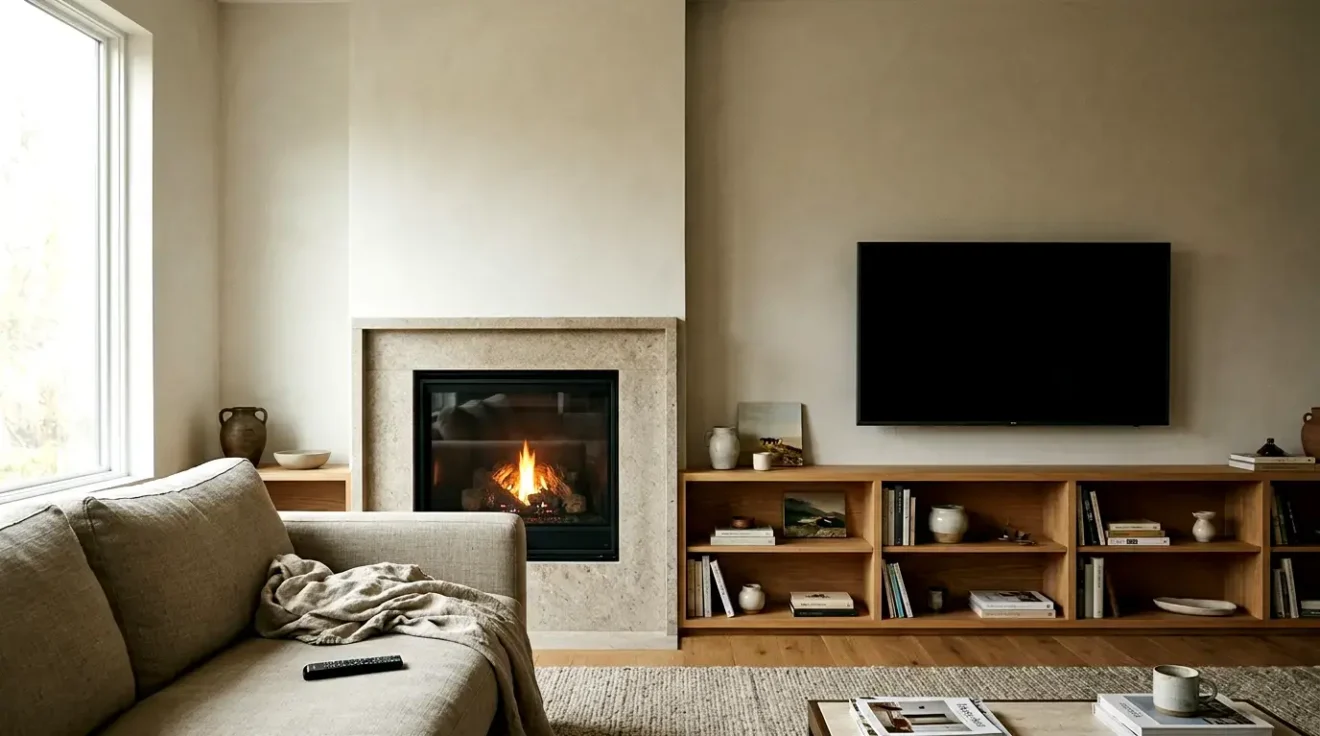
For a particularly wide wall, two independent focal points can appear disconnected. A continuous low cabinet, a consistent wall finish, or carefully arranged shelving can establish a visual relationship without requiring either feature to dominate.
Conversely, placing the television immediately against the fireplace surround may make the composition feel crowded and expose the screen to unwanted heat or light. The appropriate spacing must account for both aesthetic proportions and appliance requirements.
The relationship between symmetry and viewing comfort is worth testing before installation.
| Consideration | Symmetrical composition | Comfort-led offset composition |
|---|---|---|
| Visual character | Formal, balanced, architectural | Relaxed, adaptable, furniture-led |
| Television alignment | May follow decorative wall geometry | Follows the principal seating position |
| Furniture placement | Often encourages centrally arranged seating | Allows seating to favour the screen |
| Best suited to | Rooms where the fireplace remains dominant | Rooms used frequently for television and films |
Low furniture can also soften the transition between the two focal points. A media cabinet beneath the television provides a visual base, while a bookcase or niche between the features creates separation without leaving an awkward empty stretch of wall.
Lighting should support this relationship rather than exaggerate it. A softly lit shelf can make the wall feel cohesive, while a bright decorative light close to the screen may introduce glare.
Where the wall does not offer enough usable width, it may be better to move the television onto another wall instead of squeezing both features into a compromised composition.
Same Wall or Separate Walls for a Fireplace and Television in an L-Shaped Room?
In an L-shaped living room, separate walls often provide the most flexibility because the fireplace and television can serve different activities. The fireplace can anchor a conversation area while the television faces a dedicated sofa. Keeping both on one wall creates a more unified focal point, but may impose greater viewing-height and furniture-placement compromises.
The advantage of an L-shaped room is that its geometry naturally suggests distinct zones. The shorter section may accommodate relaxed seating around a fire, while the longer section provides a better viewing distance and orientation for television entertainment.
However, separate focal points are not automatically better. If the television and fireplace remain visible from the same seat, they may compete for attention, particularly when flames are bright against a darker television image.
Before deciding, map the sightlines from each frequently used seat. Note where a person looks naturally when sitting upright, reclining, or turning towards another occupant.
A swivel chair can help bridge both zones. A large fixed sofa is less adaptable, so its orientation should primarily support whichever activity dominates daily use.
Consider a hypothetical L-shaped lounge where the fireplace occupies the shorter wall and a television can fit along the longer wall. Placing the main sofa opposite the television allows direct viewing, while a pair of armchairs angled towards the fireplace creates a conversation area. The layout works only if the chairs do not obstruct circulation or block the screen.
The two principal approaches have different trade-offs:
- Same wall: creates one visual destination and can simplify furniture orientation, but may increase competition for wall space or encourage an excessively high TV installation.
- Separate walls: allows more independent positioning, but requires careful planning of electrical outlets, cables, furniture orientation, and circulation.
When using separate walls, plan the power supply and cable routes before finalising furniture positions. Avoid routing cables through fireplace cavities or other heat-exposed areas unless the installation method is specifically permitted.
The most successful zoning does not make the two parts of the room feel disconnected. Repeating materials, upholstery colours, or lighting finishes can maintain continuity while allowing different furniture orientations.
Once the preferred walls are identified, their technical suitability matters as much as their appearance. In particular, a television positioned near the chimney breast must be checked for heat exposure before mounting.
The Heat Clearance Mistake to Avoid When Mounting a TV Near a Fireplace
The most important heat-clearance mistake is assuming that a television is safe simply because it does not touch the fireplace or mantel. Warm air can rise along the chimney breast and expose the screen to temperatures outside its permitted operating conditions. Safe placement depends on the specific fireplace, its ventilation arrangement, and the television manufacturer’s requirements.
Even an enclosed fireplace or insert can release substantial heat into its surroundings. A glass front does not necessarily prevent convection currents from carrying warm air upwards.
Different fireplace types also create different conditions. An open wood-burning fire, an enclosed insert, a gas fireplace, and an electric unit can have markedly different heat-output paths and installation requirements.
There is no universal fireplace-to-TV clearance that can safely replace the product manuals.
Heatilator‘s advice on mounting a TV above a fireplace explains that such installations can be possible when heat is appropriately managed and the relevant clearances are respected. The manufacturer discusses mantel and alcove arrangements that may help redirect heat, but stresses the importance of following both appliance manufacturers’ specifications.
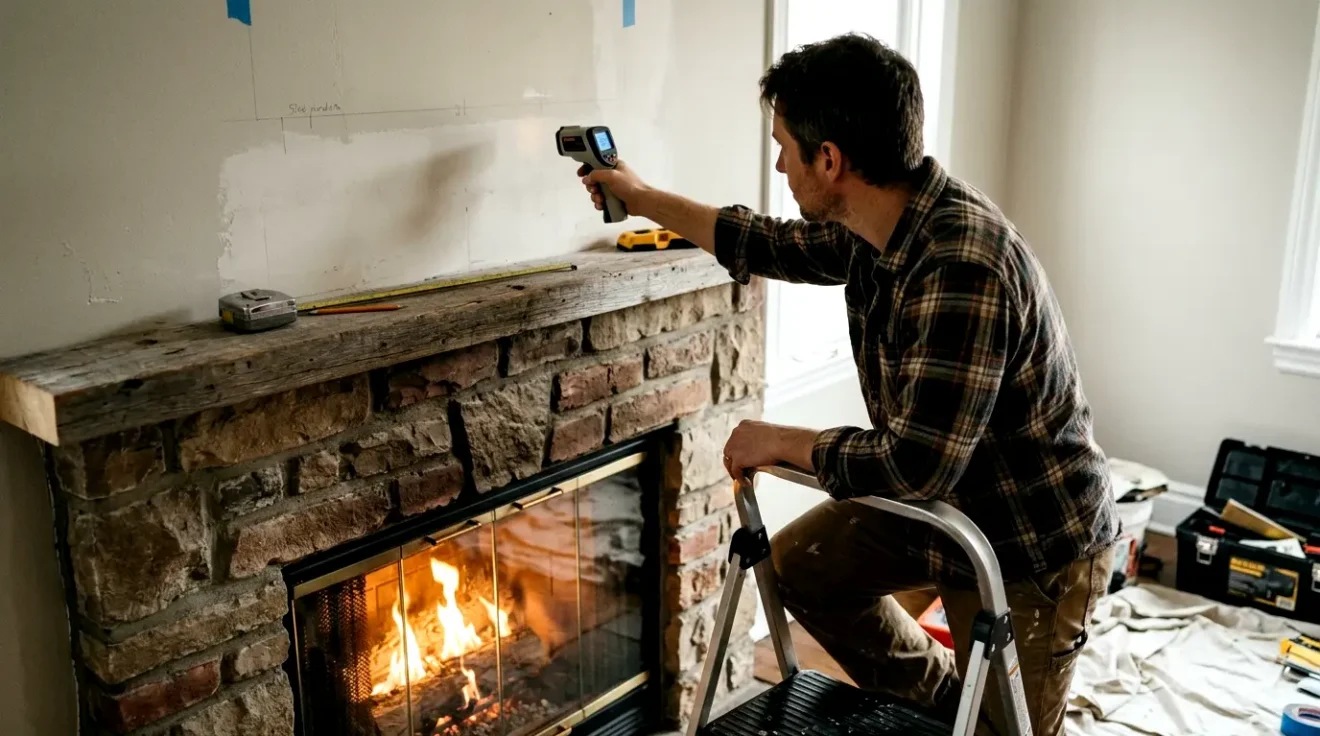
Heat exposure is not solely a question of immediate failure. Repeated operation outside an electronic device’s specified temperature range can place additional stress on internal components and may shorten its useful life. Potential problems include overheating, unexpected shutdowns, and premature deterioration.
Measuring wall temperature can help identify a potentially unsuitable location, but the wall surface is not the same as the air around the television. An infrared thermometer also measures surface temperature and can be affected by the material’s emissivity. It cannot, by itself, certify an installation as safe.
A useful pre-installation check therefore combines documentation, measurement, and professional assessment where necessary.
Five checks before mounting a television near a fireplace
- Identify both appliance models. Record the fireplace and television model numbers and obtain their installation or operating manuals.
- Mark the intended screen position. Prepare a wall sketch showing the television outline, fireplace opening, mantel, nearby vents, and proposed bracket location.
- Document the required clearances. Create a short checklist of all relevant manufacturer restrictions, including ventilation and combustible-material requirements.
- Assess heat during normal fireplace use. Where safe and appropriate, record surface-temperature observations and identify the manufacturer’s permitted ambient operating range; do not treat wall readings as proof of compliance.
- Approve or revise the layout. Produce a final mounting plan that satisfies both manuals and applicable installation requirements, or move the TV to a safer location.
If the manuals are unclear or the fireplace installation has been modified, consult a qualified installer familiar with the appliance. An attractive mantel arrangement does not justify overlooking a clearance restriction.
Once the installation is technically acceptable, visual comfort still needs attention. Even a safely mounted screen may become distracting when moving flames appear in its reflective surface.
How to Limit Fireplace Reflections on a TV Screen During Evening Viewing?
To reduce fireplace reflections on a television, first identify whether the flames are visible in the screen from the main sofa. Adjusting the screen angle, changing its position, or choosing a display with effective reflection handling can reduce glare. Gentle background lighting may improve perceived comfort, although it will not remove the reflection itself.
Most television screens reflect some ambient light. Glossy displays can produce distinct, mirror-like images of bright objects, while matte or anti-reflective finishes tend to alter how reflected light appears.
A fireplace can be particularly distracting because its brightness and movement change continuously. During dark scenes, the reflected flame pattern may become more noticeable than it would be during a bright programme.
RTINGS‘ television reflection tests explain how screen finishes influence direct reflections. Glossy surfaces can preserve sharp reflections, whereas matte treatments spread reflected light more diffusely, with potential trade-offs for contrast and overall picture appearance.
These laboratory tests concern controlled light sources rather than residential fireplaces, but the underlying reflection behaviour is relevant to living room planning.
The most useful first step is a simple evening observation. Sit in the usual viewing position with the fireplace operating normally and the television showing a darker image. Notice whether the reflected light comes directly from the flames, from another light source, or from a secondary reflection elsewhere in the room.
Then consider the following adjustments:
- Change the screen angle: a modest swivel may move the reflected fireplace out of the main viewer’s sightline, provided off-axis picture quality remains acceptable.
- Reconsider relative positions: placing the fireplace farther to the side of the principal viewing direction can reduce competing light sources.
- Evaluate screen finishes: compare reflection handling under lighting conditions similar to those in the living room.
- Introduce subdued ambient lighting: a low-intensity light behind or near the television may soften the perceived contrast between the screen and its surroundings.
A glass fireplace screen should not automatically be assumed to reduce television glare. Depending on its finish and viewing geometry, the glass may introduce additional reflections. Any fire screen must also remain appropriate for the fireplace and its safety requirements.
Completely darkening the room can make bright reflected flames more conspicuous. A restrained lighting scheme often feels more comfortable than switching off every other light, although it cannot compensate for a fireplace directly mirrored in the display.
Reducing glare makes television viewing more enjoyable, but the fireplace itself also needs a comfortable sightline. The ideal flame height follows different priorities from the ideal television height.
How to Set Fireplace Glass Height for Comfortable Viewing From a Sofa?
Set fireplace glass height by checking the flames from the actual sofa position rather than selecting an opening height purely for appearance. The fire should remain naturally visible without the coffee table, mantel, or furniture blocking the view. Unlike a television, a fireplace can often be enjoyed comfortably through relaxed or peripheral viewing rather than continuous direct attention.
A television demands sustained focus on a defined rectangular image. A fireplace usually serves as a softer visual feature, allowing people to enjoy the flame movement while talking, reading, or resting.
This difference gives the fireplace opening greater flexibility in vertical placement. However, the visibility of the flame bed still matters, particularly from low seating or a reclining position.
A floor-level glass opening can look dramatic in a contemporary interior, but the lower flames may disappear behind a coffee table, an ottoman, or the legs of someone seated nearby.
At the opposite extreme, a very high opening may make the fire less naturally visible when relaxing on a low sofa.
To evaluate the height, temporarily mark the proposed glass opening on the wall. Sit in each important position and check which parts of the opening remain visible. Include the far end of an L-shaped sofa, armchairs, and any seating that faces the fireplace obliquely.
Judge the visible flame area, not simply the centre of the fireplace opening. A partially obscured opening may still look attractive from across the room but offer a disappointing view from the main seat.
Comfort also has a thermal dimension. The installation height and nearby furnishings must respect the fireplace manufacturer’s requirements for combustible materials, hearth protection, ventilation, and other relevant clearances.
A low fireplace opening should therefore not be chosen solely to improve visibility if it places rugs, furniture, or other materials too close to a heat source. Similarly, an elevated installation cannot be assumed safe without considering the specified surround construction.
For built-in contemporary fireplaces, review the opening height before the wall finish and surrounding cabinetry are designed. Changing the position after construction may be considerably more disruptive.
These principles are especially useful when selecting an electric fireplace, where the choice between a low installation and a more elevated focal point can shape the entire media-wall design.
Low-Mounted or Eye-Level Electric Fireplace for a Contemporary Living Room?
A low-mounted electric fireplace generally suits a contemporary living room where television viewing is the primary activity. It keeps the flame effect below the main sightline and allows the TV to occupy a more comfortable position. An eye-level electric fireplace is more appropriate when the fire itself is the main focal point and the television is secondary or located elsewhere.
The decision depends less on decorative fashion than on how the room is used. An electric fireplace can provide a visual flame effect independently of combustion, but models differ in heat output, ventilation arrangements, and permitted installation configurations.
In a media wall, the television should usually be positioned first according to the main seating position. The fireplace can then be integrated below it, provided the chosen model explicitly permits that arrangement.
A lower opening can give the wall a restrained horizontal composition and keep both features within a coherent architectural zone. It can also reduce the need to mount the television unusually high.
However, electric does not automatically mean heat-free. Some models discharge warm air from the front, top, or another specified opening. Others require particular ventilation spaces or access to controls and serviceable components.
An overly tight recess may interfere with airflow. Installing a television immediately above the outlet of a heated electric fireplace can also create an unsuitable operating environment, even when the flame effect itself appears gentle.
Before choosing a vertical arrangement, distinguish between decorative flame-only operation and operation with the heater activated. Both modes may be relevant to everyday use, but neither overrides the manufacturer’s installation instructions.
The practical differences can be summarised as follows.
| Design factor | Low-mounted fireplace | Eye-level fireplace |
|---|---|---|
| Primary purpose | Complementing a television-centred room | Making the flames a main visual feature |
| Media-wall integration | Can fit below the screen where approved | Often better on a separate wall |
| View from the sofa | May be partly hidden by low furniture | Can make flames more prominent |
| Technical priorities | Heat outlet, ventilation, floor and furniture clearances | Mounting requirements, nearby materials and sightlines |
| Visual impression | Horizontal, understated composition | Prominent architectural focal point |
When the fire is mainly decorative, a low position can work particularly well alongside a modest media cabinet and an appropriately placed screen. Where people gather primarily to watch flames, a more elevated fireplace may provide better visibility across the seating area.
Before committing to either arrangement, consider how the fireplace affects movement through the room. A beautifully designed media wall is less successful if furniture and circulation become awkward around it.
Key takeaways before finalising the floor plan
- Identify whether the fireplace acts as a wall feature, a projecting obstacle, or a natural boundary between living areas.
- Preserve an uninterrupted viewing relationship between the main sofa and television while allowing access to the fireplace.
- Use architectural constraints to define purposeful zones rather than forcing every activity into one seating arrangement.
How to Improve Room Flow When a Fireplace Interrupts the Living Space?
Improve circulation around an awkwardly positioned fireplace by treating it as a boundary between functional zones rather than an obstacle to remove. Arrange furniture to preserve natural walking routes, keep the main television sightline clear, and use the fireplace’s projecting structure to organise seating, storage, or reading areas without creating cramped passages.
A fireplace built into the centre of a room or projecting from an intermediate wall can divide the available floor area. It may reduce the number of practical sofa positions and create separate front and rear zones that feel difficult to connect.
The temptation is often to make all furniture face the fireplace, even when the television is positioned elsewhere. This can produce an attractive arrangement for conversation but require awkward head rotation during screen viewing.
Instead, begin with the most frequently travelled routes: entrances, doorways, adjoining rooms, and paths between seating areas. Mark these routes on a simple floor plan before deciding where the sofa and occasional chairs should stand.
A comfortable route should allow people to move without brushing against furniture or crossing directly in front of the television whenever someone leaves the room. The precise clearance depends on the occupants, accessibility needs, furniture dimensions, and local requirements rather than a single universal measurement.
Several design strategies can make a projecting fireplace more useful:
- Create two purposeful zones: place the main television seating on one side and a reading or conversation area on the other.
- Make use of the rear wall: consider a console, bookcase, or suitable bench where the structure and heat clearances permit.
- Use adaptable furniture: occasional chairs and movable side tables can provide flexibility without disrupting the primary television orientation.
- Maintain visual continuity: repeat materials, wall colours, or lighting finishes so the divided areas still feel like one living room.
A double-sided fireplace may offer another solution by making the flames visible from adjoining zones. However, converting an existing fireplace into a double-sided appliance is a substantial technical alteration, not merely a decorative change.
It also creates additional design considerations. More visible flame surfaces can mean more potential reflections, while fireplace openings, ventilation requirements, and surrounding wall construction may restrict where television brackets or cabinetry can be installed.
Before moving furniture, sketch the proposed layout and draw direct lines from the main seated eye position towards the television. Then trace the natural walking paths to the fireplace and room exits. If a frequently used route crosses the screen’s viewing area, reconsider the furniture arrangement.
The goal is not to eliminate every architectural interruption. A fireplace can provide useful spatial definition when each side has a clear role and the room remains easy to navigate.
Before committing to the final layout, test it at full scale with temporary furniture positions, then check the seated screen view, visible flames, walking routes, and appliance clearances. This gives each activity an appropriate place without forcing comfort to follow the architecture.
Can a pull-down TV mount make an above-fireplace installation comfortable?
A pull-down mount can bring a television closer to seated eye level while it is being watched, potentially improving viewing comfort. However, the lowered and stored positions must both comply with the fireplace’s heat-clearance requirements. The bracket must also be suitable for the television’s weight, dimensions, and mounting specification. A movable bracket does not make an otherwise unsafe fireplace installation acceptable.
Should the television or fireplace be the main focal point in a family living room?
The main focal point should reflect how the room is used. In a living room where films, television programmes, and gaming occupy much of the time, orienting the principal seating towards the screen generally makes sense. When conversation and relaxation around the fire dominate, the fireplace may take priority. Both features can remain visually important without needing to share the same height or wall.
Is a recessed television safer from fireplace heat than a surface-mounted television?
Not necessarily. A recessed installation can change the airflow around the television and may restrict ventilation if the recess is poorly designed. Safety depends on the television’s ventilation requirements, the fireplace’s heat distribution, the surrounding materials, and the permitted installation arrangement. A recess should be approved against the relevant product manuals rather than assumed to provide thermal protection.
Can a television and fireplace share a feature wall in a small living room?
Yes, provided the available wall dimensions allow comfortable screen positioning, compliant fireplace clearances, and practical furniture placement. A low electric fireplace below a television may be suitable where the appliance manufacturer permits the configuration. Alternatively, placing the screen beside the fire or on an adjacent wall can avoid an uncomfortable high mounting position. The smallest room is not always best served by stacking both features vertically.
What should be checked before choosing the final sofa position?
Check the natural viewing direction towards the television, the visibility of the fireplace opening, reflections under evening lighting, and the available walking routes. Also verify that sofas, rugs, and other furnishings respect fireplace clearances. Testing these conditions with temporary furniture placement is often more informative than judging the arrangement from a floor plan alone.