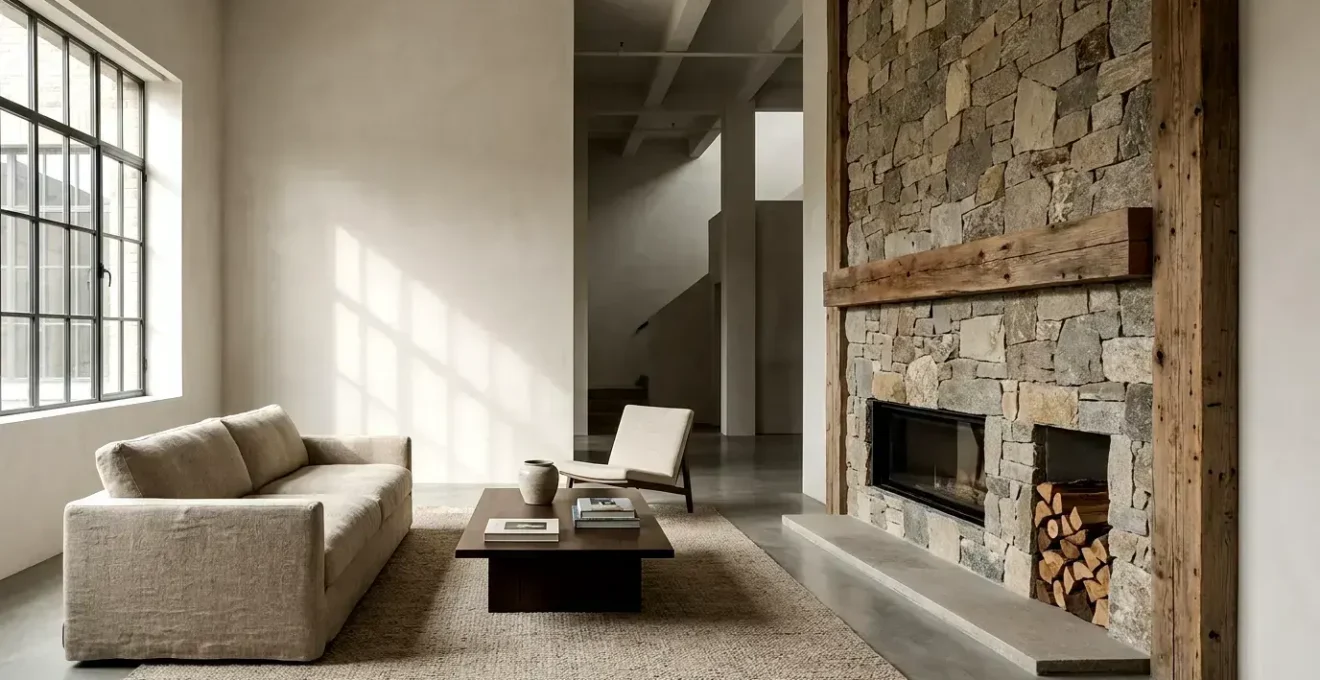
A rustic fireplace does not need a massive stone chimney breast, heavy wooden beams or an abundance of country-style decorations. In a contemporary home, the most convincing rustic character often comes from something quieter: the irregular surface of natural stone, the grain of weathered timber and earthy colours that connect the fireplace to its surroundings.
The challenge is balancing these tactile materials with the clean lines, open space and visual simplicity of modern interiors. A rough-cut stone surround can feel inviting rather than imposing when its colour relates to the flooring, its proportions suit the room and nearby surfaces remain relatively calm.
Creating this balance begins with choosing materials for their texture rather than their decorative associations. It also means understanding how daylight changes their appearance, where contrasting finishes should stop and how much reclaimed character a room can comfortably accommodate. Whether updating an existing fireplace or planning a new feature wall, a carefully restrained approach allows rural warmth and contemporary design to coexist.
Modern Rustic Fireplace Design: The Essentials
- Choose texture over decoration: let natural stone or reclaimed timber provide rustic character while keeping surrounding surfaces simple.
- Coordinate materials and colours: compare undertones, surface patterns and natural light before selecting fireplace cladding or wall paint.
- Connect the fireplace to the room: repeat one material or tonal detail elsewhere, leaving enough negative space for the design to feel contemporary.
- Why Do Reclaimed Timber and Rough Stone Give Fireplaces a Rustic Feel?
- How to Add Rustic Character to a Plain Fireplace Wall With Natural Finishes?
- Exposed Brick or Rough-Cut Stone for a Modern Rustic Fireplace?
- Why Too Many Reclaimed Materials Can Make a Rustic Fireplace Look Cluttered
- How to Combine Earthy Wall Colours With a Rustic Stone Fireplace?
- Steel or Stone Cladding for a Contemporary Fireplace Feature?
- Why Can a Grey Fireplace Look Wrong in a Warm Neutral Interior?
- How to Match a Fireplace With Your Home Interior Without Creating a Style Clash?
Why Do Reclaimed Timber and Rough Stone Give Fireplaces a Rustic Feel?
Reclaimed timber and rough stone create a rustic fireplace aesthetic because their visible grain, uneven edges, irregular surfaces and natural colour variations suggest age, craftsmanship and a connection to the landscape. These characteristics introduce warmth through texture rather than ornament, allowing a fireplace to feel established and welcoming even in a contemporary room with simple furniture and clean architectural lines.
The visual appeal comes partly from how these surfaces interact with light. Rough stone creates small shadows across its ridges, while weathered timber reveals knots, growth rings and changes in tone. Unlike a uniformly smooth manufactured surface, each section offers slightly different visual information.
The International Masonry Institute‘s technical guidance on stone construction explains that lighting and surface finishes significantly affect the appearance of installed stone. Grazing light emphasises surface irregularities, while more diffuse illumination can soften their visibility.
This distinction matters when selecting materials. A rustic fireplace should not depend on adding numerous decorative objects. Texture-led rustic design allows the architectural materials themselves to communicate character, leaving the surrounding room uncluttered.
Before buying stone or reclaimed timber, examine physical samples rather than relying exclusively on photographs. Run a hand over each sample to assess its surface, then view it beside a window and under the room’s evening lighting. Look for genuine depth, subtle shadows and natural tonal variation.
Finishing treatments deserve equal attention. A heavily varnished timber beam may become glossy enough to obscure its weathered appearance, while a more restrained compatible finish can preserve visible grain. However, old timber still needs appropriate cleaning, treatment and assessment before installation.
Reclaimed wood should never be positioned close to an operating fire solely on decorative grounds. Mantel clearances and material suitability depend on the appliance, its installation instructions and applicable local fire-safety requirements.
Once the primary material has enough character to stand on its own, the next consideration is how to extend that warmth across a plain fireplace wall without covering every available surface.
How to Add Rustic Character to a Plain Fireplace Wall With Natural Finishes?
A plain fireplace wall can gain rustic character through a single dominant natural finish, such as limewash, textured plaster or appropriately installed timber panelling. The most balanced approach concentrates stronger texture near the fireplace and gradually transitions towards smoother surrounding surfaces. This creates architectural interest without making the entire wall visually heavy or competing with contemporary furniture.
Start by evaluating the existing wall. A smooth plaster surface may need only subtle mineral texture around the fireplace opening, while a large, uninterrupted chimney breast can accommodate a more substantial stone or plaster treatment.
Choose one primary finish before considering supporting materials. Limewash can give suitable masonry a softer, weathered appearance. Textured plaster adds irregular depth without introducing another strong material colour. Timber panelling creates a more visibly structured effect through grain and linear joints.
In Architectural Digest‘s fireplace design ideas, architect Bob LeMoine discusses using paint or limewash to soften the appearance of existing brick or stone while retaining some of its original surface texture.
A useful design starting point is to keep roughly two-thirds of the feature wall visually calm and concentrate stronger rustic texture within the remaining third. This is a flexible composition guideline, not a measured architectural rule. A narrow chimney breast or a particularly dark finish may require an even smaller textured area.
Develop the material transition outward from the fireplace rather than treating the entire wall identically. For example, a rough stone surround might meet softly textured plaster, which then gives way to smooth painted walls. The transition can be defined by architectural edges rather than a literal blended finish.
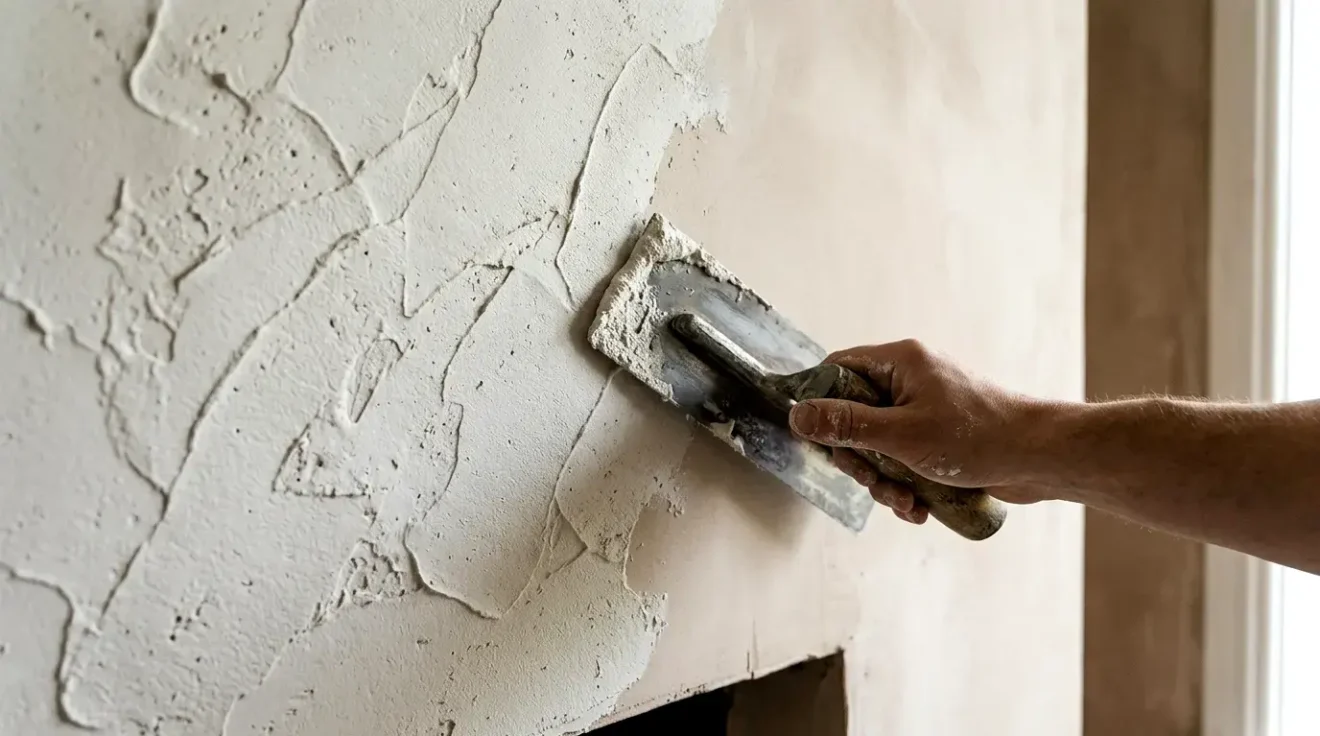
A frequent mistake is applying limewash, reclaimed wood and rough stone with equal visual intensity. Each finish introduces its own colour variation and pattern, leaving the eye with no clear resting point. A more effective arrangement gives one finish priority and lets the others play quieter supporting roles.
Surface compatibility is also essential. Limewash and plaster products are not interchangeable across all substrates, and neither should be assumed suitable for direct heat exposure. Check the substrate, product instructions and fireplace manufacturer’s requirements before application.
A carefully finished wall establishes the setting, but the choice of exposed brick or natural stone will determine whether the fireplace feels patterned, rugged, warm or visually substantial.
Exposed Brick or Rough-Cut Stone for a Modern Rustic Fireplace?
Exposed brick is often better for a modern rustic fireplace when the room benefits from a familiar, rhythmic masonry pattern and warmer colour. Rough-cut stone is often preferable when the fireplace should become a distinct architectural focal point with organic texture. The right choice depends on the material’s undertones, the scale of its surface variation and its relationship with existing finishes.
Brick and stone create different kinds of rustic character. Brick is composed of repeated units and mortar joints, making its pattern immediately recognisable. Stone can vary more widely in shape and surface relief, giving an impression of natural mass even when installed as thinner cladding.
Neither material has a fixed colour temperature. Traditional red brick often feels warmer, but grey and buff brick are available. Similarly, stone may be cool grey, sandy beige, creamy limestone or brown with warm mineral variations.
The following comparison provides a practical starting point for material selection.
| Design criterion | Exposed brick | Rough-cut stone |
|---|---|---|
| Typical visual character | Regular masonry rhythm with visible joint lines | Irregular shapes and more variable surface relief |
| Common colour options | Red, terracotta, buff, brown and grey | Grey, cream, buff, beige and mixed mineral tones |
| Visual impact | Repeated pattern can become busy across a large wall | Pronounced texture can create a strong sense of mass |
| Contemporary compatibility | Works particularly well with simple industrial or warm modern finishes | Works particularly well as a focal element within restrained interiors |
| Key consideration | Brick colour and mortar-joint contrast | Stone profile, jointing, weight and fixing method |
For smaller rooms, consider how much surface pattern is already present. Brick can feel overly busy beside patterned flooring, while highly projecting stone may look disproportionate next to slim contemporary furniture. The area covered is often as important as the material itself.
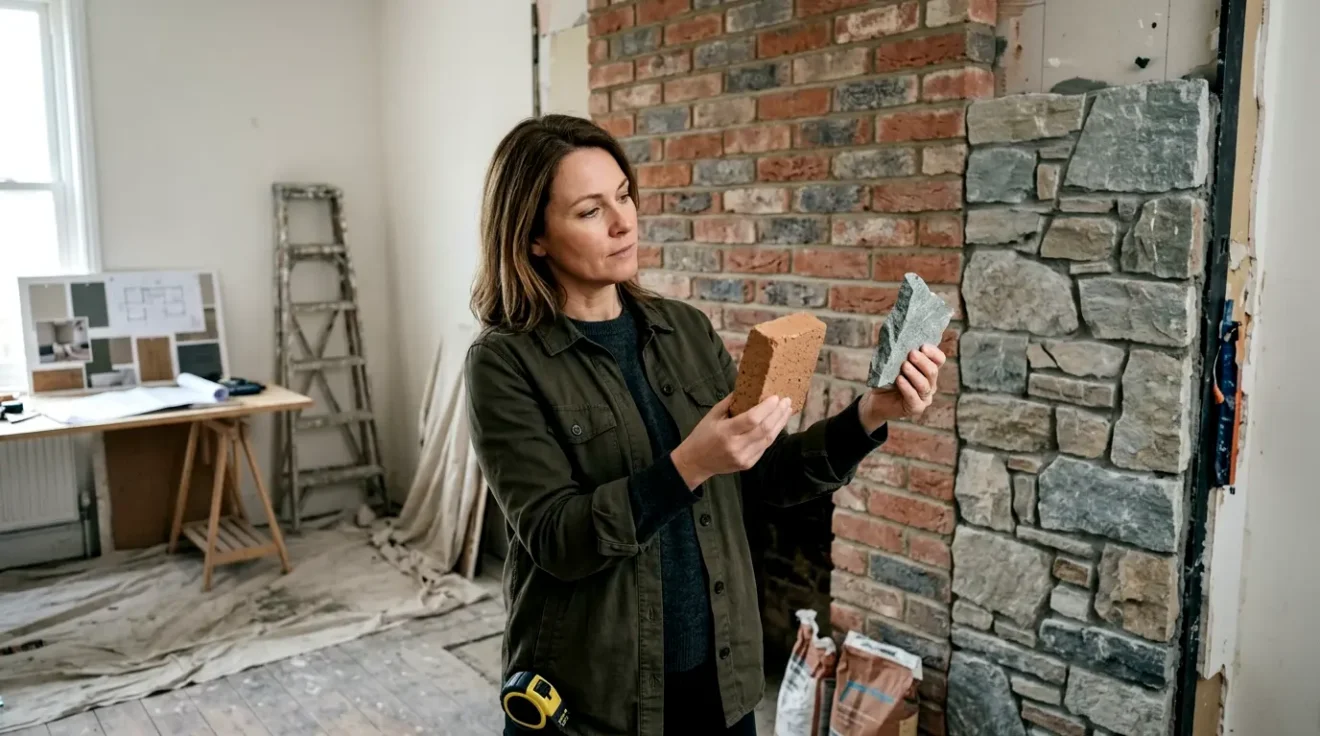
A hybrid arrangement can work when the materials have clearly different roles. A narrow stone lintel above a brick surround, or restrained brick edging beside a stone hearth, introduces contrast without giving both surfaces equal prominence.
However, avoid combining strong red brick with highly variegated stone unless there is a deliberate colour relationship. Using two expressive materials does not automatically make a fireplace more authentic.
Before making a decision, photograph the room in daylight and create a greyscale version of the image. Compare the relative lightness of the intended fireplace finish against the floor, skirting boards and largest furniture pieces. This helps reveal whether the fireplace will stand out too strongly, although the original colour photograph is still needed to assess undertones.
The most successful choice is rarely the material with the strongest texture. It is the one that introduces enough character without requiring additional rustic finishes to justify its presence.
Why Too Many Reclaimed Materials Can Make a Rustic Fireplace Look Cluttered
Too many reclaimed materials can make a rustic fireplace look cluttered because each aged surface introduces different colours, imperfections, textures and visual patterns. When several equally expressive materials compete within a small area, their individual character becomes difficult to appreciate. A restrained combination creates a clearer focal point and preserves the simplicity that allows rustic elements to work in contemporary interiors.
Consider a fireplace surrounded by rough stone, a heavily distressed timber mantel, reclaimed brick, exposed metal brackets and several weathered decorative objects. Individually, these materials may be attractive. Together, they can produce visual saturation, with no single element establishing a coherent design direction.
This is particularly noticeable in modern homes, where surrounding furniture often has simple silhouettes and relatively uniform finishes. Against that calm background, every chipped edge, dark knot or irregular joint becomes more visually prominent.
A useful working limit is one hero material and one supporting texture within the immediate fireplace zone. For example, let rough stone define the main surround and introduce a simple timber mantel. Keep nearby walls smooth and avoid filling the mantel with numerous additional reclaimed accessories.
This guideline is not a universal limit on the number of materials a room can contain. It is a practical way to control their visual intensity. Subtle combinations can accommodate more variety than strongly distressed finishes.
Intentional layering also differs from accumulating unrelated vintage objects. A timber mantel can connect naturally to a nearby oak dining table or exposed ceiling beam. Repeating a material elsewhere establishes rhythm, whereas placing several unrelated reclaimed pieces around the fireplace may make the design feel assembled rather than considered.
Before introducing another aged finish, audit what the room already contains. Visible floorboards, textured upholstery, woven rugs and existing brickwork all contribute to the overall texture density, even when they are not part of the fireplace itself.
Negative space is equally important. An uncluttered section of plaster beside a rough surround makes the stone’s irregularity more noticeable. Removing a decorative object can sometimes strengthen rustic character more effectively than adding another.
Once the material palette has been simplified, wall colour becomes the next tool for integrating the fireplace and softening the contrast between rugged surfaces and contemporary architecture.
How to Combine Earthy Wall Colours With a Rustic Stone Fireplace?
Earthy wall colours work best with a rustic stone fireplace when they share compatible undertones and have a considered difference in lightness. Warm buff or ochre stone often pairs naturally with cream, clay or warm beige, while cooler grey stone may suit muted greige or mineral neutrals. Testing colours in the actual room is essential because daylight changes how both paint and stone appear.
Begin by identifying the stone’s dominant undertone rather than choosing paint from its general colour description. A beige stone may contain yellow, pink or grey undertones, and each will interact differently with neighbouring wall colours.
Compare several stone samples under natural daylight. Look at the background colour of the stone, not only its darkest veins or most prominent fragments. Then choose wall samples that either share that undertone or offer a deliberate, controlled contrast.
Tone-on-tone styling is particularly effective for contemporary rustic interiors. Rather than surrounding a dark stone fireplace with stark white, consider a related wall colour approximately two or three shades lighter. The visual transition can feel softer while still preserving enough separation to reveal the fireplace’s shape.
This difference is a design starting point, not a fixed colour formula. The apparent contrast will depend on surface texture, room lighting and paint light reflectance.
For example, a fireplace with warm limestone tones might sit against mushroom-beige plaster, with pale oak furniture carrying the same warmth across the room. By comparison, grey stone with blue undertones may feel disconnected against intensely yellow-beige walls unless another material bridges the difference.
Light direction can alter the result considerably. Sherwin-Williams‘ advice on paint colours and room orientation explains that north-facing rooms generally receive cooler daylight, while south-facing rooms tend to experience warmer light. East- and west-facing rooms also change in character during the day.
For that reason, a paint colour that looks beautifully earthy in a showroom may appear dull or unexpectedly cool once applied beside a stone surround.
Five Checks Before Finalising Your Fireplace Colour Scheme
- Identify the stone undertone: examine a sample in daylight and record whether its dominant appearance is warm, cool or neutral.
- Shortlist three wall colours: prepare a labelled sample board showing each candidate beside the actual stone finish.
- Test changing daylight: photograph the samples in morning, afternoon and evening light to create a comparable visual record.
- Check the surrounding palette: place floor and furnishing samples beside the shortlisted combination and note any obvious undertone conflicts.
- Approve the complete material pairing: keep one final photograph and a written record of the selected stone, paint and supporting finish before purchasing materials.
Once the colours are coordinated, the remaining decision is whether the fireplace should remain entirely natural in character or gain a sharper contemporary edge through metal detailing.
Steel or Stone Cladding for a Contemporary Fireplace Feature?
Stone cladding generally provides a stronger rustic impression through natural surface variation, while steel creates a cleaner, more industrial contemporary appearance. Stone is often the better primary material when texture and rural character are priorities. Steel can work particularly well as a restrained secondary detail, although the final choice must also account for installation weight, maintenance, heat exposure and compatibility with the fireplace system.
These materials behave differently in both appearance and use. Stone can display irregular surfaces, natural mineral colour variation and changing shadows. Steel usually creates a more continuous, precise outline, particularly when fabricated with slim edges or consistent dark finishes.
Their long-term appearance also differs. Some natural stones acquire subtle surface changes over time that may be appealing in rustic interiors, but staining, soot and incompatible cleaning products can damage particular finishes. Steel may show fingerprints, scratches, oxidation or uneven patina depending on its surface treatment and use.
Neither material is automatically maintenance-free. The stone type, porosity, protective treatment and exposure conditions matter, just as steel’s coating and corrosion resistance affect its upkeep.
| Consideration | Steel | Natural stone |
|---|---|---|
| Design character | Precise, sleek and industrial | Organic, textured and rustic |
| Ageing | Finish-dependent scratching, oxidation or patina | Finish-dependent weathering, staining or surface wear |
| Maintenance | Cleaning and finish-specific surface care | Cleaning appropriate to stone type and porosity |
| Heat behaviour | Conducts heat readily; exposed surfaces may become hot | Thermal response varies by stone and installation assembly |
| Installation constraints | Panel thickness, fixing, thermal movement and corrosion protection | Weight, substrate capacity, anchorage and compatible fixing systems |
A particularly useful compromise is to make stone the primary cladding and introduce steel only around the firebox, as a slender hearth edge or as a precisely detailed frame. The metal defines the contemporary geometry while the stone retains the fireplace’s tactile character.
Structural suitability must be established before selecting cladding purely for appearance. Thick natural stone installations can impose substantial loads, while thinner stone systems vary in weight and fixing requirements. Steel assemblies also require appropriate support and consideration of thermal movement.
Do not assume that steel is lighter in every possible configuration or that any stone panel can be adhered directly to an existing wall. The supporting substrate, fixing system and appliance manufacturer’s instructions determine what is suitable.
Likewise, heat reflection, surface temperatures and fire protection depend on the complete fireplace assembly, not simply whether the visible finish is steel or stone. Decorative cladding must not replace specified non-combustible protection or interfere with required ventilation and clearances.
If the room already contains several warm natural materials, a slim metal accent may be enough to introduce contrast. However, selecting grey stone or dark steel without checking the surrounding colour temperature can create a different kind of imbalance.
Why Can a Grey Fireplace Look Wrong in a Warm Neutral Interior?
A grey fireplace can look out of place in a warm neutral interior when its cool blue, green or violet undertones contrast with the yellow, red or earthy undertones of nearby walls and furniture. The fireplace may then appear visually detached rather than integrated. This is not a universal problem with grey; the effect depends on the particular shade, lighting and surrounding materials.
Grey is often treated as a neutral that works with almost everything. In reality, many grey stone and metal finishes have noticeable underlying colour. A cool slate-grey surround may look balanced beside white or charcoal surfaces but feel unexpectedly stark against cream walls and honey-coloured timber.
Conversely, a warmer grey containing beige or brown undertones may sit comfortably within a neutral palette. Colours such as greige, mushroom and certain stone greys can provide a gentler transition between a contemporary fireplace and traditional earthy finishes.
To diagnose an undertone mismatch, place the grey sample beside a plain white sheet of paper in indirect daylight. Observe whether the grey appears blue, green, violet or brown by comparison. This is a quick visual screening method, not a definitive colour measurement; lighting, the white paper itself and neighbouring materials can all influence perception.
Next, compare the sample against the actual wall colour and flooring. The important relationship is between the fireplace and the finished room, not between the material and an abstract neutral reference.
Replacement is not always necessary when a grey fireplace already feels too cool. Introducing bridging materials can establish a connection between the fireplace and its surroundings.
- Weathered timber can bring warm grain and muted grey tones into the same visual element.
- Greige linen or upholstery can soften the transition between cool stone and warm beige walls.
- Aged brass can introduce warmth through a restrained metallic accent without changing the fireplace surround.
These additions should be selective. One well-positioned timber shelf or an existing piece of warm-toned furniture may be more effective than several small accessories.
The colour-matching principle remains the same as for earthy walls and natural stone: compare undertones under real lighting conditions, and consider the entire palette before judging one material in isolation.
The final step is to extend this material and colour logic beyond the fireplace itself, ensuring that the feature feels connected to the style and proportions of the whole room.
Key Takeaways Before Making Your Final Design Decision
- Evaluate the existing room first: fireplace materials should respond to the flooring, furniture and architectural finishes already present.
- Use transitional details deliberately: a repeated wood tone or carefully chosen metal finish can connect contrasting design languages.
- Check the complete composition: a beautiful individual sample does not guarantee a cohesive room once materials, colours and lighting interact.
How to Match a Fireplace With Your Home Interior Without Creating a Style Clash?
To match a rustic fireplace with a contemporary interior, start by assessing the room’s existing colours, texture density and overall level of formality. Choose one dominant rustic material that complements those conditions, then use a limited number of transitional details to connect the fireplace to the rest of the space. Consistent undertones, balanced proportions and deliberate repetition create cohesion without requiring every element to share the same style.
The most common design mistake is choosing an attractive fireplace in isolation and trying to adapt the room afterwards. Reversing that process makes material selection more practical and reduces the risk of expensive changes.
Begin with the existing architecture. Identify whether the room relies on strong horizontal lines, smooth minimalist surfaces, exposed industrial details or softer natural finishes. Then examine the three main design variables:
- Dominant undertones: establish whether the major wall, floor and furniture colours are warm, cool or relatively balanced.
- Texture density: assess how many prominent natural grains, patterns and irregular finishes are already visible.
- Formality level: decide whether the space feels relaxed and tactile or precise, polished and highly controlled.
These observations indicate how much rustic character the room can accommodate before the fireplace becomes an unrelated feature.
Scandinavian-inspired interiors often work comfortably with pale timber, simple stone and restrained earthy colours. Wabi-sabi-influenced spaces can accommodate irregular surfaces and natural imperfections, while softened industrial interiors may combine brick or rough stone with dark metal details.
High-gloss minimalist spaces require more careful integration because rugged stone can contrast sharply with polished cabinetry and uniform surfaces. Mid-century interiors may also benefit from considered bridging, particularly through timber tones, material proportions and existing geometric lines.
These are design tendencies rather than rigid compatibility rules. A highly polished contemporary room can still accommodate a rugged fireplace when its scale and colour are carefully managed.
The bridge-element principle provides a practical solution. Rather than repeating a large stone wall elsewhere, introduce a smaller element that shares the fireplace’s material or colour language. A timber mantel can relate to nearby shelving, while muted stone tones can appear in textiles or other existing finishes.
Hypothetical Design Scenario: A Rustic Fireplace in a Modern Living Room
Imagine a contemporary living room with pale oak flooring, warm off-white walls, a low cream sofa and simple black-framed windows. The homeowner wants a rough stone fireplace without introducing a heavy country-house appearance.
A possible scheme would use warm buff stone only around the fireplace opening and chimney breast, with a slim dark metal firebox frame and a restrained oak mantel where permitted by the appliance’s clearance requirements. The remaining wall would stay smooth and warm neutral, while the oak flooring would provide the visual connection to the mantel.
This is an illustrative design proposal, not a documented renovation or measured performance result. It demonstrates how coordinating material roles can make a rustic focal point feel intentional in a modern room.
Before committing to renovation, review the complete composition from several viewpoints. A fireplace that looks balanced when viewed directly may feel too broad, dark or textured when seen beside the room’s main seating area.
Installation constraints must also be part of the design decision. Existing chimney breasts, hearths and fireplace openings should not be treated as purely decorative elements. Historic England‘s advice on fireplace alterations, for example, distinguishes structural chimney components from decorative surrounds and explains why structural changes require particular care.
Local approvals, combustible-material clearances and installation requirements vary between countries, jurisdictions and appliance types. A qualified professional should assess structural alterations, and the relevant fireplace manufacturer and local authority should be consulted where necessary.
A cohesive contemporary rustic fireplace should ultimately satisfy four conditions: one visually dominant rustic material, one restrained accent texture, wall colours with compatible undertones and at least one material connection elsewhere in the room. The aim is not to conceal the contrast between rustic and modern styles, but to make that contrast feel deliberate.
Before ordering materials, assemble the chosen stone or brick sample, timber finish, wall colour and relevant flooring or furniture samples in the actual room. Observe them in daylight and artificial light, confirm the installation requirements, and remove any element that competes unnecessarily with the fireplace. This simple final review can turn a collection of appealing finishes into a cohesive, warm and distinctly contemporary living space.
Can an electric fireplace have a rustic stone surround?
Yes. An electric fireplace can be integrated into a rustic stone feature when the selected appliance and cladding system are compatible. The design may use natural stone, suitable stone veneer or other approved finishes. Check the electric fireplace manufacturer’s requirements for ventilation, installation clearances, support and permitted surround materials before proceeding.
Is a rustic fireplace suitable for a small contemporary living room?
Yes. In a smaller room, concentrate rustic texture within a limited area, such as the fireplace surround or a restrained section of the chimney breast. Select colours that relate to the existing walls and flooring, and avoid oversized mantels or deeply projecting finishes that make the fireplace feel disproportionately large.
Can an existing painted fireplace be given a rustic finish without rebuilding it?
Sometimes. Compatible decorative finishes, including suitable mineral paints or textured treatments, may change the appearance of an existing fireplace without major reconstruction. However, the original surface, previous coatings, operating temperatures and product compatibility must be checked. Structural components and required fire protection should not be altered as part of a purely decorative update.
Should a rustic fireplace mantel match the wooden floor exactly?
No. A mantel and floor can look cohesive without having identical timber species, grain or colour. Similar warm or cool undertones usually matter more than exact matching. A slightly darker mantel can provide definition, while a related wood tone elsewhere in the room can reinforce the connection between the fireplace and surrounding furniture.
Are reclaimed wooden beams safe to use above a working fireplace?
Reclaimed wooden beams are combustible and should only be used where the installation meets the applicable clearance and fire-safety requirements. Safe positioning depends on the fireplace or stove type, heat exposure, projection of the mantel and local rules. Consult the appliance manufacturer’s instructions and a qualified installer before fitting reclaimed timber near an operating fireplace.