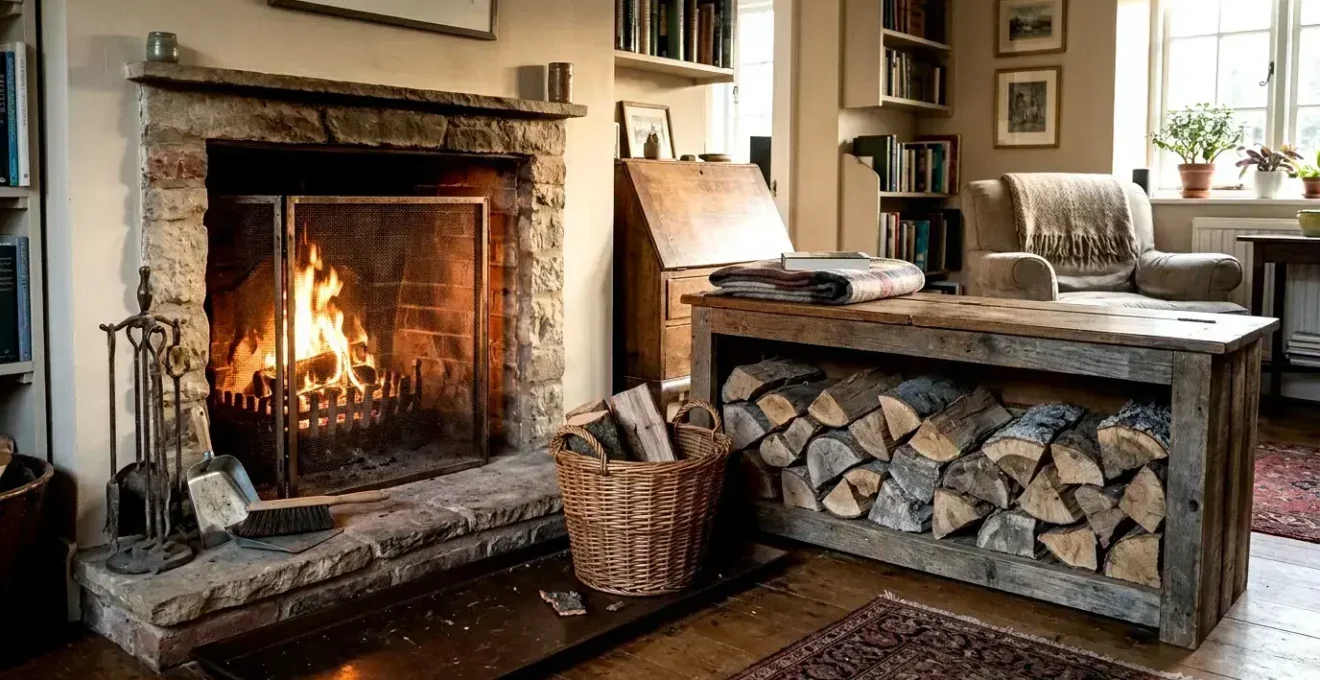
Keeping firewood inside makes a wood-burning fireplace easier to use, but convenient storage can introduce moisture, insects, floor damage and unnecessary fire hazards. A decorative stack that looks attractive beside the hearth is not necessarily safe, especially when logs sit close to radiant heat or remain indoors for extended periods.
The most practical arrangement separates long-term firewood storage from the small supply needed for immediate use. Seasoned logs stay outdoors in a ventilated, weather-protected location, while a stable indoor basket or rack holds a limited quantity at a safe distance from the fireplace. A protective tray contains debris, and sufficient clearance keeps combustible materials away from heat and escaping sparks.
Whether the room has space for a recessed log niche, a slim basket or a freestanding wood store, the right choice depends on fireplace design, available floor area and how often the household burns wood. The goal is a storage system that remains safe, manageable and attractive throughout the heating season.
Indoor firewood storage: essential rules
- Store dry wood in small quantities: aim for less than 20% moisture content before burning and bring indoors only enough logs for approximately one or two days.
- Keep combustible wood away from the fire: use the general three-foot (approximately 0.9 m) separation recommended by US fire-safety authorities, subject to fireplace-specific and local requirements.
- Control debris at the source: choose a stable rack or basket with a protective tray, inspect logs before bringing them inside and clean the storage area regularly.
- Why Damp Firewood Brings Moisture and Insects Into Your Living Room
- How to Design a Built-In Log Niche That Keeps Firewood Easy to Access
- Log Basket or Built-In Wood Store for a Compact Fireplace Room?
- Why Stacking Firewood Against a Fireplace Can Create a Serious Fire Risk
- How to Keep Floors Clean Around an Indoor Firewood Storage Area
- When Should You Prepare Firewood and Fireplace Equipment for Winter?
- Why Shelving Too Close to a Fireplace Can Damage Books and Finishes
- Is a Wood-Burning Fireplace Right for Your Home and Lifestyle?
Why Damp Firewood Brings Moisture and Insects Into Your Living Room
Damp firewood introduces unnecessary moisture and can carry insects into a living room because logs retain water and may contain organisms beneath their bark. Once brought into a warm house, the wood can gradually dry while dormant insects become active. Keeping the indoor supply small and properly seasoned reduces both problems without sacrificing fireplace convenience.
Freshly cut logs contain substantial water. As they dry, moisture evaporates into the surrounding air. In a poorly ventilated storage cavity, this can increase local humidity, especially when large amounts of wet wood remain indoors.
Moisture-related damage depends on the room’s ventilation, temperature and existing humidity. Water released from logs does not automatically cause condensation, but persistently damp storage conditions can contribute to surface deterioration. Direct contact with wet wood may also leave stains or moisture marks on flooring and finishes.
The US Environmental Protection Agency recommends burning wood with a moisture content below 20 %, a threshold associated with better combustion performance. Its EPA guidance on best wood-burning practices also recommends seasoning firewood for at least six months and storing it outdoors, raised above the ground and covered on top.
Drying time is not identical for every wood species. Larger hardwood logs, wet climates and poorly ventilated stacks can extend the seasoning period considerably.
How to recognize firewood that may still be damp
Before bringing logs indoors, check their appearance and condition:
- Split ends: checking and small cracks often develop as logs dry, although these are not definitive evidence of low moisture.
- Surface appearance: seasoned bark may look weathered or gray, but color alone cannot establish dryness.
- Knock test: striking two logs together may produce a clearer, more ringing sound when they are dry, but the result varies with species and shape.
- Moisture meter: for a more dependable assessment, split representative logs and measure the freshly exposed interior with a meter suitable for firewood, following its instructions.
Surface readings can be misleading because the outside of a log may dry before its center. When buying a winter supply or checking an uncertain stack, a moisture meter is more useful than relying entirely on sound or appearance.
Why insects appear after firewood enters a warm room
Firewood can shelter bark beetles, wood-boring beetle larvae, ants and spiders. These organisms do not all behave alike, but some beetles can develop within wood and emerge after the logs warm up indoors.
The University of Maryland Extension‘s guidance on beetles in firewood identifies several beetle groups associated with stored logs, including bark beetles and larger wood-boring species. Small round holes, differently shaped exit holes and fine sawdust can indicate beetle activity.
1–2 days
The approximate indoor firewood supply recommended by University of Maryland Extension to reduce the likelihood of beetles emerging inside residential rooms. This is pest-prevention guidance, not a fire-clearance rule.
University of Maryland Extension — Beetles in Firewood.
Insects emerging from logs do not necessarily establish themselves in structural timber or furniture. Nevertheless, their appearance is unpleasant, and storing large quantities of wood indoors increases opportunities for unwanted emergence.
A few properly seasoned logs brought inside shortly before burning are different from a large stack of unseasoned wood left beside the fireplace for weeks.
Once log quality is under control, the next decision concerns storage design: the container should make wood accessible without creating a damp, enclosed or overheated space.
How to Design a Built-In Log Niche That Keeps Firewood Easy to Access
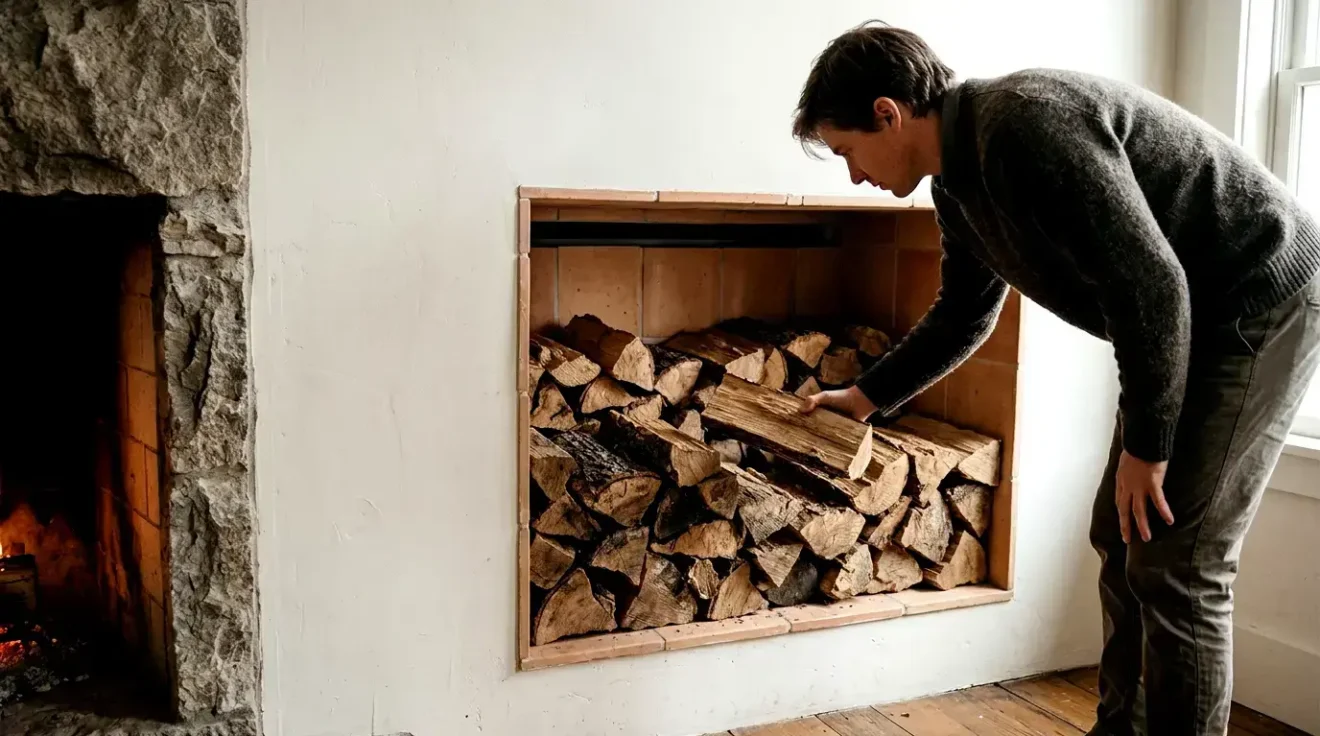
A well-designed built-in log niche keeps seasoned firewood accessible without placing combustible logs in the fireplace’s heat-exposure zone. It should have a stable base, ventilation, durable surfaces and sufficient clearance from the firebox and flue. Its dimensions should reflect actual household consumption rather than the maximum amount of wood that fits inside the wall.
The strongest design begins with placement, not appearance. A niche beside the fireplace can shorten the distance between storage and hearth tools, but it must remain outside the appliance’s required combustible-material clearances.
The ideal location allows an adult to retrieve logs comfortably without reaching across a hot hearth, opening a storage door into the fire area or blocking the fireplace’s operating space.
Choose a location and capacity that match actual use
A recessed niche can preserve circulation space in a narrow room, while a projecting enclosure is usually easier to install without major structural work. Both require careful assessment of the fireplace, surrounding walls and floor construction.
Size the niche by observing how much wood the household typically burns during one evening or day. A larger visible capacity may look impressive, but routine indoor storage should remain limited. A decorative multi-day or multi-week stack creates unnecessary housekeeping and pest-management obligations.
Keep the bottom accessible for cleaning, avoid unstable high stacks and allow sufficient clearance for comfortable log handling. If children or pets use the room, the design should also prevent logs from rolling or falling outward.
Materials, ventilation and chimney-wall precautions
Tile, masonry and stone surfaces are useful around log storage because they tolerate abrasion and can be cleaned relatively easily. Metal liners and removable trays can protect vulnerable surfaces from bark, dust and occasional dampness.
Wooden shelving or trim may be appropriate in some locations, but it remains combustible. A fire-resistant-looking lining does not automatically make a cavity safe if combustible framing or concealed materials remain exposed to excessive heat.
Leave space for air to circulate around the stack, including behind the logs where the design allows. Avoid tightly enclosed cavities that retain moisture or prevent inspection of the rear wall.
Never assume that a chimney breast is a suitable storage cavity. Flues, masonry and nearby structural elements can become hot during operation. Cutting into the chimney breast may also compromise an existing chimney or its required separation from combustible materials.
A competent fireplace installer or qualified building professional should assess the construction, flue route, wall temperatures and relevant local requirements before a niche is built. A surface-temperature check during normal operation may support that assessment, but it cannot replace the required construction and clearance checks.
For renters or households avoiding permanent alterations, freestanding niche-style storage units and compact modular racks can achieve a similar appearance. They still need appropriate clearances, stability and floor protection.
Where space is limited or fireplace construction is uncertain, a movable container is often more practical than altering a wall. Choosing between that container and a built-in store is primarily a question of storage volume and daily habits.
Log Basket or Built-In Wood Store for a Compact Fireplace Room?
A log basket is usually the better choice for a compact fireplace room when fires are occasional and floor space is limited. A built-in wood store can improve organization for frequent users, but it requires adequate clearances, careful construction and more cleaning access. In many homes, a small indoor basket supported by a larger outdoor woodpile offers the most practical balance.
Storage capacity should reflect burn frequency rather than decorative preference. An occasional fireplace user may need only a few logs for an evening, while a household that burns wood daily needs a dependable supply and a convenient restocking route.
The following comparison helps identify which arrangement suits the room.
| Decision factor | Log basket or freestanding rack | Built-in wood store |
|---|---|---|
| Typical room | Small living room with limited circulation space | Room with suitable wall space and a verified installation location |
| Burn frequency | Occasional fires or small daily supplies | Frequent burning with planned daily restocking |
| Installation | Usually movable and requires no structural alterations | May require design work, construction and professional safety checks |
| Floor-space impact | Depends on basket footprint; slim designs are available | Recessed designs can preserve floor space |
| Debris management | Removable tray and washable liner simplify cleaning | Requires accessible base and corners for cleaning |
| Flexibility | Easy to relocate or replace | Fixed location and capacity |
| Indoor storage duration | Best suited to a short working supply | Capacity must still be limited to avoid prolonged indoor storage |
Match the container to the room
In a particularly narrow living room, a slim metal basket with a solid base can hold a modest supply without making the hearth feel crowded. A low rectangular rack may fit neatly against a suitable adjacent wall, provided it is outside all required clearance zones.
Vertical racks make use of height, but height also increases the importance of stability. Tall storage units must not tip, obstruct exits or allow logs to fall toward hot surfaces. Wall-mounted racks require suitable fixings and must not be installed above or too close to an active fireplace.
Open baskets make logs easy to see and retrieve, although bark fragments can fall through woven sides or open bottoms. Closed storage compartments contain some loose debris, but a tightly sealed container can retain dampness and conceal insects.
A removable liner or shallow tray often provides a better compromise than an airtight enclosure.
Why a hybrid arrangement usually works
For many households, the simplest system consists of an outdoor store holding the seasoned supply and a small indoor basket holding the next fire’s logs.
This arrangement keeps most dirt outside, reduces the quantity of wood exposed to room temperatures and makes it easier to inspect each new batch.
Rotate the indoor supply regularly by using older logs first and avoiding forgotten pieces at the bottom. A large built-in compartment should not become an excuse to leave unused logs inside for weeks.
Whichever container suits the room, its placement matters more than its appearance. Even a small basket becomes a serious concern when it sits within the fireplace’s spark or radiant-heat exposure zone.
Why Stacking Firewood Against a Fireplace Can Create a Serious Fire Risk
Stacking firewood against a fireplace creates a fire hazard because logs are combustible and may be exposed to escaping sparks, embers or sustained radiant heat. Repeated heating can also alter nearby combustible materials over time. A storage arrangement must therefore respect the fireplace manufacturer’s clearances and applicable local fire-safety requirements, even when the logs appear undamaged.
The front of an open fireplace can release sparks or embers when burning wood shifts. Glass-fronted appliances can also radiate substantial heat through their doors and nearby surfaces.
Firewood does not become safe simply because it sits on a stone hearth or looks contained in a metal rack. A noncombustible container does not eliminate the ignition risk of the logs inside it.
How far should firewood be from a fireplace?
The US Fire Administration’s heating fire safety recommendations advise keeping combustible materials at least three feet, approximately 0.9 metres, away from heat sources including fireplaces.
3 ft / approximately 0.9 m
General US Fire Administration guidance for separating combustible materials from fireplaces and other heating sources. Actual fireplace and installation requirements may differ.
US Fire Administration — Heating Fire Safety.
This distance is a useful general fire-prevention reference, not a universal building-code clearance or a guarantee of safety for every appliance. A particular fireplace or stove may require greater separation, while approved built-in arrangements may be governed by specific installation instructions.
Always check the manufacturer’s manual and local requirements. Measure from the relevant fireplace or appliance surfaces identified in those instructions, not from an arbitrary decorative point on the surround.
Where those requirements cannot be confirmed, a qualified fireplace professional should determine an appropriate location before permanent storage is installed.
Repeated heat exposure and overlooked hazards
Radiant heat can warm stacked logs without any direct flame contact. Sustained or repeated heating may cause thermal degradation of combustible materials, a process associated with pyrolysis.
However, whether a particular woodpile could ignite depends on its temperature history, duration of exposure and surrounding conditions. There is no reliable visual test that proves a repeatedly heated stack is safe.
Firewood storage can also create other hazards when logs roll, stacks collapse or containers obstruct normal fireplace operation.
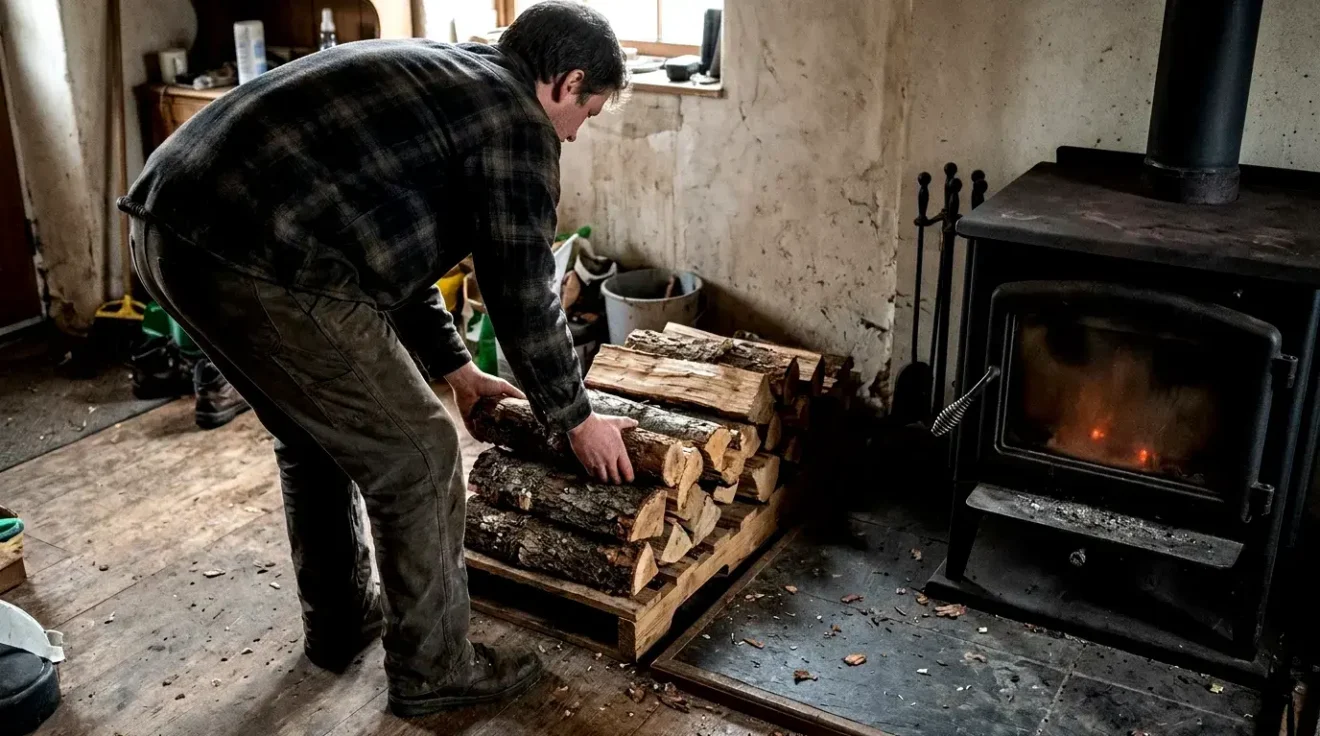
Storage should not block the fireplace opening, damper controls, hearth tools, ash-removal access, room exits or the airflow needed by the appliance. Smoke and carbon monoxide alarms must remain correctly positioned and unobstructed in accordance with applicable guidance.
Keeping logs low and stable may reduce the risk of a stack falling, but placing them below hearth level does not automatically make them safe. Similarly, positioning wood to the side is not sufficient unless the required clearances are respected.
Five checks for a safer indoor firewood storage setup
- Identify the fireplace requirements: locate the manufacturer’s clearance instructions and record the relevant distances for combustible materials.
- Check the proposed location: measure the available separation from the relevant fireplace surfaces and record whether the storage position satisfies the applicable requirements.
- Inspect the storage unit: confirm that the rack or basket stands securely and that no logs can roll toward the hearth; remove or reposition anything unstable.
- Keep operating access clear: verify that doors, damper controls, fireplace tools, escape routes and required alarm locations remain unobstructed.
- Confirm conditions during normal use: have any uncertain heat exposure or built-in installation assessed by a qualified professional before using that location for combustible storage.
Safe separation protects the room from heat exposure, but a good storage location also needs to protect the floor. Once the fire risk is controlled, everyday cleanliness becomes much easier to manage.
How to Keep Floors Clean Around an Indoor Firewood Storage Area
Keeping floors clean around indoor firewood storage requires controlling bark, sawdust and moisture before they spread across the room. Inspect and gently clean logs before bringing them inside, place the basket or rack over a protective surface, and remove debris after restocking. A small, accessible supply also makes hidden dampness and insect activity easier to detect.
Most firewood mess comes from three sources. Bark flakes detach during handling, sawdust and wood fragments accumulate beneath split logs, and damp pieces can leave moisture marks where they touch the floor.
These problems require different preventive measures. Sweeping addresses loose debris, but it does not prevent water exposure. A waterproof tray protects a sensitive surface, but it cannot remove moisture trapped beneath a poorly ventilated stack.
Choose floor protection that suits the material
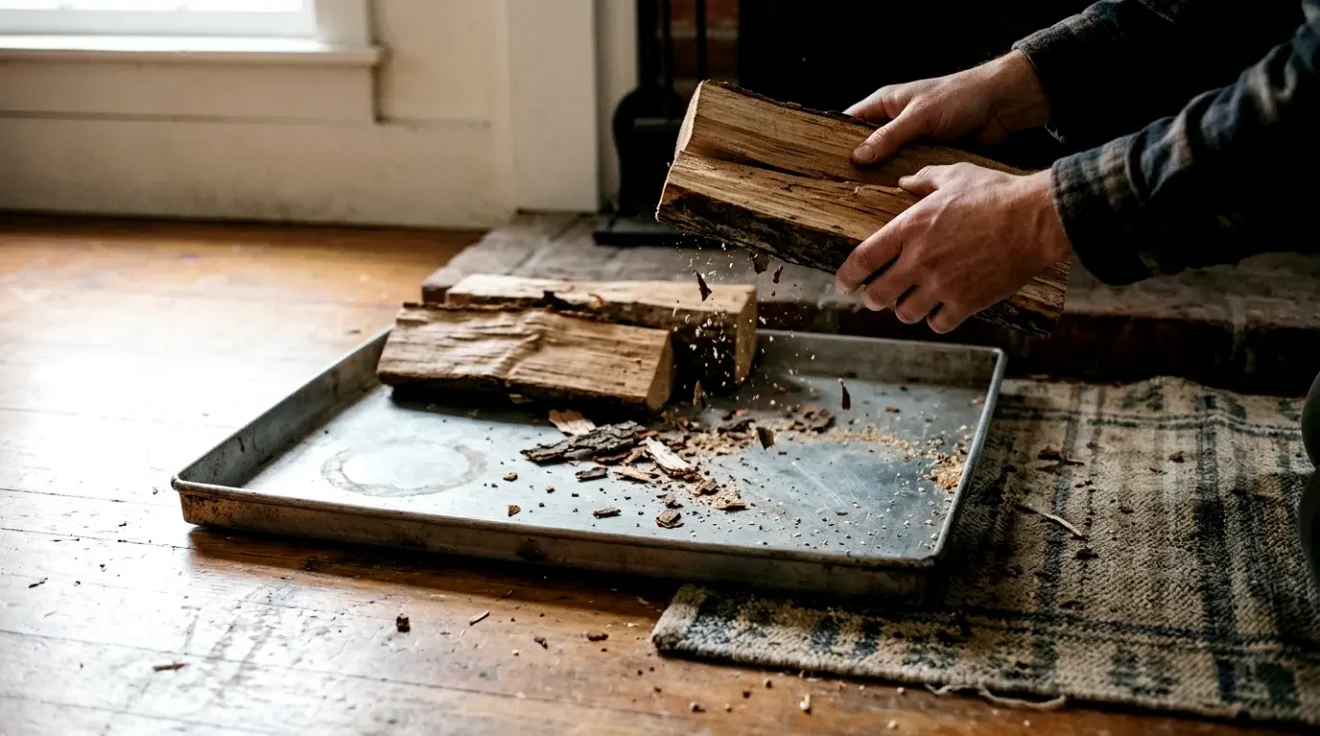
On hardwood or engineered wood flooring, use a stable, sealed tray with raised edges and a protective underside that will not scratch the finish. Clean and dry the floor beneath it periodically, especially if damp logs have been brought indoors accidentally.
A washable mat can collect loose bark, but its material should be compatible with the flooring manufacturer’s recommendations. Some rubber-backed mats can affect particular floor finishes, and absorbent textiles should not be used to conceal ongoing dampness.
Tile and stone are generally easier to sweep, although joints and porous surfaces can collect dust or stains. A removable tray still reduces cleaning effort.
Carpet is less practical around firewood because fibers trap splinters and fine debris while absorbent backing can retain moisture. Any floor covering near the hearth must also comply with applicable fireplace and hearth requirements.
Where possible, keep wood storage over an approved hard, cleanable surface rather than directly on carpeting.
A cleaning routine that takes little effort
The easiest approach is to prevent debris from crossing the room in the first place. Inspect logs outdoors and gently knock loose bark from suitable pieces before carrying them inside. Avoid aggressively stripping bark or scattering wood debris across indoor furniture.
Keep a small brush and dustpan near the storage area, but outside the fireplace’s combustible-material clearance zone. Sweep after replenishing the basket rather than waiting until debris spreads under chairs and rugs.
Once a week during regular fireplace use, empty or move the storage container when safe to do so. Check its underside for moisture, unexpected sawdust, insect activity and damage to the floor finish.
Dispose of cold wood debris separately from hot fireplace ash. Ash requires its own safe handling procedures, including a suitable metal container and careful cooling away from combustible materials.
The biggest reduction in cleaning often starts outdoors. Firewood stored off the ground, protected from rain and allowed to dry properly will generally arrive in better condition than logs collected from a wet, soil-covered pile.
Maintaining that routine becomes easier when the outdoor supply and fireplace equipment are prepared before cold weather arrives, rather than being organized hurriedly after the first fire.
When Should You Prepare Firewood and Fireplace Equipment for Winter?
Firewood preparation should begin months before the heating season, ideally during spring or early summer, while fireplace equipment should be checked and serviced sufficiently ahead of the first planned fire. Wood needs time to dry naturally, whereas chimney inspection, sweeping and equipment checks can generally be scheduled closer to winter. Delaying either task can compromise convenience and safe operation.
Freshly split firewood requires adequate airflow and time to lose moisture. A general minimum of six months of seasoning is a useful planning reference, although some wood types and storage conditions require longer.
The most dependable way to plan is to prepare or purchase an outdoor supply early, store it correctly and verify its moisture before burning. Do not assume that every log becomes ready simply because it has been stored for a particular number of months.
A practical seasonal preparation schedule
| Period | Firewood preparation | Fireplace and storage preparation |
|---|---|---|
| Spring or early summer | Split and stack wood outdoors with airflow and weather protection | Review expected fuel consumption and available storage space |
| Late summer | Check stacking conditions and investigate any persistent dampness | Arrange professional chimney and appliance servicing |
| Before the first fire | Test representative logs for moisture and separate unsuitable pieces | Check the hearth, screen, damper, tools, alarms and indoor storage position |
| Throughout winter | Bring indoors only a small working supply | Remove debris, inspect storage conditions and follow appliance maintenance instructions |
The schedule is illustrative and should be adapted to local climate, the start of the heating season and the fireplace’s maintenance requirements.
What to inspect before lighting the first fire
A pre-winter review should cover the chimney or flue, fireplace opening, damper operation, hearth condition, appropriate screen or doors, ash-handling equipment and alarm systems.
Arrange professional chimney and heating-equipment inspection and cleaning at the intervals required for the installation. The US Fire Administration recommends annual professional cleaning and inspection of heating equipment and chimneys.
Test smoke and carbon monoxide alarms according to their manufacturers’ instructions and applicable local requirements. Confirm that the fireplace screen or doors are in good condition and that hearth tools are accessible without entering an unsafe heat zone.
Reassess the indoor log basket or niche before the heating season. Furniture arrangements may have changed since the previous winter, potentially reducing clearance or obstructing access.
What if winter arrives before the firewood is ready?
Buying wood advertised as seasoned can be a practical fallback, but the label alone does not verify moisture content. Request information about drying and check representative logs with a suitable moisture meter.
When available, properly kiln-dried or otherwise verified dry firewood can reduce dependence on unfinished home seasoning. Fuel should still be inspected for contamination and stored appropriately.
A warm living room is not a substitute for months of outdoor seasoning. Bringing a large amount of wet wood inside to dry can increase indoor moisture and introduce unwanted insects.
If the available wood is unsuitable for burning, store it under appropriate outdoor drying conditions and postpone using it until ready. Heating needs should not justify burning excessively damp fuel.
Seasonal preparation should also include the furniture surrounding the hearth. Even a well-maintained fireplace can damage books, shelves and nearby finishes when room layouts ignore repeated heat exposure.
Why Shelving Too Close to a Fireplace Can Damage Books and Finishes
Shelving positioned too close to a fireplace can suffer damage from radiant heat and repeated changes in temperature and humidity. Wooden finishes may discolor, crack or deteriorate, while books and other delicate objects can deform or age prematurely. Adding a nearby firewood rack introduces another potential source of moisture and debris, making careful placement essential.
Fireplaces create uneven temperature zones within a room. Surfaces facing the fire may receive substantially more heat than those farther away, even when the overall room temperature feels comfortable.
Wooden shelves respond to changes in temperature and moisture. Repeated drying and reabsorption can contribute to dimensional movement, while particular coatings and adhesives may deteriorate under unsuitable conditions.
Books introduce additional vulnerabilities. Paper, bindings, leather, photographs and adhesives are sensitive to prolonged heat exposure and humidity fluctuations. Decorative waxes and some finishes may soften, discolor or lose their original appearance.
How to identify a potentially damaging location
Start by identifying the fireplace’s required clearances. Shelving made from wood or holding combustible objects must not be treated as safe simply because the structure is fixed to a wall.
A location that feels uncomfortably warm during normal fireplace operation deserves further assessment. However, the hand-comfort test is only a rough warning sign, not a measurement of safe clearance or long-term material exposure.
Surface temperatures vary during a fire, and heat can build up in concealed locations. Where a permanent shelf, cabinet or decorative installation is proposed near a firebox or flue, consult the fireplace manufacturer’s instructions and a qualified installer.
Particularly vulnerable objects include:
- Books with leather bindings or delicate adhesives.
- Photographs, prints and other heat-sensitive paper products.
- Lacquered or wax-polished decorative finishes.
- Wooden cabinets and shelving exposed to repeated uneven heating.
Organize the fireplace wall into practical zones
Keep heat-sensitive collections on an adjacent wall where temperature and humidity conditions are more stable. Where appropriate and permitted by the installation requirements, stone, masonry or metal surfaces can be useful near the hearth, but the objects placed on them must also be considered.
A log niche or rack should be positioned so that it does not introduce moisture or debris directly beneath books, framed artwork or delicate cabinetry.
Do not assume that a metal shelf makes combustible books, decorations or wooden trim safe at an otherwise unsuitable distance. The complete installation and its contents matter.
The fireplace wall often works best when dedicated to essential fireplace features and carefully positioned tools rather than dense display storage. Firewood can be kept elsewhere in the room if the space nearest the hearth cannot accommodate it safely.
A room designed around these boundaries may require fewer decorative compromises than expected. Yet the need to manage fuel, heat and maintenance raises a broader question about whether a wood-burning fireplace suits the household’s lifestyle.
Key Takeaways Before Choosing Your Fireplace Setup
- A wood-burning fireplace requires adequate space not only for the appliance but also for safe log handling, storage and cleaning.
- Frequent use makes an organized outdoor fuel supply and an efficient indoor routine more valuable than a large decorative woodpile.
- If safe storage, regular maintenance or reliable dry fuel is impractical, an alternative fireplace type may better suit the household.
Is a Wood-Burning Fireplace Right for Your Home and Lifestyle?
A wood-burning fireplace is a good fit when a household enjoys tending real fires and can reliably manage dry fuel, safe storage, ash removal and regular maintenance. It is less convenient for people who want immediate heat with minimal preparation or cleaning. The decision should reflect available space, physical effort, local restrictions and ongoing responsibilities rather than appearance alone.
Indoor wood storage is only one part of ownership. Each fire involves obtaining suitable fuel, moving logs, lighting and supervising the fire, allowing the appliance to cool and handling the resulting ash safely.
For occasional use, these activities may be an enjoyable part of the experience. For frequent heating, they become recurring household tasks that require dependable planning.
Compare the practical alternatives
Wood-burning fireplaces, gas appliances and electric fireplaces meet different needs. The right choice depends on the type of heating and atmosphere desired, together with the maintenance a household is prepared to accept.
| Practical consideration | Wood-burning fireplace | Gas fireplace or insert | Electric fireplace |
|---|---|---|---|
| Fuel storage | Needs a suitable dry firewood supply | No log storage; requires an appropriate gas supply | No physical fuel storage |
| Indoor debris | Bark, wood dust and ash require cleaning | No wood debris or routine wood ash | No combustion ash or wood debris |
| Daily convenience | Requires preparation, tending and fuel handling | Usually controlled through an appliance interface | Usually straightforward electrical operation |
| Ongoing maintenance | Chimney or flue servicing, appliance care and ash handling | Gas-appliance servicing and applicable venting checks | Electrical and appliance maintenance according to instructions |
| Space requirements | Fireplace clearances plus indoor and outdoor fuel storage | Appliance space, clearances and gas/venting arrangements where required | Suitable electrical supply and appliance clearances |
| Operating constraints | Fuel availability, smoke restrictions and local burning rules | Gas availability and applicable installation requirements | Electrical capacity and appliance suitability |
These are general comparisons. Individual appliances differ in heating performance, installation requirements and maintenance needs. An existing fireplace cannot necessarily be converted to a gas or electric system without professional assessment.
Check the household’s practical limits
Before committing to wood burning, consider the following questions:
- Frequency: will the fireplace be used occasionally for atmosphere or regularly for heat?
- Physical effort: can household members comfortably carry, stack and replenish logs?
- Storage: is there a suitable outdoor area for keeping fuel dry and ventilated?
- Maintenance: is regular chimney servicing, ash handling and indoor cleaning acceptable?
- Local constraints: do applicable smoke-control rules, burn restrictions, installation standards or insurance conditions affect the proposed setup?
- Fuel supply: is properly seasoned or verified dry wood reliably available at a cost the household considers reasonable?
Rules vary across English-speaking countries and sometimes between regions or municipalities. Building regulations, emissions controls, fireplace-installation requirements and insurance conditions should be verified locally before installing or substantially modifying a solid-fuel system.
The condition of an existing chimney is particularly important. A suitable-looking fireplace opening does not demonstrate that the chimney, flue or ventilation arrangements are safe for operation.
Choose the experience, not just the appearance
A real wood fire offers an experience that some homeowners consider worth the work. Others may prefer a gas or electric fireplace because it reduces the need to purchase, season, transport and store solid fuel.
Neither choice is universally better. A household with sufficient outdoor storage, reliable firewood and established cleaning habits may find wood burning entirely manageable. The same system may become frustrating in a small home with limited storage and little time for upkeep.
That trade-off becomes more important when the fireplace is intended as a primary or substantial source of heat rather than an occasional feature.
Before the next fire, inspect the wood supply, check the fireplace’s clearance requirements and select a stable storage location that can be cleaned easily. If those basic conditions cannot be met, reassess the room layout or consider a fireplace option that requires less fuel handling.
Can you store firewood in a closed cabinet beside a fireplace?
A closed cabinet may contain loose bark and wood dust, but it must be outside the fireplace’s required combustible-material clearances and suitable for the temperatures at its location. Avoid airtight compartments that trap moisture, and provide access for inspecting and cleaning the stored logs. A decorative cabinet should never be assumed safe solely because its exterior is made of metal or masonry.
Should firewood be stored with the bark facing up or down?
There is no universal bark-orientation rule that makes indoor firewood storage safe or clean. For a small indoor supply, stable stacking, dry logs and a debris-catching base matter more than which direction the bark faces. Arrange pieces so they cannot roll or fall, and remove loose bark before bringing them into the room.
Can indoor firewood attract termites or other wood-damaging pests?
Firewood can transport insects, including certain wood-boring beetles and, depending on local conditions, other wood-associated pests. Finding insects in logs does not automatically mean the building is infested. Avoid storing wood against structural timber, inspect suspicious material and consult a local pest specialist if there is evidence of activity in the building itself.
Is it safe to store firewood under a fireplace hearth extension?
Not automatically. An area beneath a hearth extension may contain combustible construction materials or experience heat transfer during use. Storage is appropriate only if the particular fireplace design, applicable installation instructions and local requirements permit it. Have an unverified existing cavity assessed before placing firewood inside.
What should you do if stored firewood smells musty or shows mold?
Move the affected logs out of the living area without disturbing visible mold unnecessarily, investigate how the wood became damp and check the storage container and floor for retained moisture. Do not attempt to solve the problem by keeping wet or moldy logs beside a hot fireplace. Use properly dry replacement fuel and correct any moisture or ventilation problems before restocking.