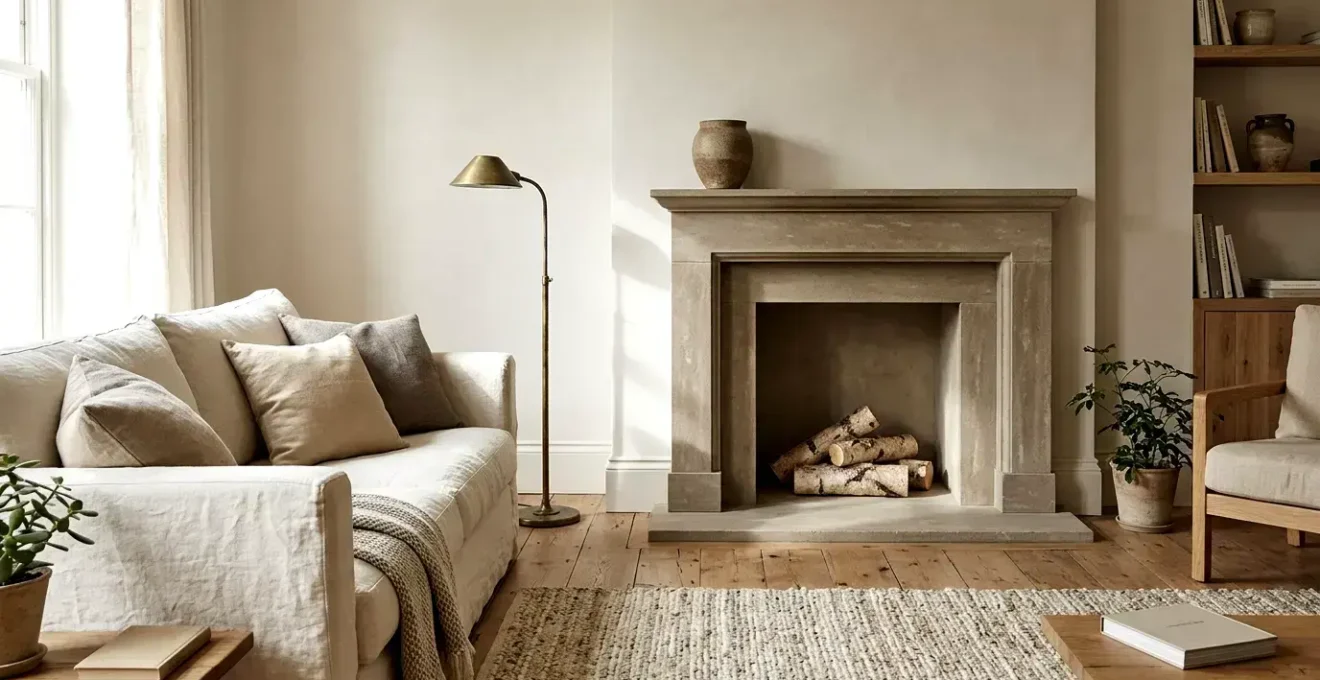
A new fireplace can look beautiful in isolation yet feel strangely out of place once installed. The problem is rarely the fireplace alone. More often, its colour temperature, material, decorative detail or visual weight conflicts with the flooring, furniture and finishes already defining the room.
To match a fireplace with an existing interior, begin with what cannot easily change: floors, architectural details, large furniture and the room’s dominant colour palette. Choose a fireplace finish that relates to these elements through a shared undertone, repeated material or deliberate contrast. The aim is continuity, not identical colours throughout.
This matters particularly when updating a furnished home. Replacing a surround should not automatically require replacing the sofa, repainting every wall or buying coordinated accessories. A considered fireplace can complement mixed wood furniture, soften contemporary interiors or bring structure to a neutral living room while preserving the character that makes the space feel established.
The key is deciding whether the fireplace should blend into the interior, introduce a controlled contrast or become its defining architectural feature.
Matching a fireplace to an existing interior: the essentials
- Compare fireplace undertones with flooring, woodwork and furniture under the room’s actual lighting before selecting a finish.
- Choose matching, tonal contrast or strong contrast according to the room’s existing visual balance rather than a passing trend.
- Use repeated materials, restrained mantel styling and considered furniture placement to connect the fireplace to the wider interior.
- Why Can a Grey Fireplace Look Wrong in a Warm Neutral Interior?
- How to Make a New Fireplace Work With Existing Furniture and Wood Finishes?
- Matching or Contrasting Fireplace Finishes for a Neutral Living Room?
- Why a Highly Ornate Fireplace Can Clash With Simple Contemporary Furniture
- How to Repeat Fireplace Colours in Soft Furnishings Without Making the Room Look Dated?
- How to Style a Traditional Fireplace Mantel Without Excessive Ornamentation?
- Steel or Stone Cladding for a Contemporary Fireplace Feature?
- How to Make a Fireplace the Main Focal Point in a Living Room With Multiple Features?
Why Can a Grey Fireplace Look Wrong in a Warm Neutral Interior?
A grey fireplace can look disconnected in a warm neutral interior when its undertone conflicts with the colours already present. Blue-based greys may appear noticeably cooler beside cream upholstery, honey-coloured oak or warm beige walls. The solution is not to avoid grey altogether, but to select a grey that shares the room’s warmth or introduces a clearly intentional contrast.
Consider a living room with pale oak flooring, ivory curtains and a beige sofa. These elements create a warm colour foundation. A fireplace finished in cold, blue-grey stone may introduce an isolated cool patch, particularly when nothing else in the room shares that temperature.
This can produce what designers might describe as a visual dead zone: an area that seems detached from its surroundings rather than integrated into the composition. It is a descriptive design observation, not a scientifically established colour phenomenon. Cool and warm shades can work together beautifully when their relationship is deliberate.
The distinction between a colour’s overall appearance and its underlying tones is explained in Sherwin-Williams‘ explanation of paint undertones. The guidance also highlights why neighbouring colours and lighting conditions influence how a finish appears.
Test undertones against fixed surfaces before making a final choice. Place a physical fireplace material sample beside the flooring and skirting boards, then compare it with a second sample of similar lightness but a different grey undertone.
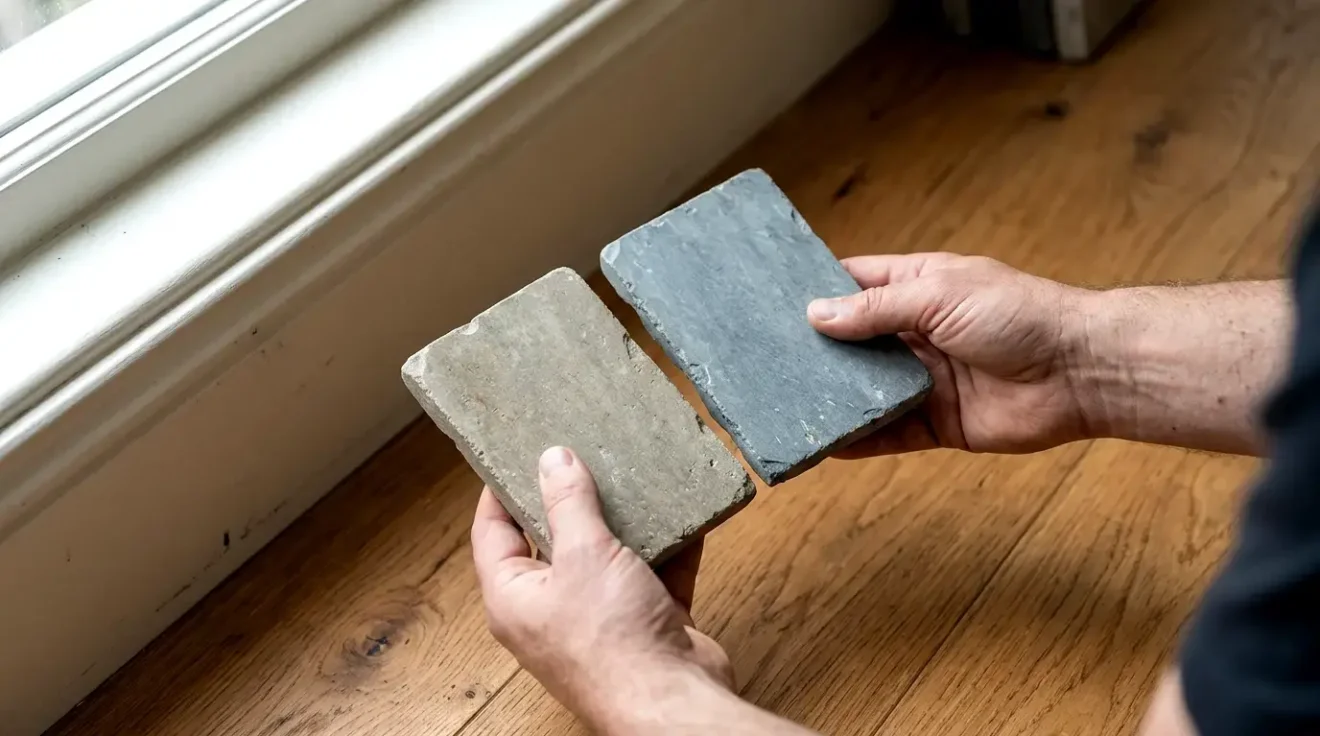
Repeat the comparison in daylight and with the room’s evening lights switched on. A sample that appears comfortably neutral during the day may look distinctly blue after dark. Stone, painted timber and metal also have different textures and reflective properties, making a showroom photograph an unreliable substitute for an actual sample.
If a cool grey fireplace is already installed, consider introducing stronger, warmer counterpoints instead of searching for accessories in precisely the same grey. Textured wool, aged brass and visibly grained timber can make the contrast appear more purposeful.
Once the colour temperature feels resolved, the next consideration is whether the fireplace’s finish connects naturally to the furniture and materials already occupying the space.
How to Make a New Fireplace Work With Existing Furniture and Wood Finishes?
A new fireplace works best with existing furniture when its finish has a recognisable relationship with the room’s established materials. It can echo the floor, complement a recurring wood tone or provide a neutral bridge between different finishes. The objective is not perfect matching, but a material and tonal connection that makes the addition feel intentional.
Before selecting a surround, make a simple dominant, secondary and accent finish audit. Identify the largest visual surfaces, followed by substantial furniture and smaller recurring finishes.
- Dominant: flooring, wall colours, large fitted cabinetry and other extensive surfaces.
- Secondary: the sofa, dining or coffee table, substantial shelving and larger wood furniture.
- Accent: lighting hardware, furniture handles, metal frames and smaller decorative details.
Note which materials appear more than once. For example, an oak floor and oak sideboard establish a repeating timber reference, while brass lamps and cabinet handles create a secondary metallic connection. A fireplace could acknowledge either relationship without duplicating every finish.
The fireplace’s tonal position matters as much as its material. Imagine a hypothetical room containing pale wood flooring, mid-brown furniture and dark metal lamps. A medium-toned stone surround could connect these existing light and dark values, whereas an unusually bright white or intensely dark finish might feel isolated unless supported elsewhere.
Mixed woods need not be a problem. Architectural Digest‘s advice on mixing wood furniture discusses deliberate contrasts and the balancing role of materials including rugs, glass, stone and metal. Wood finishes can differ in lightness or grain while still sharing an overall warm or cool character.
When the furniture already includes several species of timber, a quiet stone or painted surround may work better than introducing yet another prominent wood grain.
A five-step fireplace compatibility check
- Photograph the room in daylight from its main entrance and seating position. Keep two reference photographs showing the existing palette.
- Record the dominant, secondary and accent finishes. Produce a short list identifying the materials already repeated in the room.
- Place two or three candidate fireplace samples beside the floor, skirting and largest furniture piece. Take labelled comparison photographs.
- Check the samples in daylight and evening lighting. Record which finishes remain compatible and which introduce unwanted undertones.
- Choose a preferred finish that relates to at least two established room elements, or document a deliberate contrast strategy. Keep a final selection note before purchasing.
This last check is a practical design boundary, not an industry requirement. It helps prevent a fireplace replacement from becoming an unintended full-room renovation.
After identifying compatible finishes, decide how prominently the fireplace should stand out. That distinction becomes especially important in rooms built around quiet, neutral colours.
Matching or Contrasting Fireplace Finishes for a Neutral Living Room?
Matching fireplace finishes suit neutral living rooms that already have sufficient depth and visual interest, while contrasting finishes are useful when the space needs a stronger focal point. The decision should follow the room’s existing balance: choose tonal continuity for a quieter architectural effect, or introduce controlled contrast when the interior feels visually flat.
Neutral interiors are often described as easy to coordinate, but a room containing only cream, beige and pale grey can lack definition. Matching the fireplace perfectly to the walls may make the structure disappear, even when the surround has attractive proportions.
In that situation, material contrast can be more effective than introducing an unrelated colour. Textured limestone against a smooth painted wall or blackened steel beside pale upholstery creates interest while preserving the existing palette.
There are three useful degrees of contrast to consider.
| Contrast approach | Visual effect | Most suitable situation |
|---|---|---|
| Tone-on-tone | Fireplace and wall belong to the same tonal family. | The room already has strong furniture, artwork or architectural features. |
| Tonal step | The fireplace is moderately lighter or darker than its surroundings. | The room needs definition without an assertive feature. |
| Full contrast | A dark or materially distinct surround becomes a clear anchor. | The room lacks a focal element and can support a stronger statement. |
The awkward result is often an accidental half contrast: a fireplace that differs enough to catch attention but not enough to establish a convincing design intention. This is a useful diagnostic, although subtle differences can also be successful when supported by texture and lighting.
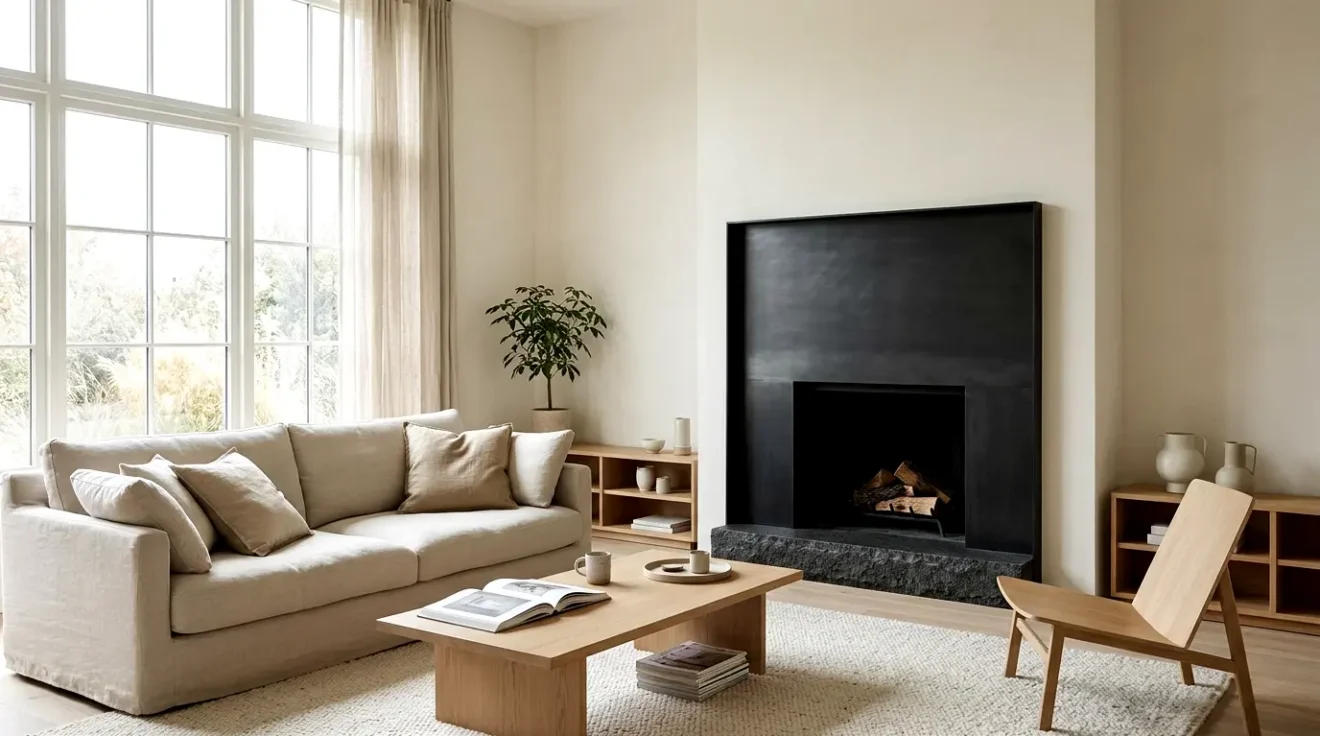
Before choosing a bold contrast, think about future changes. A prominent black fireplace, for example, becomes a lasting reference point when selecting new upholstery, wall colours or lighting. It does not prevent experimentation, but it may require more careful balancing than a mid-tone stone finish.
A useful test is to view the room from its doorway and imagine the fireplace with all temporary accessories removed. If its contrast still feels compatible with the flooring, windows and major furniture, the selection is more likely to remain convincing as the décor evolves.
Colour and material are only part of the relationship. The amount of decorative detail on the fireplace can also determine whether it feels compatible with contemporary furniture.
Why a Highly Ornate Fireplace Can Clash With Simple Contemporary Furniture
A highly ornate fireplace can clash with contemporary furniture because its elaborate carving, layered mouldings and decorative density compete with the furniture’s clean lines. The conflict is not necessarily between old and new styles. It arises when different elements demand equal attention without a clear visual hierarchy or a considered connection between them.
Picture a room furnished with a low-profile sofa, a simple coffee table and understated shelving. An intricately carved fireplace adds a large concentration of detail along the same wall as otherwise restrained furniture.
That contrast can be appealing, particularly in a period property. Problems arise when additional ornate mirrors, decorative lighting and heavily patterned furnishings create several competing statements rather than one carefully chosen feature.
There are three practical ways to resolve the tension without automatically replacing the surround.
- Let the fireplace lead. Reduce surrounding decoration, simplify nearby furniture arrangements and allow the carving to provide the room’s primary character.
- Reduce visual emphasis. Where the material and condition make painting appropriate, a wall-related colour may soften the contrast while allowing the carved relief to remain visible.
- Bridge traditional and contemporary forms. Introduce a restrained transitional element, such as a simple hearth treatment or appropriately specified modern insert, to connect the fireplace with cleaner furniture lines.
The most interesting approach is sometimes to retain the contrast. An original carved fireplace in an otherwise minimalist room can act as the sole historical feature, giving the space character without making the overall interior traditional.
However, preservation should take priority over cosmetic convenience when dealing with original or potentially significant materials. Painting historic stone or timber may be difficult to reverse safely, and stripping existing finishes can damage underlying surfaces.
Historic England‘s guidance on changing a fireplace explains that alterations to fireplaces in listed buildings may require consent. That guidance concerns England; homeowners in other countries or jurisdictions should check their applicable heritage protections and building requirements.
Before making permanent changes, test reversible alternatives such as removing nearby decorative objects, changing furniture placement or adjusting the visual weight of surrounding walls. Specialist conservation advice is appropriate when an original fireplace may be historically significant.
Once the architectural detailing is balanced, smaller decorative elements can reinforce the relationship between the fireplace and room without making the interior feel excessively coordinated.
How to Repeat Fireplace Colours in Soft Furnishings Without Making the Room Look Dated?
Repeat fireplace colours through related tones, varied textures and a small number of carefully chosen furnishings rather than exact colour matches. A stone surround does not need cushions, curtains and rugs in precisely the same shade. Subtle echoes across different materials establish continuity while leaving the room flexible enough to accommodate future changes.
Literal matching can make an interior appear overly coordinated. For example, repeating a fireplace’s dark red tone identically across the curtains, cushions and rug may create a decorative scheme that feels tied to a particular stylistic period.
Instead, treat the fireplace as the starting point for a layered tonal relationship. A warm grey stone surround might be complemented by a similarly muted linen throw and a ceramic vessel with comparable depth, even if neither is exactly the same colour.
Use two principles when building these connections:
- Repeat the fireplace’s tone in at least two different materials, such as woven fabric and glazed ceramic, instead of duplicating the same finish across several objects.
- Distribute the echoes at different visual weights, keeping the fireplace as the strongest concentration of its defining material or colour.
This is a practical composition technique rather than a fixed decorating standard. More restrained repetition may be appropriate in a small room, while a larger open-plan space can accommodate subtler references across greater distances.
Match tonal value before exact hue. A charcoal fireplace can relate to darker threads in a patterned cushion or a deep-toned rug without requiring charcoal accessories everywhere. Likewise, a pale limestone surround may connect through the lightness of curtains or textured upholstery rather than an identical beige.
Strong pairings, such as black and cream or deep red and ivory, are not inherently dated. They can, however, evoke specific decorating styles when repeated too literally and symmetrically. Variations in texture, proportion and colour intensity help keep the scheme less prescriptive.
Textiles are also easier to replace than stone or metal surrounds. That flexibility makes them useful for updating the room while maintaining a consistent architectural foundation.
These smaller connections are especially useful around traditional fireplaces, where a restrained mantel arrangement can bring established architectural details into a more contemporary room.
How to Style a Traditional Fireplace Mantel Without Excessive Ornamentation?
A traditional fireplace mantel looks balanced when its decoration forms one clear composition rather than a collection of unrelated objects. Start with a single anchor, such as artwork or a mirror, then introduce no more than two supporting objects as an initial styling experiment. Varied heights, visible empty space and a connection to existing room materials help preserve the fireplace’s character.
Traditional mantels often have their own decorative profile, mouldings or carving. Adding numerous small ornaments can obscure those details and make the entire wall feel crowded.
Begin with an anchor that relates to the width and character of the fireplace. A framed painting or mirror can provide structure without requiring multiple objects on either side.
As a proportion guide, keep the overall arrangement clearly narrower than the mantel and leave visible breathing room around the edges. A taller element placed slightly off-centre can make the composition feel relaxed rather than rigidly symmetrical.
These are styling preferences, not universal requirements. In its collection of mantel decorating ideas, Architectural Digest features designers discussing asymmetry, varied object heights and restrained displays, while also showing that other arrangements can work.
To connect a traditional mantel with contemporary furniture, select at least one accessory that references a material already present elsewhere. A small brass object might relate to a floor lamp, while a dark ceramic vessel could echo metal furniture legs.
This material connection is often more subtle than matching pairs of candlesticks. It encourages the eye to recognise a relationship between different parts of the room without making the fireplace appear overly decorated.
The mantel also offers a convenient place for seasonal adjustments. A branch arrangement, artwork or simple ceramic object can change without altering the permanent surround. Keep the architectural materials consistent and allow these smaller elements to reflect the room’s evolving personality.
For an operational fireplace, check clearances and the appliance manufacturer’s instructions before positioning decorations. Combustible objects, textiles and potentially heat-sensitive artwork must remain outside required safety distances.
Once the mantel arrangement is settled, attention can return to the surrounding structure itself, particularly when deciding between modern cladding materials.
Steel or Stone Cladding for a Contemporary Fireplace Feature?
Steel is often suitable for a contemporary fireplace that needs a slim profile, crisp edges and a visually lighter treatment. Stone generally provides greater apparent mass, texture and architectural grounding. The better choice depends on the room’s proportions, existing materials and colour temperature, as well as the maintenance requirements and installation constraints of the fireplace.
In a narrow living room, a carefully designed steel surround can emphasise vertical lines without introducing a broad, heavy-looking feature. Stone can be effective in a larger room where the fireplace needs to anchor a substantial seating area.
However, the material name alone does not determine the result. Thin stone panels can look restrained, while thick steel detailing can create a deliberately industrial presence.
The two materials also interact differently with light. Reflective steel finishes borrow visible colours and highlights from their surroundings, whereas matte or textured steel behaves more quietly. Natural stone brings distinctive veining, surface variation and underlying colour, which can become more apparent under directional lighting.
The following comparison helps translate these differences into a practical design decision.
| Design consideration | Steel cladding | Stone cladding |
|---|---|---|
| Visual character | Precise edges, thin-looking profiles and a potentially industrial feel. | Natural texture, visible mass and a grounded architectural appearance. |
| Colour integration | Reflective finishes can pick up surrounding colours; matte finishes create a more fixed effect. | Natural undertones and veining must be coordinated with existing surfaces. |
| Everyday upkeep | Some finishes reveal fingerprints, smudges or scratches readily. | Care varies by stone type, porosity, surface treatment and exposure. |
| Future flexibility | Some surface treatments may be replaceable or refinished, subject to the system. | Permanent stone installations can be more disruptive to change. |
| Existing-room connection | Can relate to metal furniture frames, lighting or architectural detailing. | Can relate to flooring, worktops, hearth materials and natural textures. |
Neither material is automatically more timeless or easier to maintain. A highly specific coloured steel finish may eventually feel restrictive, while strongly veined stone can dominate future colour choices. Conversely, restrained finishes in either material can support multiple decorating approaches.
For continuity, aim to repeat a material already present or introduce only one genuinely new material as a considered accent. This reduces the risk of adding several unrelated finishes around the fireplace.
Appearance must also be separated from suitability. The cladding, fixings, backing materials and required clearances must be appropriate for the fireplace type and installation. Confirm relevant manufacturer requirements and local building or fire-safety regulations before commissioning work.
Once the cladding complements the room, the final design question concerns prominence: should the fireplace command attention, or share that role with other architectural features?
Key takeaways before defining the room’s focal point
- A fireplace that harmonises with existing materials does not automatically need to dominate the room.
- Strong contrast creates visual emphasis, but furniture layout and sightlines determine whether that emphasis feels natural.
- Where windows, screens or architectural features compete for attention, a shared visual hierarchy may be more comfortable than a single dominant feature.
How to Make a Fireplace the Main Focal Point in a Living Room With Multiple Features?
A fireplace becomes the main focal point when its visual emphasis is supported by the room’s layout, lighting and principal sightlines. Contrast alone is rarely sufficient in a living room containing large windows, a television or an open-plan kitchen. Furniture orientation and the relative prominence of competing features must work together to establish a convincing hierarchy.
Begin by identifying which elements naturally attract attention. A television introduces movement and brightness, a large window draws the eye towards an exterior view, and an open-plan kitchen may contribute strong architectural lines or distinctive cabinetry.
Rather than trying to make every feature equally prominent, rank them according to their existing visual impact and the way the room is actually used.
There are three practical ways to give the fireplace greater presence:
- Contrast: use a defined wall colour or a distinctive surround material to separate the fireplace from its background without overwhelming the established palette.
- Lighting: consider suitable architectural or picture lighting that highlights the fireplace wall while avoiding glare and respecting heat-related installation restrictions.
- Sightlines: position the primary seating, rug and coffee table so their arrangement acknowledges the fireplace rather than directing all attention towards a competing feature.
Furniture orientation is especially influential. A sofa facing entirely towards a television on another wall establishes the screen as the functional centre of the space, regardless of how striking the fireplace looks.
Angling an armchair towards the hearth, aligning the centre of a rug with the fireplace or arranging seating in a conversational grouping can strengthen its role. These adjustments need not create rigid symmetry; even a partial orientation can establish a relationship between the fireplace and daily use of the room.
In some interiors, however, making the fireplace dominant is neither practical nor desirable. A living room with expansive landscape views may feel more balanced when the window and fireplace act as complementary focal points on different walls.
The same principle applies to rooms where television viewing is important. The screen can serve the functional seating position while the fireplace provides architectural character and a calmer visual centre when the television is switched off.
Define this hierarchy before adding decorative accessories. Additional mantel objects cannot reliably correct a furniture arrangement that directs attention elsewhere.
For the next practical step, photograph the room from the doorway and the main seating position. Identify where attention naturally settles, then test one furniture adjustment or background treatment before committing to further fireplace changes. A successful result should feel connected to both the room’s architecture and the way it is lived in.
Should a fireplace match the wall colour or the flooring?
Neither is compulsory. Matching the wall colour creates a quieter, more integrated appearance, while relating the fireplace finish to the flooring can strengthen material continuity. Compare both relationships using physical samples. Prioritise whichever connection supports the room’s existing character without introducing an unwanted undertone.
Can a modern fireplace work in a traditionally furnished home?
Yes. A contemporary fireplace can complement traditional furniture when its materials, proportions and colour temperature have a clear relationship with the surroundings. A restrained stone surround or simple metal detail may provide contrast without competing with carved furniture, decorative cornices or other traditional features.
Is it necessary to replace an existing hearth when updating the fireplace surround?
Not necessarily. An existing hearth may offer a useful material connection with the floor or surrounding architecture. Whether it can remain depends on its condition, the proposed fireplace system and applicable installation requirements. Have its suitability assessed before replacing it purely for aesthetic reasons, especially where original historic materials are involved.
What is the best way to evaluate fireplace finishes before installation?
Compare physical samples in the intended room, preferably beside the flooring, skirting and substantial furniture. Observe them in natural and artificial light, then photograph the alternatives from the main viewing positions. Assess colour temperature, texture, reflectivity and visual weight rather than judging the finish from a small online image alone.
Can an existing fireplace be updated without redecorating the entire room?
Often, yes. Changing mantel accessories, adjusting nearby furniture, introducing complementary textiles or modifying surrounding wall colours may improve visual continuity without replacing major furnishings. Cosmetic changes should still respect fireplace clearances and material compatibility. For a historic or protected fireplace, seek appropriate advice before altering the original structure or finish.