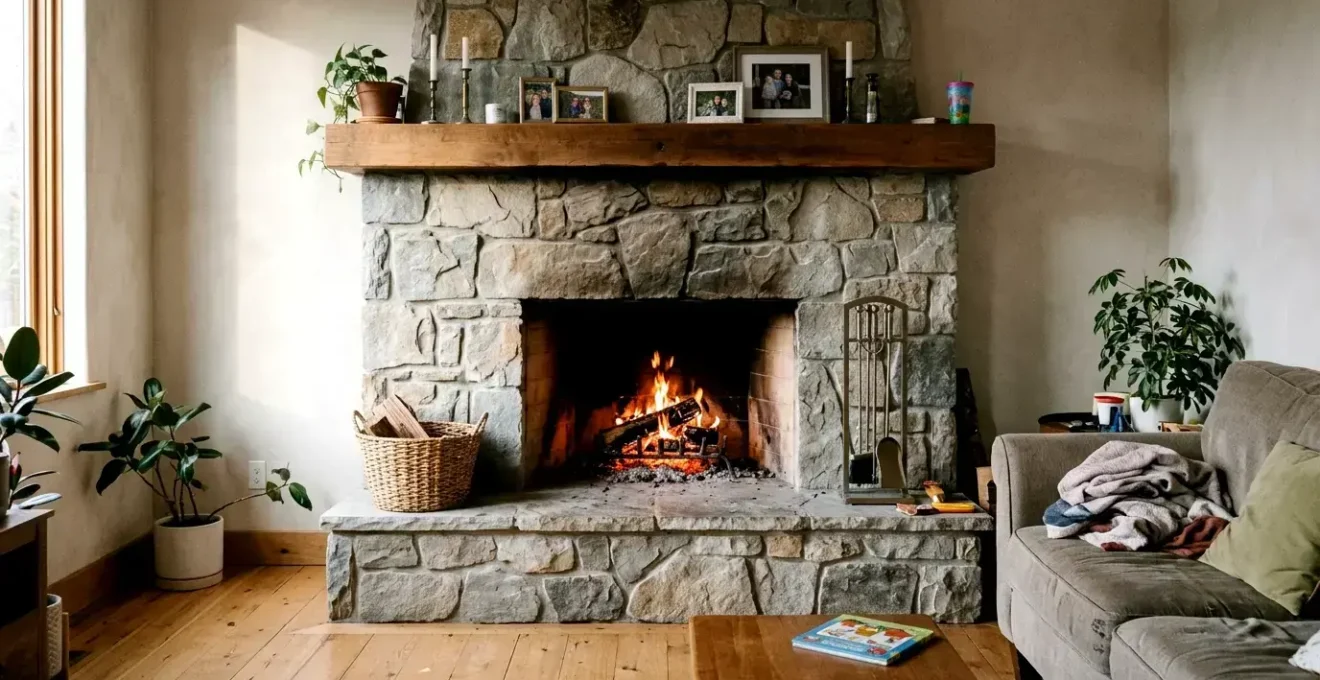
The best fireplace surround material for a busy family home is one that can safely withstand the heat produced by the specific appliance while remaining easy to clean, durable and appropriate for the room. Suitable porcelain or other approved mineral finishes can offer a practical balance, while natural stone provides character with additional maintenance requirements.
However, no material is automatically suitable for every fireplace. An open wood-burning fire, a gas insert, a wood stove and an electric fireplace can expose surrounding surfaces to very different temperatures. Even a non-combustible material may crack, discolour or suffer installation damage if its thermal limitations are overlooked.
Family life introduces another set of considerations. Spilled drinks, fingerprints, soot, pet activity and frequent cleaning all influence how a surround looks after several years. The right choice therefore depends on three questions: how hot the installation becomes, what the room experiences every day and how much maintenance the household can realistically manage.
Choosing a family-friendly fireplace surround
- Prioritise appliance compatibility: Check the manufacturer’s clearance requirements and obtain confirmation that the complete surround assembly is suitable for the expected heat exposure.
- Match the material to daily use: Approved dense mineral surfaces often simplify cleaning, while porous natural stone generally requires more careful stain prevention.
- Think beyond the initial appearance: Consider cleaning products, sealing, surface repairs, ageing and the room’s design before purchasing.
- Why Do Some Fireplace Surrounds Stain More Easily Than Others?
- How to Check Whether a Fireplace Surround Material Is Rated for Your Appliance?
- Limestone or Engineered Stone for a Frequently Used Fireplace Surround?
- The Cleaning Products That Can Damage Natural Stone Fireplace Surrounds
- When Should a Natural Stone Fireplace Surround Be Resealed?
- Why Do Metal and Mineral Fireplace Finishes Age Differently Under Heat?
- The Mantel Clearance Error to Avoid When Installing a Timber Fireplace Surround
- How to Design a Fireplace Surround That Suits a Modern or Traditional Room?
Why Do Some Fireplace Surrounds Stain More Easily Than Others?
Fireplace surrounds stain at different rates because their surfaces vary in porosity, chemical composition and finish. Porous materials such as limestone can absorb liquids and staining substances, while sufficiently dense, low-absorption surfaces generally keep more contamination near the surface. In a family living room, this difference affects how easily soot, fingerprints and accidental spills can be removed.
Natural limestone and many varieties of marble contain interconnected pores that can admit moisture, oils and dissolved staining substances. The amount absorbed depends on the particular stone, its surface treatment and how long a spill remains in contact with it.
Dense porcelain surfaces and certain engineered stone products generally offer greater resistance to liquid penetration. That can make everyday cleaning easier, although joints, damaged areas and unsuitable surface treatments may still retain dirt. Stain resistance does not establish whether a product is safe for fireplace temperatures.
It is also important to distinguish between surface contamination and absorbed staining. A film of soot or a visible fingerprint may come away with appropriate cleaning. Grease or coloured liquid that penetrates unprotected stone can be much more difficult to remove.
Acidic drinks present a separate problem. On limestone or marble, an acidic spill may chemically etch the stone rather than simply leave a removable stain. Sealing can reduce some absorption risks but cannot prevent this chemical reaction.
For practical maintenance, the Natural Stone Institute‘s care and cleaning recommendations explain how stone composition, staining substances and surface treatments influence cleaning and restoration.
Consider a hypothetical family whose fireplace surround doubles as a visually prominent feature beside a sofa. Sticky fingers, a knocked-over drink, candle residue and occasional soot all create different cleaning challenges. A pale limestone finish may remain attractive with prompt cleaning and suitable sealing, but a compatible low-absorption tile could demand less attention.
A small water-drop check on a cool, inconspicuous area can provide a preliminary indication of surface absorption. If water visibly darkens the stone, its protection may need assessment. However, there is no universally validated absorption time that determines whether every natural stone fireplace surround requires sealing. Follow the stone supplier’s instructions and avoid testing untreated, stain-sensitive finishes without approval.
Stain resistance determines how manageable a surround will be, but suitability for the appliance must be established before any material becomes a serious purchasing option.
How to Check Whether a Fireplace Surround Material Is Rated for Your Appliance?
To confirm that a fireplace surround material is suitable, identify the exact appliance model, consult its current installation manual and compare the permitted construction arrangements with the material manufacturer’s technical documentation. Check combustible clearances, heat exposure and installation requirements. The complete assembly, including adhesives, backing materials and fixings, must be compatible with the proposed location.
Begin with the appliance itself. Open wood-burning fireplaces, enclosed gas appliances, electric fires and freestanding wood stoves distribute heat differently. A material approved for the decorative facing of one appliance may be unsuitable beside the firebox or flue of another.
The appliance manufacturer’s instructions should identify relevant distances from combustible construction and any restrictions on the surrounding wall, hearth, mantel or facing. Applicable local building and fire-safety requirements must also be checked in the country and jurisdiction where the fireplace is installed.
Non-combustible does not mean heatproof. Stone, ceramic materials and metal do not present the same ignition risk as timber or MDF, but they may still crack, deform, discolour or transfer damaging heat into an unsuitable substrate.
Resin-containing engineered stone deserves particular scrutiny. Its stone or mineral content does not automatically make the finished composite suitable beside high-temperature components.
For example, Cosentino’s Dekton fireplace technical manual specifies a maximum temperature of 300 °C within its stated technical parameters. It also warns about direct flames, overheated metal components, inadequate ventilation and stresses caused by thermal expansion. This value applies to the described Dekton applications, not to all porcelain, quartz or engineered stone products.
Such documentation demonstrates why the expected operating temperature, construction method and location of the facing all matter. A material’s stated thermal limit alone does not authorise installation in any fireplace configuration.
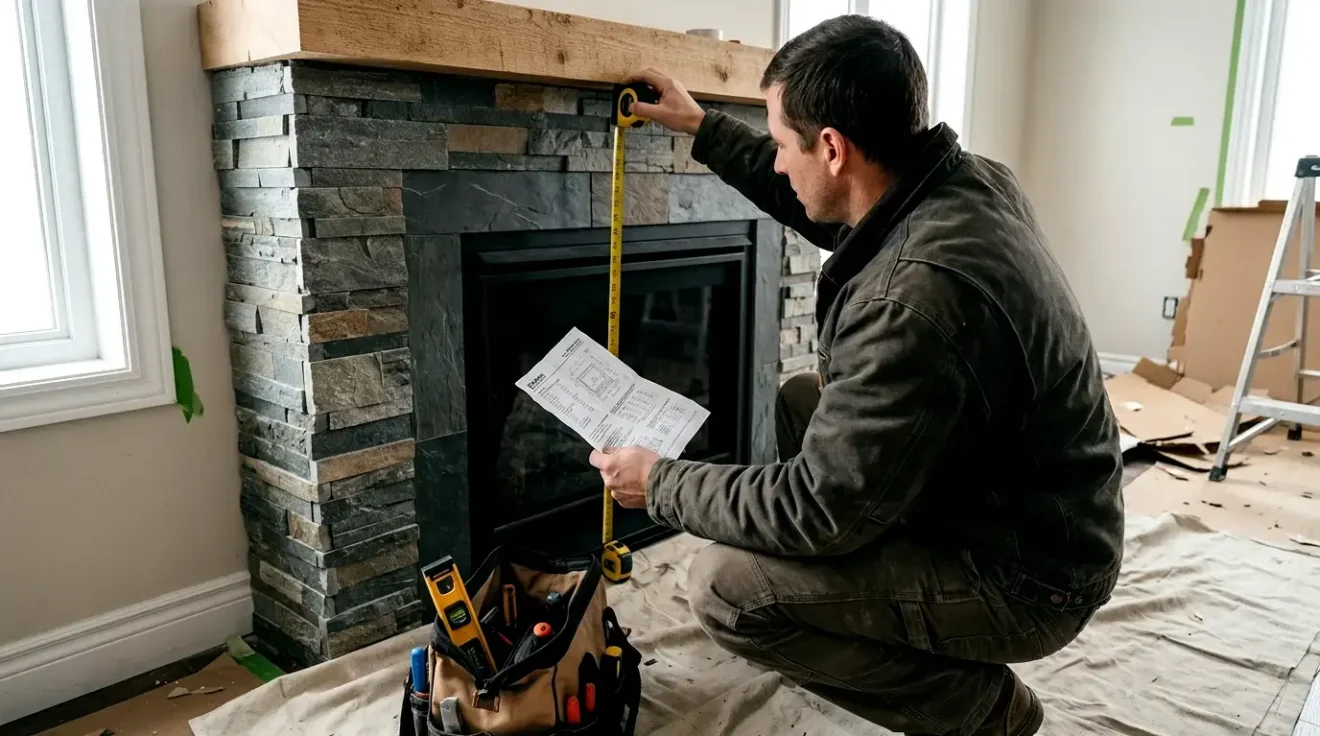
For an online purchase or showroom order, request written technical information before agreeing to fabrication. The documentation should identify the precise product rather than merely describe it as heat-resistant, fire-rated or natural stone.
Five checks to complete before ordering a fireplace surround
- Identify the appliance. Record its manufacturer, exact model and fuel type, with a photograph of the identification plate where accessible.
- Find the installation requirements. Save the current appliance manual and mark the relevant facing, mantel and combustible-clearance diagrams.
- Verify the proposed material. Obtain the technical data sheet and written confirmation of its suitability for the expected heat exposure and appliance arrangement.
- Check the complete construction. Ask the installer to document the proposed backing board, adhesive, fixings, ventilation and any required insulation.
- Confirm compliance before installation. Request a dimensioned installation drawing and written confirmation that the arrangement meets the appliance instructions and applicable local requirements.
A showroom sample confirms colour and texture, not thermal compatibility. Where the manufacturer does not provide a clear answer, ask the installer or manufacturer to resolve the uncertainty rather than assuming the material will perform safely.
Once heat and installation requirements have been established, material selection can focus on practical differences in cleaning, durability, appearance and long-term cost.
Limestone or Engineered Stone for a Frequently Used Fireplace Surround?
Limestone can be an attractive choice for a frequently used fireplace when the specific stone and installation are suitable for the heat exposure, but its porosity generally demands more careful maintenance. Engineered stone may offer easier everyday cleaning and a more consistent finish, although resin-containing products can have heat restrictions that make some unsuitable for fireplace applications.
Limestone brings natural colour variation, fossil markings and a tactile appearance that can suit both contemporary and traditional interiors. Its visual character often becomes an important part of the room’s design.
However, limestone is calcium-carbonate-based and may absorb oils or coloured liquids. It can also be etched by acidic substances, even when an impregnating sealer has been applied. These characteristics matter in homes where the fireplace is surrounded by children, pets and frequent household activity.
Engineered stone is a broad category rather than a single material specification. Some products combine minerals with polymer binders, while other manufactured mineral surfaces use different compositions and production methods. Their thermal performance and suitability for fireplace cladding must therefore be evaluated individually.
The differences are easier to assess when maintenance and heat requirements are considered together.
| Selection criterion | Limestone | Engineered stone |
|---|---|---|
| Appearance | Natural variation, distinctive texture and individual character | Typically more consistent patterns and finishes, depending on the product |
| Stain resistance | Porosity varies; some installations benefit from impregnating sealers | Many dense products resist common household stains effectively |
| Cleaning | Requires stone-compatible, non-acidic cleaning methods | Often straightforward, subject to the manufacturer’s instructions |
| Heat suitability | Depends on stone properties, heat exposure and installation details | Must be confirmed individually; polymer binders and other components may impose limits |
| Ongoing maintenance | May include resealing and specialist stain treatment | Some products require no routine impregnating sealer, but maintenance varies |
| Repair considerations | Certain marks or surface damage may be professionally refinished | Repair options depend on composition and finish; visible repairs may be difficult to conceal |
Manufacturer guidance illustrates the distinction between stain resistance and heat suitability. Cosentino‘s Silestone maintenance instructions describe routine cleaning with neutral soap and a damp microfiber cloth, alongside precautions concerning sudden temperature changes. These maintenance recommendations do not establish approval for using every Silestone product beside a fireplace.
For a household using its fireplace daily, select from products already confirmed compatible with the appliance. Among those options, a low-absorption finish with accessible joints and straightforward cleaning may make family life easier.
For occasional fires in a quieter room, the texture and individuality of limestone may justify its care requirements. Natural stone can also remain a sensible long-term choice when appropriate refinishing is feasible.
Initial purchase price is only one component of ownership cost. Compare the installed system, expected maintenance products, possible resealing, repair access and likely consequences of surface damage. Neither material category is automatically cheaper over its entire service life.
Whichever material is selected, its appearance will depend partly on how household members clean it. Natural stone is particularly sensitive to products that seem harmless on other surfaces.
The Cleaning Products That Can Damage Natural Stone Fireplace Surrounds
Acidic cleaners are among the most damaging products for limestone and marble fireplace surrounds because they react with calcium carbonate and can permanently dull or etch the surface. Abrasive products may also scratch stone, while incompatible alkaline cleaners, solvents and strong chemical formulations can affect certain finishes or sealers. Routine cleaning should follow the stone supplier’s recommendations.
Many household cleaning products are formulated for glass, ceramic bathroom fittings or general hard surfaces rather than natural stone. Their ingredients may be unsuitable for a fireplace surround, even when they remove visible dirt successfully.
Vinegar and lemon-based sprays are especially problematic on calcareous stone. The resulting dull patch is not necessarily a stain: it may be physical surface damage caused by a chemical reaction, requiring specialist refinishing rather than stronger cleaning.
Abrasive powders and rough cleaning pads can scratch polished finishes or alter the texture of softer stones. Strong degreasers and bleach-containing formulations should not be treated as universally safe; suitability depends on the stone, its treatment, product concentration and application instructions.
The simplest household approach is to separate routine stone care from general-purpose cleaning.
| Cleaning situation | Preferred approach | Products or practices to avoid |
|---|---|---|
| Routine dust and fingerprints | Soft cloth and a suitable pH-neutral stone cleaner | Abrasive powders, rough pads and aggressive scrubbing |
| Fresh drink spill | Blot immediately, then clean gently and dry | Leaving acidic or coloured liquids on the surface |
| Light surface dirt | Warm water with a manufacturer-approved mild cleaner | Vinegar, lemon-based sprays and unsuitable bathroom cleaners |
| Greasy marks | Stone-compatible cleaner selected for the stain and finish | Unverified strong degreasers and solvents |
| Soot deposits | Gentle removal using a suitable method recommended for the stone | Harsh scraping, excessive wetting or unapproved chemicals |
Cleaning should only take place once the fireplace and surrounding surfaces are completely cool. Loose dust or soot should be removed carefully before damp cleaning to avoid spreading deposits across the stone.
For accidental spills, blot rather than rubbing the liquid over a larger area. Follow with an appropriate cleaner, rinse where recommended and dry with a soft cloth. If the mark remains, identify whether it is a stain, etching or another form of damage before attempting additional treatment.
Sealing is not chemical immunity. An impregnating sealer may slow liquid absorption, but it does not prevent acidic damage to limestone or marble. Unsealed stone can absorb contamination more readily, while previously sealed stone may still be vulnerable where protection has deteriorated.
Do not assume that a glossy appearance proves a surface is sealed. Polishing and sealing are different treatments. Ask the supplier which finish and protective product were applied, particularly if the fireplace surround was installed by a previous homeowner.
For persistent smoke staining, specialist stone treatment may be more appropriate than repeated domestic cleaning. Some deposits can be removed, while deep staining or etched surfaces may require professional work.
Correct cleaning reduces preventable damage, but the condition of any existing impregnating treatment should also be reviewed when a stone surround begins absorbing moisture more readily.
When Should a Natural Stone Fireplace Surround Be Resealed?
A natural stone fireplace surround should be considered for resealing when its existing protective treatment no longer provides the stain resistance intended by the manufacturer. Increased water absorption, repeated darkening after minor spills or visibly uneven protection can justify inspection. There is no universal annual resealing requirement: the stone, sealer, cleaning history and fireplace conditions determine the appropriate schedule.
Limestone and other porous stones differ considerably in their absorption characteristics. The type of impregnating treatment, application quality and cleaning products used can also influence how long protection remains effective.
Frequent soot removal, spills and intensive household cleaning may increase the need to review the condition of the finish. However, fireplace use alone does not establish a reliable resealing interval. A specific maintenance schedule should come from the stone and sealer suppliers.
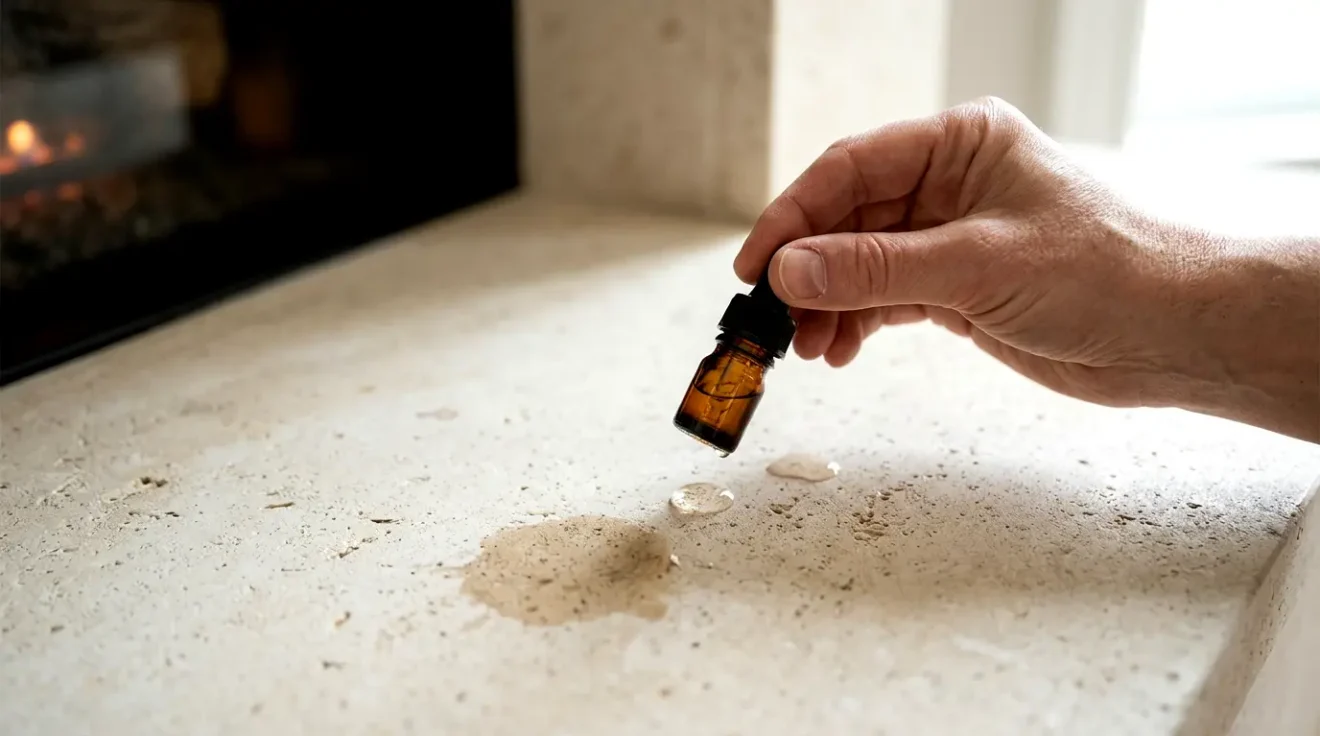
The water-drop method can serve as a simple preliminary observation. On a fully cool, clean and inconspicuous area, and only when permitted by the supplier, place a few drops of water on the stone. Observe whether they remain on the surface or cause noticeable darkening as moisture is absorbed.
Rapid darkening may suggest that the stone is absorbent or that an existing treatment is less effective. Nevertheless, a water-drop test is not a definitive sealer assessment. Some stones are intentionally left unsealed, and no single time threshold applies to all natural stone finishes.
When resealing is appropriate, the general sequence begins with cleaning the stone using a suitable product and allowing it to dry completely. The chosen impregnating sealer is then applied according to its instructions, including coverage, excess removal and curing requirements.
Applying new treatment over soot, moisture or unresolved staining may compromise the result. Excess product can also leave unwanted residue or an uneven appearance. Always check that the sealer is approved for the stone finish and its fireplace application, including the anticipated temperature exposure.
A sealer does not repair etching, cracks or deeply embedded stains. Existing damage should be assessed before treatment rather than hidden under another layer of product.
For a busy household, preventative maintenance is generally more manageable than dealing with persistent marks after contamination has penetrated the surface. Yet unnecessary resealing can waste products and create finish problems, making evidence-based inspection preferable to an automatic calendar reminder.
Once cleaning and sealing needs are understood, the next concern is how the chosen material will change under repeated heating, cooling and ordinary family wear.
Why Do Metal and Mineral Fireplace Finishes Age Differently Under Heat?
Metal and mineral fireplace finishes age differently because they respond to heat through different physical and chemical processes. Metals may expand, oxidise or develop visible colour changes, while stone, tile and concrete can experience thermal stresses associated with expansion and contraction. The outcome depends on material composition, surface treatment, appliance temperatures and how the surround is installed.
Steel and cast iron can develop oxidation or changes in surface colour, depending on their coating and exposure conditions. Some deliberately untreated metal finishes acquire a patina that complements industrial or traditional interiors.
Painted and powder-coated metal behaves differently. If the finish is exposed to temperatures above its specified working range, discolouration, cracking or blistering may occur. A metal substrate’s heat tolerance does not guarantee the same performance from its decorative coating.
Mineral materials usually show ageing in other ways. Limestone, marble, porcelain, ceramic tile and concrete have different thermal properties, but all require suitable construction details to accommodate their particular response to temperature changes.
Repeated heating and cooling can create stress where a rigid facing is restrained by adjacent components that expand differently. Under unsuitable conditions, the result may be cracking, debonding, spalling or movement at joints. These problems are possible failure mechanisms, not inevitable outcomes for properly specified mineral surrounds.
A frequently operated fireplace may experience more thermal cycles than one used occasionally. However, the actual temperature range, rate of heating and installation details often matter more than usage frequency alone.
Daily family activity adds mechanical wear. Metal surrounds may acquire scratches where toys or furniture make contact, while vulnerable stone edges can chip. Textured surfaces may disguise certain marks but can also make dirt removal more involved.
Finish selection therefore deserves as much attention as the base material:
- Uncoated or appropriately finished metal: May develop character through surface ageing, although corrosion and maintenance requirements must be understood.
- Heat-compatible coated metal: Can retain a consistent appearance when the coating is suitable for the actual exposure conditions.
- Honed or textured natural stone: Offers a less reflective appearance, but some textures can retain dirt and certain stones remain stain-sensitive.
- Polished stone: Reflects light and highlights decorative markings, but scratches, etching and dull patches may be more noticeable.
- Compatible porcelain or ceramic facing: Can provide a relatively consistent finish when the product, joints and installation system are appropriate.
Before choosing a finish, ask to see a used installation or suitable maintenance examples where available. A new sample demonstrates initial appearance but cannot establish how a complete fireplace surround will age in the proposed environment.
It is also worth considering whether future refinishing is practical. Some natural stone can be repolished or repaired by a specialist, while certain coated metals may need refinishing. Repair options for engineered products and decorative coatings depend on the manufacturer’s system.
Ageing may be largely cosmetic, but installation errors involving combustible elements create more serious risks. This distinction becomes particularly important when a design incorporates a timber mantel.
The Mantel Clearance Error to Avoid When Installing a Timber Fireplace Surround
The principal timber mantel clearance error is positioning combustible wood too close to the fireplace opening or another heat-producing component. Heat exposure can cause progressive thermal damage and, under unsafe conditions, ignition. The correct clearance is determined by the exact appliance, mantel dimensions, installation configuration and applicable local requirements, not by a universal measurement.
Timber remains combustible even when it is painted, varnished or treated with a decorative coating. MDF and many laminated wood products also require careful assessment because their composition does not make them suitable for unrestricted heat exposure.
Heat may travel upward from the fireplace opening or radiate from the appliance and adjacent components. A deep mantel shelf can intercept this heat differently from a shallow decorative trim, which is why mantel projection and vertical position must be evaluated together.
The practical mistake often begins during the design stage. A homeowner selects an attractive timber mantel based on appearance, then discovers that its depth or desired height conflicts with the appliance’s clearance requirements.
Manufacturer documentation demonstrates why seemingly small design changes matter.
19 in (483 mm) versus 16.5 in (419 mm)
For a specific illustrated Regency Gi29LU gas-insert arrangement with a 12-inch (305 mm) mantel projection, the manufacturer’s diagrams show these different vertical dimensions from the top of the fireplace opening, respectively without and with the specified 2.5-inch (64 mm) mantel deflector. These are model-specific dimensions, not universal clearance recommendations.
The comparison illustrates how an approved deflector arrangement can affect the dimensions required for one particular appliance. It does not mean that adding a generic heat shield allows any timber mantel to be installed closer to a fire.
Heat shields and deflectors must be specified or approved for the particular appliance and arrangement. Some installations also require non-combustible backing, framing or other construction details that cannot be replaced by decorative stone facing alone.
A reliable pre-installation check should confirm the model-specific clearance diagram, the height above the fireplace opening, the mantel’s projection and the materials behind the visible finish. Measurements must be taken from the reference points identified by the manufacturer.
For existing fireplaces, do not rely on the assumption that a long-standing mantel is compliant. If there are signs of scorching, unusual discolouration or heat damage, stop using the appliance until it has been inspected by a suitably qualified professional.
Across English-speaking countries, the relevant building regulations, appliance approvals and installation requirements may differ. A local qualified installer should establish compliance with the rules applicable to the property, whether in the United States, United Kingdom, Canada, Australia, New Zealand or another jurisdiction.
With the safety requirements fixed, the remaining design choices can focus on proportions, architectural character and finishes that fit naturally into the family living room.
Key takeaways before choosing a surround design
- Establish the appliance’s heat and clearance constraints before deciding on a mantel shape, surround depth or decorative finish.
- Choose materials according to family activity and realistic maintenance habits rather than showroom appearance alone.
- Use the room’s architecture to guide proportions, then select a compatible finish that can age acceptably under daily use.
How to Design a Fireplace Surround That Suits a Modern or Traditional Room?
A fireplace surround should suit the room’s architecture while meeting the appliance’s technical requirements and the household’s practical needs. Modern interiors often benefit from restrained profiles, simple geometry and consistent finishes, whereas traditional rooms may suit natural stone, layered detailing and timber mantels positioned within approved clearances. Material compatibility, proportions and maintenance should guide the final design.
In a modern living room, a broad, uncomplicated fireplace facing can create a calm focal point without overwhelming nearby furniture. Compatible large-format porcelain panels, approved mineral surfaces and suitably specified slim metal profiles can reinforce this appearance.
Simple surfaces may also reduce the number of exposed edges and decorative recesses where dust can collect. However, large panels still need suitable joints, backing and allowance for thermal movement where required by the installation system.
Traditional rooms often benefit from more visual depth. Limestone surrounds, decorative stone profiles and properly positioned timber mantels can complement period detailing, cornices and existing joinery.
Natural stone can provide visual warmth through tonal variation, while a timber shelf may connect the fireplace to doors, flooring or furniture. The combustible nature of wood must remain a controlling factor, regardless of how well its proportions suit the architecture.
Families do not need to abandon either aesthetic to obtain a practical surround. The challenge is selecting a suitable material and finish within the chosen design language.
| Design element | Modern room | Traditional room |
|---|---|---|
| Overall shape | Simple geometry, restrained framing and clean visual lines | Layered profiles, architectural detailing and defined mantel features |
| Material direction | Approved porcelain, suitable mineral facing or heat-compatible metal | Compatible natural stone, decorative masonry and correctly positioned timber |
| Surface character | Uniform, matte or subtly textured finishes | Natural variation, honed stone and carefully chosen decorative details |
| Family practicality | Easy-access surfaces and limited dirt-catching recesses | Cleanable profiles, protected vulnerable surfaces and manageable detailing |
| Visual balance | Surround proportions coordinated with the firebox and wall | Mantel and side elements coordinated with the room’s existing architectural features |
Proportion is especially important. A surround that is too wide for a narrow chimney breast may dominate the room, while an undersized mantel can appear disconnected from a substantial fireplace opening.
Modern designs often use fewer projecting elements to create a streamlined appearance. Traditional designs may use a more pronounced shelf and layered side pieces. Neither approach should override clearance, ventilation or structural requirements.
Before finalising dimensions, prepare a scale drawing that shows the firebox, surround width and height, mantel projection where applicable, and adjacent walls or built-in furniture. Review how the arrangement looks from the main seating position, not only from directly in front of the fireplace.
For households with young children, consider accessible edges and the possibility that surfaces may become hot during or after use. Choose appropriate edge details and follow the appliance manufacturer’s guidance on protective barriers and safe operation. A non-combustible facing can still cause contact burns.
The most dependable design sequence is to identify the appliance, confirm its installation constraints, shortlist compatible materials, consider maintenance needs and only then refine colour, texture, proportions and decorative detailing.
For the next step, obtain samples of technically suitable materials, compare them in the room’s natural light and ask a qualified installer to review a dimensioned proposal. This helps ensure the finished surround works as a family surface, an architectural feature and a safe part of the fireplace installation.
Is porcelain always a better fireplace surround choice than natural stone?
No. Porcelain can offer useful stain resistance and straightforward cleaning, but its suitability depends on the specific product, installation system and appliance. Natural stone may provide a preferred appearance and repair options. Both should be assessed against the fireplace’s thermal and construction requirements before comparing maintenance advantages.
Can an existing stone surround be kept when replacing a fireplace appliance?
Possibly, but compatibility must be checked again. A replacement appliance may have different heat distribution, clearance requirements, facing restrictions or ventilation needs. The existing stone, backing materials, fixings and condition should be assessed by a qualified installer before reuse.
Does a darker fireplace surround hide soot and household stains better?
A darker or textured finish may make some marks less obvious, but it does not necessarily resist staining better. Dark surfaces can also reveal pale dust, water residue and scratches. Choose the material for its actual cleanability and compatibility, then use colour and texture to manage visual appearance.
Can a family install a fireplace surround as a DIY project?
Decorative work may be possible in some circumstances, but fireplace surrounds can involve fire clearances, thermal movement, ventilation, structural support and regulated appliance installation. Requirements vary by location and appliance. Obtain qualified advice and check applicable permissions before undertaking work, particularly around gas appliances, solid-fuel systems or combustible construction.
What should homeowners request before accepting a finished fireplace surround?
Request the applicable appliance instructions, identification of the installed facing and construction products, relevant installation or compliance documentation, and manufacturer maintenance guidance. Keep these records with information about any sealing treatment and approved cleaning products so future maintenance or appliance replacement can be assessed correctly.