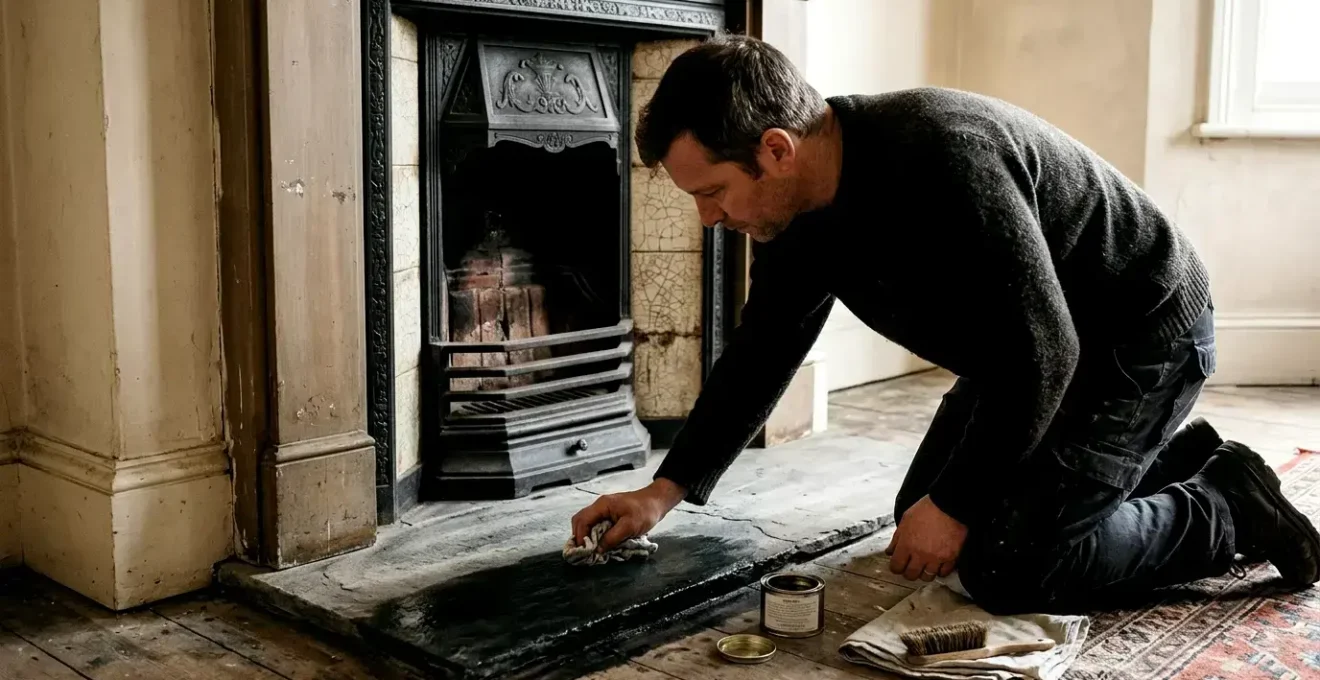
An old fireplace hearth rarely needs to look new to become an attractive feature again. Worn slate, uneven stone, faded Victorian tiles and marks left by decades of use can contribute to the architectural character of a period home. The challenge is deciding which imperfections deserve preservation and which indicate deterioration requiring repair.
Updating a disused hearth usually begins with identifying its materials, assessing its stability and choosing an appropriate future use. A decorative fireplace may need little more than careful cleaning and local repairs. Returning the opening to a working fire, however, introduces additional questions about hearth construction, chimney condition and combustion safety.
The most sympathetic approach is to retain sound original materials, use compatible treatments and make alterations reversible wherever practical. Whether the room is being fully restored or adapted to a contemporary interior, the aim is to improve its appearance and usefulness without erasing the evidence of its history.
Restoring an old fireplace hearth: the essentials
- Preserve sound original stone, tiles and historic wear rather than automatically levelling or replacing them.
- Start with gentle cleaning and compatible repairs; abrasive sanding, harsh chemicals and unsuitable adhesives can cause irreversible damage.
- Have cracks, unstable masonry and the fireplace construction assessed before reintroducing a live fire.
- Why Do Original Fireplace Hearths Often Have Uneven Stone or Tile Surfaces?
- How to Refresh a Worn Slate Hearth Without Removing the Original Stone?
- Restore or Replace Victorian Hearth Tiles in a Renovated Living Room?
- Why Aggressive Sanding Can Permanently Damage an Old Stone Hearth
- When Should a Cracked Original Hearth Be Assessed Before Fireplace Reuse?
- Why Do Some Fireplace Surrounds Stain More Easily Than Others?
- The Brickwork Removal Mistake That Can Damage an Old Fireplace Opening
- How to Plan a Fireplace Renovation Without Unexpected Costs or Delays?
Why Do Original Fireplace Hearths Often Have Uneven Stone or Tile Surfaces?
Original fireplace hearths often have uneven surfaces because their stone, tiles and bedding have experienced prolonged use, thermal changes, building movement and successive repairs. Slight undulations, worn edges and irregular joints may reflect the fireplace’s history rather than serious deterioration. However, raised tiles, loose stones and progressive movement require closer investigation before any cosmetic restoration begins.
Traditional fireplaces were constructed using materials and techniques that varied between properties and periods. Some stone slabs were never perfectly uniform, while others developed wear grooves where fire tools, coal containers or hearth furniture repeatedly rested. Heat exposure may contribute to changes in certain materials, although unevenness cannot automatically be attributed to thermal cycling.
Movement in the chimney breast, supporting floor or original bedding can also produce irregularities. Later repairs may introduce tiles of different thicknesses or harder jointing materials, creating visible steps between adjacent surfaces.
The distinction between historic patina and active deterioration is particularly important. A shallow indentation or discoloured joint may be worth keeping; a tile that rocks underfoot or stone that crumbles under gentle contact is a different matter.
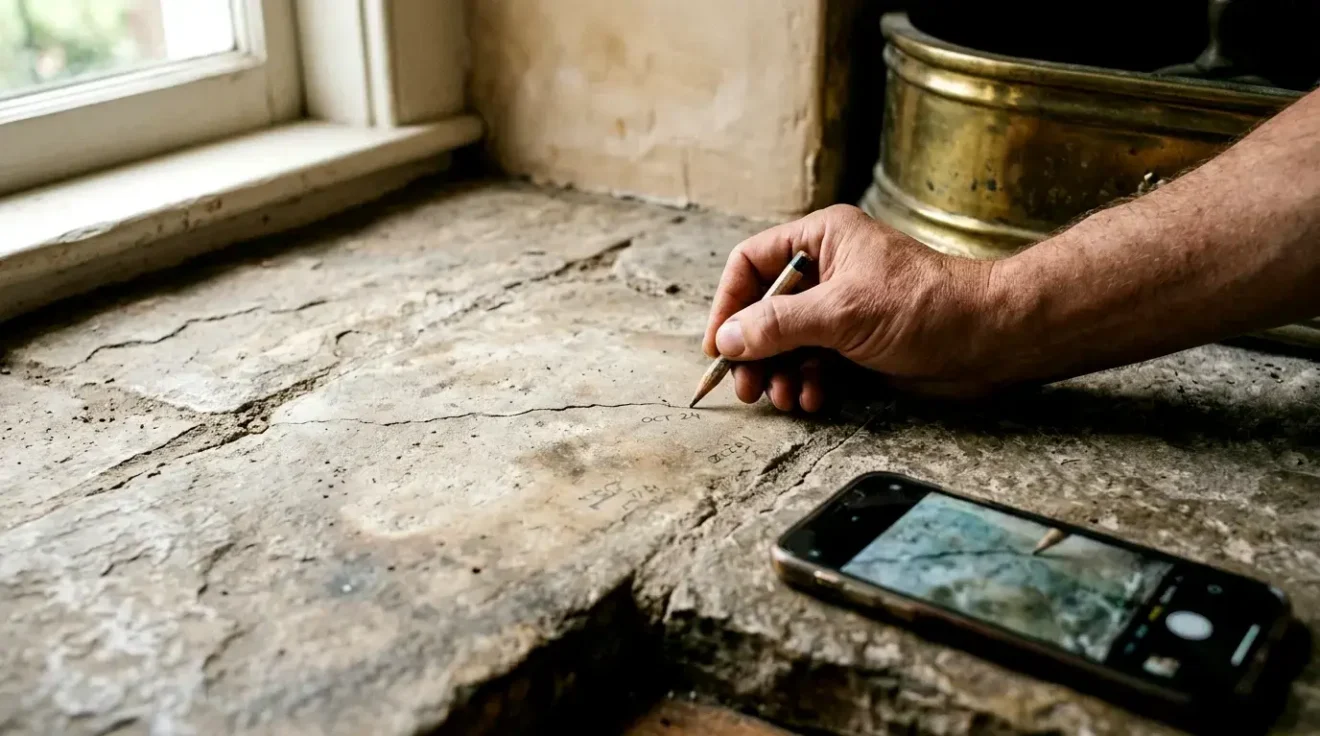
Inspect the surface in raking daylight, which makes differences in height more apparent. Check for loose components without forcing them, and record any cracks or separation between the hearth and surrounding floor. Avoid using the fireplace until potentially unsafe movement has been evaluated.
| Observation | Likely interpretation | Appropriate response |
|---|---|---|
| Shallow grooves or rounded edges | Possible accumulated wear | Preserve if the material remains sound |
| Discoloured but firm joints | Possible historic staining or earlier repairs | Clean gently and monitor |
| Raised or rocking tiles | Possible bedding failure or movement | Assess and stabilize |
| Friable stone or widening gaps | Possible material or structural deterioration | Obtain specialist advice |
There is also an architectural reason to resist unnecessary levelling. A perfectly flat modern replacement may disrupt the relationship between an original hearth, cast-iron insert and surrounding joinery. Preserving established wear can retain visual continuity with the rest of the room, although any effect on property value is subjective rather than guaranteed.
Once the existing material has been evaluated, a worn slate hearth is often a promising candidate for a restrained, surface-level refresh.
How to Refresh a Worn Slate Hearth Without Removing the Original Stone?
A worn slate hearth can often be refreshed without removal by cleaning it gently, evaluating previous coatings and addressing localized damage before considering a new finish. A suitable treatment may improve its appearance, but oils, waxes and sealants can substantially alter its colour or sheen. Testing a discreet area first helps prevent a permanent result that conflicts with the hearth’s original character.
Slate is a naturally layered stone, and its condition matters more than the degree of visible dullness. An intact surface with superficial marks may require only careful cleaning. Flaking layers, loose edges or cracks need a different response.
Begin by removing loose dust with a soft brush and vacuum using a suitable gentle attachment. Where the slate and its joints are sound, a small amount of pH-neutral cleaner on a lightly damp cloth may be appropriate. Avoid saturating old bedding or joints, and allow the surface to dry before assessing the result.
Next, investigate any existing treatment. Old wax, oil, paint or sealant may affect how the stone responds. Applying another coating without identifying the previous one risks patchiness, trapped residues or incompatible finishes.
Oiling is not a neutral cleaning method. It can darken slate significantly, sometimes in a lasting or difficult-to-reverse way. Wax may also change its appearance and require maintenance. Neither treatment should be assumed suitable for a hearth exposed to future combustion temperatures.
For a discreet compatibility test, select a small, inconspicuous area, preferably away from vulnerable joints. Apply the proposed product according to its instructions, allow the test area to dry or cure fully, and assess colour, sheen and surface behaviour in normal daylight. Products should only be considered after their suitability for the particular stone and intended fireplace use has been established.
| Slate condition | Preferred approach | When to seek specialist advice |
|---|---|---|
| Surface dirt and slight dullness | Gentle dry cleaning followed by cautious damp cleaning | If dirt or staining persists |
| Uneven sheen or old coating | Identify the existing finish and test compatibility | Before stripping, recoating or honing |
| Hairline crack in stable stone | Record and assess before selecting a repair | If the hearth will support a live fire |
| Flaking or delaminating layers | Avoid abrasion and stabilize the affected area | Before applying any surface treatment |
Light re-honing may occasionally be an option for suitable slate, but it removes material and should be assessed by a stone conservation specialist. Chemical paint strippers are similarly risky, particularly where residues can penetrate joints or vulnerable stone layers. Localized professional treatment may be safer than indiscriminate stripping.
When the hearth is tiled rather than formed from a single stone slab, preserving its character introduces another challenge: deciding how much of an incomplete historic pattern should survive.
Restore or Replace Victorian Hearth Tiles in a Renovated Living Room?
Victorian hearth tiles should generally be restored when a substantial proportion of the original layout remains stable and repairable. Partial replacement is often preferable to removing an entire historic scheme. Full replacement becomes more reasonable when deterioration is extensive, materials cannot be safely reused or the intended fireplace function requires changes that the existing installation cannot accommodate.
Original Victorian tilework contributes more than colour. Its geometric layout, glaze, thickness and relationship with the fireplace insert can help define the room’s period character. Even when other furnishings become contemporary, a retained hearth can provide a meaningful link to the building’s past.
The first decision is whether damage affects the tiles themselves, the supporting bed or both. A cracked individual tile may be repairable or replaceable. Widespread lifting, however, may indicate movement, moisture problems or incompatible previous repairs.
According to Historic England‘s guidance on conserving historic architectural tiles, historic tiles can deteriorate through movement, moisture and inappropriate bedding materials. Repair methods therefore need to consider the supporting construction as well as the visible ceramic surface.
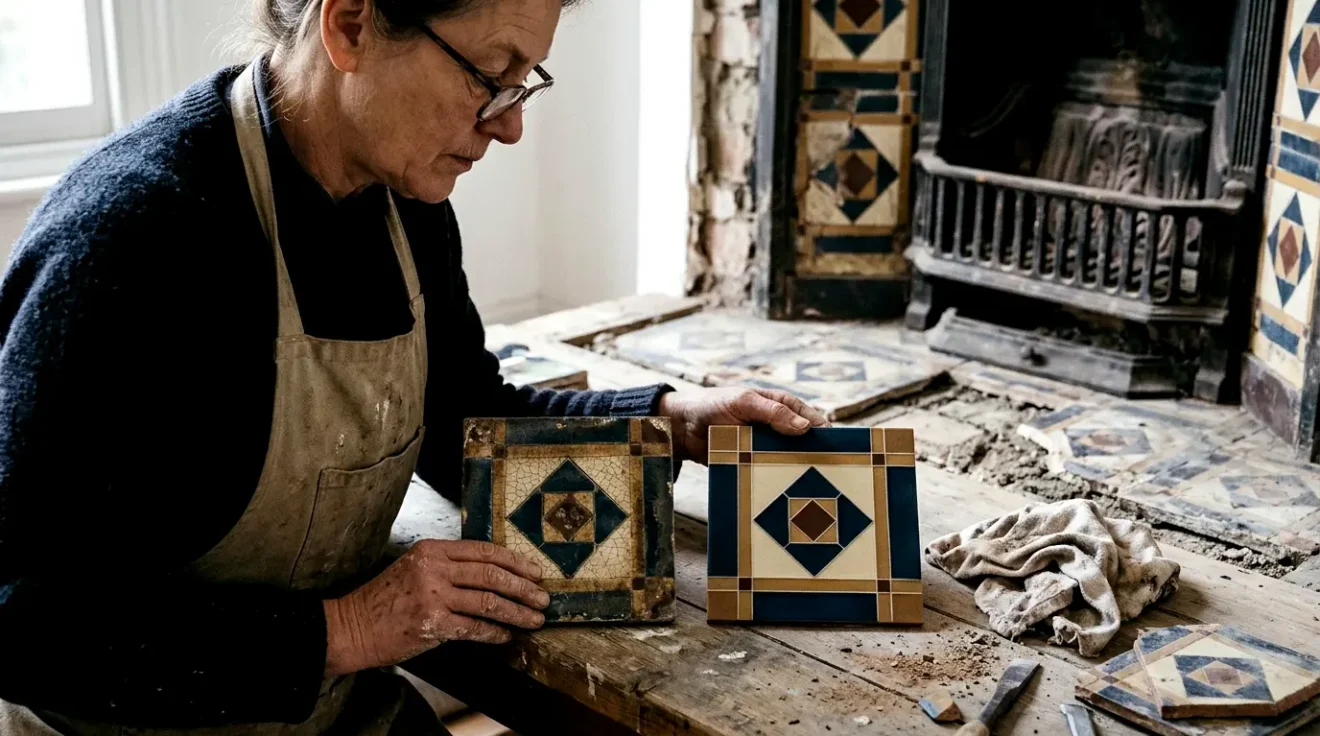
Matching replacements can be difficult because Victorian fireplaces used several tile types. Geometric and encaustic tiles are associated with many period floors, while decorative glazed tiles, including some described as majolica, were used around fireplace openings. Not every decorative wall tile is suitable for a floor-level hearth or direct heat exposure.
Salvage dealers and specialist reproduction manufacturers may offer suitable alternatives, although an exact match in glaze, dimensions and colour is not always possible. A deliberately contrasting replacement can sometimes look more coherent than an imperfect imitation, particularly in a room combining original details with modern furnishings.
| Decision factor | Restore or patch | Replace more extensively |
|---|---|---|
| Original tile condition | Most tiles remain sound | Extensive failure prevents practical retention |
| Pattern and materials | Original arrangement is identifiable | Major sections are missing or beyond recovery |
| Room design | Original detailing anchors a period or blended interior | A different treatment is justified by the overall design |
| Budget and sourcing | Targeted skilled repairs are feasible | Restoration complexity outweighs suitable replacement |
| Future use | Existing construction can safely accommodate intended use | Necessary safety alterations cannot be achieved through repair |
For partly damaged patterns, a conservator may consider relocating sound tiles from less visible positions to repair prominent gaps. This is a project-specific option, not a routine technique: removing apparently concealed tiles may damage surrounding pieces or disturb an original arrangement. Any such intervention should be documented beforehand.
Mortar selection is equally important. Very hard cement-based materials can be incompatible with vulnerable historic tile bedding. Lime-based or more flexible alternatives may be appropriate in particular circumstances, but their suitability depends on the original construction, movement, moisture and heat exposure.
Whether the hearth is tiled or made from solid stone, attempts to achieve a flawless new-looking surface can create more permanent losses than the original wear ever caused.
Why Aggressive Sanding Can Permanently Damage an Old Stone Hearth
Aggressive sanding can permanently damage an old stone hearth because it removes original material rather than simply cleaning its surface. Grinding may erase historic tool marks, soften decorative edges and change the stone’s texture or finish. The consequences depend on the stone type and its condition, but lost surface detail cannot generally be restored by applying a new coating.
Stone surfaces often carry evidence of earlier workmanship and use. Natural variations, cutting marks and accumulated wear contribute to the relationship between the hearth and its surrounding fireplace. Machine sanding can remove this evidence within a comparatively small depth of material.
There is also a physical difference between removing dirt and abrading stone. Dirt may sometimes be lifted without changing the underlying surface. Sanding discs and grinders remove part of the substrate itself, potentially exposing a different texture or more vulnerable material.
The National Park Service Preservation Brief on historic masonry cleaning, published in 2000, explains the risks associated with abrasive cleaning and recommends evaluating materials, testing treatments and choosing the least damaging effective method. Its guidance concerns historic masonry broadly rather than fireplace hearths specifically.
Stone identification should come before mechanical treatment. Limestone and many sandstones may be relatively vulnerable to abrasion and chemical attack. Granite is generally harder, but its finish can still be altered. Slate has a layered structure that creates different risks, while marble can lose its surface polish or become etched by unsuitable chemicals.
Appearance alone is not always sufficient for identification. Examine existing edges, natural layering, texture and any available building records. If the stone remains uncertain, ask a specialist before using abrasives or chemical treatments.
Levelling by grinding can also introduce a less obvious problem: the hearth may no longer align with the fireplace surround, skirting boards or adjoining floor. Removing material from one area can create conspicuous gaps and uneven junctions that cannot be resolved simply by polishing the surface.
A more sympathetic principle is consolidation before correction. Stabilize loose material, investigate the cause of cracks and consider compatible local repairs before altering the overall surface. Filling a crack with an appropriately selected repair mortar may be preferable to sanding surrounding stone to disguise it.
Some blemishes will remain visible despite careful treatment. This is not necessarily a failed restoration: retaining a stable historic surface can be more appropriate than pursuing a uniform finish at the expense of original material.
Before any cosmetic repair proceeds, however, cracks and movement must be considered separately because a visually acceptable hearth may still be unsuitable for renewed use.
When Should a Cracked Original Hearth Be Assessed Before Fireplace Reuse?
A cracked original hearth should be professionally assessed before a disused fireplace is returned to live-fire use, particularly when cracks cross the slab, appear to widen or accompany movement. Even a narrow crack may matter if the underlying construction is unknown. A sound-looking surface does not establish that combustible flooring beneath is adequately protected from heat.
A hairline crack may be confined to the surface of a stone slab or tile. Other cracks can indicate movement within the original bedding, floor structure or chimney breast. The visible width alone does not reliably distinguish these possibilities.
Warning signs include the following:
- Cracks that extend across the hearth or continue into adjacent masonry.
- New gaps between the hearth and the fireplace opening.
- Tiles or slabs that move, rock or sound noticeably hollow.
- Cracks that widen or change direction over time.
- Loose, crumbling or visibly displaced material.
Where a crack is not obviously dangerous, a photographic record can help describe changes while professional advice is arranged. Take a close-up image with a scale reference, record the date and repeat photographs from the same position. If appropriate, mark the ends on a removable surface reference rather than permanently marking significant historic material. This is a practical observation method, not a structural test or proof of safety.
The consequences of overlooking a defective hearth become more serious when a fire is reinstated. Cracks or missing protective layers may allow heat to reach vulnerable materials, while unstable tiles can deteriorate further under temperature changes. Conditions in the flue and fireplace opening also influence whether the installation is safe to use.
In England, the UK government’s Approved Document J publication provides guidance covering combustion appliances, fireplaces, hearths and flues. The appropriate requirements depend on the appliance and construction. Other countries, including the United States, Canada and Australia, have their own applicable building and installation requirements.
Professional assessment may involve checking how the hearth is supported, identifying the slab and underlying construction, evaluating separation from combustible materials and establishing whether the proposed appliance is compatible with the existing opening.
A suitable chimney specialist, experienced mason or structural professional may be required depending on the suspected defect. Inspection of the chimney and flue may be a separate task from examining the hearth itself.
Five checks to prepare before a hearth safety assessment
- Photograph the complete fireplace and hearth from several angles; save an identifiable image set.
- Record the location and visible length of each crack; prepare an annotated photograph.
- Note loose tiles, movement, gaps or crumbling materials without disturbing them; create a written condition checklist.
- Confirm whether the future fireplace will be decorative or used for combustion, including the intended appliance if known; write a clear use statement.
- Gather any previous chimney reports, renovation records and available construction details; prepare a document pack for the specialist.
The assessment should establish what can safely remain, what needs repair and whether additional work is required before the fireplace is used. Historic construction should not be presumed compliant merely because it previously supported a fire.
Once stability and intended use have been addressed, attention can turn to the surrounding materials, whose stains often reveal as much about the fireplace’s past as the condition of the hearth.
Why Do Some Fireplace Surrounds Stain More Easily Than Others?
Some fireplace surrounds stain more readily because their stone is more porous, their surface finish is more absorbent or their existing protective treatment has deteriorated. Limestone, certain marbles and other relatively absorbent materials may retain soot, wax or moisture-related marks more easily than dense polished stone. However, staining also depends on exposure history, cleaning methods and the condition of the surface.
Fireplace surrounds frequently combine different materials. A marble mantel, limestone jambs, glazed ceramic inserts and a slate hearth may each respond differently to the same cleaning product. Treating them all as interchangeable stone or tile can cause unnecessary damage.
A honed or worn surface may retain dirt differently from a polished one. Fine cracks, joints and previous repairs may also permit staining to penetrate beyond the immediately visible area.
Identifying the likely stain is therefore as important as identifying the material.
| Stain type | Possible origin | Conservation consideration |
|---|---|---|
| Black soot deposits | Historic smoke exposure | Remove loose deposits gently before considering specialist cleaning |
| Brown or sticky residues | Possible tar or combustion deposits | Investigate the source and avoid spreading residues |
| Wax marks | Historic candles or decorative use | Check the stone and existing finish before treatment |
| Orange-brown staining | Possible rust from metal accessories | Use material-specific advice rather than universal rust removers |
| Damp patches or salt deposits | Possible moisture ingress or salt movement | Identify and address moisture before cosmetic treatment |
Acidic cleaners are particularly hazardous for calcareous stone such as limestone and marble because they can dissolve or etch the surface. Strong alkaline products, aggressive brushes and excessive water may also damage susceptible finishes, old joints or decorative tile glazes.
Some persistent marks, including embedded soot staining, may not be safely removable in full. Specialist poultices can sometimes be considered after material identification and testing, but their effectiveness depends on the stain and the substrate.
A stained surround may also provide evidence about the fireplace’s previous operation. Repeated soot deposits around the opening can be consistent with smoke escaping into the room, although they do not establish the exact cause. Changes in chimney draught, old blockages or alterations to the opening may warrant investigation before reuse.
Cleaning and surface repair should remain distinct from structural alterations, especially when a blocked fireplace opening contains brickwork of uncertain origin or purpose.
The Brickwork Removal Mistake That Can Damage an Old Fireplace Opening
The most serious mistake when reopening an old fireplace is removing bricks or masonry without establishing whether they support the chimney breast, form part of the flue or protect an original structural detail. What appears to be later infill may conceal a lintel, earlier fireplace opening or altered chimney arrangement. Unplanned demolition can damage the building and create costly safety problems.
Older fireplaces were often modified as heating practices and interior fashions changed. A large opening might have been reduced for a smaller grate, later concealed behind decorative panels and eventually bricked up altogether.
These alterations can leave several layers of construction within the same opening. Some are non-structural closures; others interact with surrounding masonry or conceal components that need careful investigation.
A raised hearth step is not automatically a removable cosmetic addition. It may be associated with the original hearth construction, surrounding floor levels or a later alteration whose purpose is not immediately obvious.
Historic England’s advice on changing a fireplace explains that the chimney breast forms part of the building’s structure and that historic fireplace components deserve careful consideration. Its conservation approach favours retaining significant features and making alterations reversible wherever practical.
Before opening up a fireplace, follow a cautious sequence:
- Photograph the existing opening, hearth, surround and adjacent walls.
- Review available plans or records of previous alterations.
- Identify visible lintels, corbelling, flue walls and changes in brick bonding without disturbing them.
- Ask a qualified professional to establish which elements can safely be removed.
- Record uncovered historic details and revise the proposed work if significant features emerge.
Particular care is needed where a chimney stack serves several floors or earlier openings have been altered. Removing the wrong masonry may destabilize adjacent brickwork, cause cracks in plaster or affect the flue arrangement.
Even when structural stability is maintained, an altered opening may perform poorly. Inappropriate dimensions or unaddressed flue defects can contribute to draughts or smoke spillage if combustion is reinstated.
Preserving the original opening does not necessarily mean restoring every feature to a presumed historical state. A carefully retained infill or reversible modern treatment may be more appropriate than speculative reconstruction.
Understanding these hidden dependencies is essential to realistic renovation planning, because discovering them after demolition can disrupt both the budget and the intended finished design.
Key takeaways before starting the renovation
- Decide whether the fireplace is decorative or intended for live-fire use before specifying repairs or finishes.
- Preserve flexibility by investigating concealed construction and sourcing compatible materials before irreversible work begins.
- Keep structural assessment, specialist restoration and cosmetic improvements as separate budget priorities.
How to Plan a Fireplace Renovation Without Unexpected Costs or Delays?
Planning an old fireplace renovation starts with assessing the existing hearth, defining its future use and identifying which original features should remain. Costs and delays are easier to manage when structural concerns, material compatibility and chimney requirements are resolved before decorative work begins. The budget should also allow for hidden defects, specialist repairs and the uncertain availability of matching historic materials.
Begin with a written condition survey. Record the hearth material, uneven surfaces, cracks, existing tile patterns, surround finishes and any visible alterations to the fireplace opening. Separate cosmetic observations from unresolved safety questions.
Next, decide whether to conserve the present arrangement, undertake selective repairs or replace components that cannot reasonably be retained. This decision should account for historic significance, condition, intended use and the practical availability of suitable materials.
Restoration methods should be selected only after the relevant substrates have been identified. Gentle cleaning, local repair and compatible finishes usually deserve consideration before more invasive interventions.
Where the fireplace has been blocked or altered, investigate the opening before arranging demolition. Any structural work should be designed and assessed by appropriately qualified professionals.
The financial plan should distinguish predictable work from uncertain discoveries.
| Work category | Potential expense | Planning response |
|---|---|---|
| Initial investigation | Condition survey, chimney sweep or flue camera inspection | Arrange before committing to the final design |
| Structural and safety work | Crack assessment, supporting masonry repairs or hearth modifications | Prioritize before cosmetic expenditure |
| Historic materials | Salvaged tiles, replacement stone or specialist reproductions | Check availability before removing existing materials |
| Conservation treatment | Careful cleaning, tile rebedding or local stone repairs | Specify compatible techniques and test areas |
| Fireplace reuse | Flue work, ventilation, suitable closure or register components, appliance installation | Confirm requirements for the proposed use |
| Unforeseen discoveries | Concealed defects or earlier alterations | Maintain a project contingency without assuming a fixed percentage |
For a limited budget, safety and structural stability come first. The second priority is avoiding irreversible damage to original material. Cosmetic changes can often be postponed or carried out in stages without compromising the character of the room.
Schedule uncertainty deserves similar attention. Salvaged tiles may require searching several suppliers, while specialist stone or ceramic repairs may depend on site assessments and material testing. Ordering replacements before their dimensions and suitability are confirmed can create waste, but removing original materials before replacements are secured can leave the room unfinished.
For example, in a hypothetical renovation of a Victorian living room, an owner discovers several damaged geometric tiles and a fine crack in the slate hearth. Rather than removing the entire installation, the owner commissions an assessment, checks matching tile availability and selects a conservative repair. This illustrates a planning sequence, not a documented project outcome or guaranteed saving.
Owners of protected historic buildings should also check whether consent is needed before altering fireplace features. In England, listed building consent may be required; elsewhere, heritage protections, building codes and permit arrangements vary by jurisdiction. Approval requirements should be confirmed locally before work starts.
A clear written scope should identify which features are to remain, what investigations are outstanding, which repairs require specialist approval and how unforeseen discoveries will be handled. This gives contractors and homeowners a common basis for decisions without pretending that every concealed condition can be predicted.
Before commissioning work, photograph the fireplace, record the intended use and obtain a condition-based assessment from an experienced fireplace or conservation specialist. These first steps make it easier to retain original features, choose proportionate repairs and avoid turning a sympathetic refresh into an unnecessary reconstruction.
Can an unused fireplace hearth be kept purely as a decorative feature?
Yes. An original hearth can remain an architectural feature even when the fireplace is no longer used for combustion. Cleaning, local stabilization and reversible decorative arrangements may be sufficient. However, loose masonry, moisture problems or an unsafe chimney opening should still be addressed. A redundant flue may also require appropriate ventilation or closure arrangements to prevent deterioration.
Should an old hearth be sealed to make it easier to clean?
Not automatically. A sealant may alter the stone’s colour, sheen, vapour permeability or maintenance requirements. Compatibility depends on the material, its existing finish and whether the hearth will be exposed to heat. Historic stone and tile surfaces should be assessed before any coating is selected, and a discreet test is advisable where treatment is appropriate.
Can a modern stove be installed on an original Victorian hearth?
Possibly, but the original hearth’s appearance does not confirm its suitability. The construction, dimensions, protection from combustible materials, appliance specifications and flue arrangement must be checked against the applicable requirements. A qualified installer should determine whether the existing hearth can be retained as it is, needs modifications or requires a compliant additional solution.
Is it possible to modernize a fireplace without removing its original surround?
Yes. Contemporary wall colours, restrained fireplace accessories and carefully chosen adjoining finishes can refresh the room while preserving a historic surround and hearth. Reversible changes are generally preferable to cutting, grinding or permanently covering original details. Any proposed change affecting the fire opening or chimney construction requires separate consideration.
How can homeowners tell whether an old hearth is original?
Clues include material type, tile patterns, stone thickness, wear characteristics and the relationship between the hearth, fireplace insert and surrounding floor. Historical photographs, property records and evidence of earlier alterations may help establish its age. However, a hearth can contain original and later components together, so visual inspection alone may not provide a definitive date.